
Alphabet’s second-quarter earnings showed strong operating growth, but investor attention quickly shifted to the cost of the company’s AI buildout.
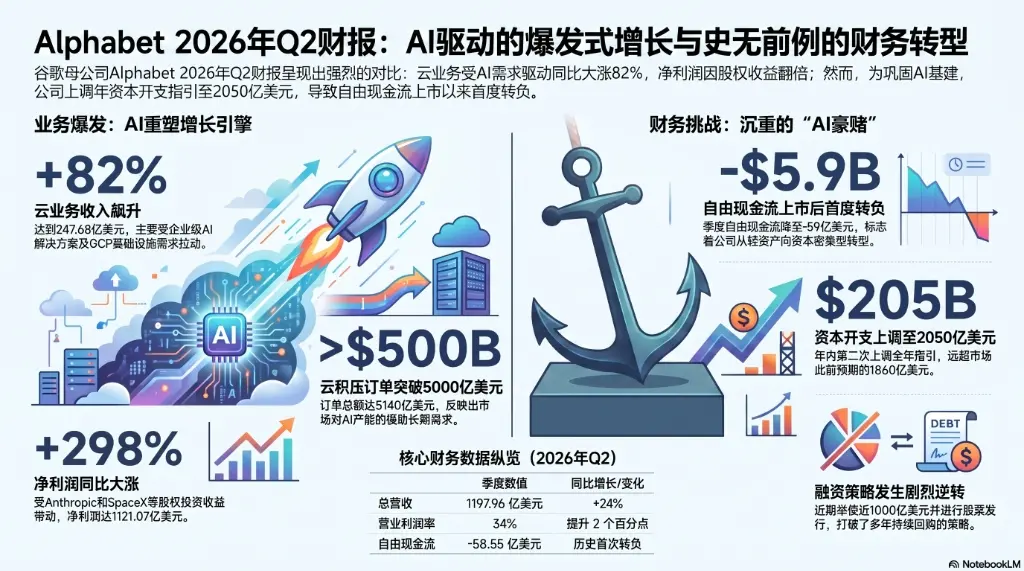
For the quarter ended June 30, Alphabet reported revenue of $119.796 billion, up 24% from a year earlier, or 23% in constant currency. It marked the 12th straight quarter of double-digit revenue growth. Operating income rose 30% to $40.77 billion, and the operating margin improved by 2 percentage points to 34%.
Still, the headline that changed the tone was cash flow. Quarterly free cash flow fell to negative $5.855 billion, the first time Google has posted negative quarterly free cash flow since going public decades ago. The company then raised its full-year capital expenditure guidance again, pushing investors to question how quickly AI spending will translate into returns.
Cloud growth beats expectations, while investment gains lift net income
Google Cloud was the clearest source of upside in the quarter.
Cloud revenue came in at $24.768 billion, above Wall Street expectations of $22.46 billion, and jumped 82% year over year, its fastest growth rate in recent years. Search advertising revenue was $63.27 billion, just below expectations of $63.28 billion.
Alphabet also benefited from gains on its equity investments, including stakes in companies such as Anthropic and SpaceX. A sharp increase in unrealized gains on equity securities drove investment income to nearly $100 billion for the quarter. That helped push net income attributable to common stockholders up 298% from a year earlier to $112.107 billion.
Shares moved modestly after the earnings release, but sentiment weakened after management updated spending guidance. The stock fell 4.2% after the announcement.
Free cash flow turns negative as capex jumps
Capital expenditures reached $44.924 billion in the second quarter, far above $22.446 billion a year earlier. That increase directly pushed free cash flow to negative $5.855 billion, or roughly negative $5.9 billion.
Free cash flow is a key Wall Street measure of a company’s financial health because it reflects the cash left after operating costs and capital spending, cash that can be used to repay debt or return capital to shareholders.
On the earnings call, CFO Anat Ashkenazi said Alphabet was lifting its 2026 capital expenditure guidance to $195 billion-$205 billion, up from a previous $180 billion-$190 billion and above analysts’ prior estimate of about $186 billion. It was the company’s second increase this year. In April, Alphabet had already raised the forecast to as much as $190 billion.
Ashkenazi said, "We expect free cash flow to remain under pressure, driven by our investments in technical infrastructure, which enable us to capture the AI opportunity and continue delivering attractive returns."
Investors are focused on a broader shift in Alphabet’s profile. The company is moving quickly from a relatively asset-light model toward a more capital-intensive one. To support large AI infrastructure commitments, Alphabet has recently taken on close to $100 billion in debt and in June completed its first stock issuance in more than two decades as a public company, raising net proceeds of about $85 billion. That marks a clear break from years of stock buybacks.
Thomas Monteiro, a senior analyst at Investing.com, said, "Another increase in capex is not favorable for Alphabet. Combined with a rising-rate environment and continued tightness in AI infrastructure supply and demand, the idea of funding this buildout entirely through operating cash flow is starting to weaken."
Dec Mullarkey, managing director at SLC Management, took a more constructive view. He said, "The market wants to see hyperscale cloud providers push hard for AI leadership, but not at the expense of profitability. Right now, Alphabet is still maintaining that balance."
Ashkenazi added that the company would use a mix of operating cash flow, debt, and equity financing to support spending. She also said Alphabet does not plan to issue stock beyond the already announced range and will maintain a strong balance sheet.
Google Cloud emerges as the main growth engine
By segment, Google Cloud remained Alphabet’s fastest-growing business.
Revenue rose 82% to $24.768 billion. The company said growth came from continued demand for Google Cloud Platform, or GCP, enterprise AI solutions, enterprise AI infrastructure, and core cloud services. Cloud operating income increased to $8.814 billion from $2.826 billion a year earlier, showing a sharp improvement in profitability.
Cloud backlog, meaning contracted revenue not yet recognized, expanded to $514 billion from about $460 billion in the previous quarter, crossing $500 billion for the first time. Alphabet said more than half of that backlog is expected to be recognized as revenue over the next 24 months, across a broad mix of customers.
Monteiro said the cloud outperformance at least makes one point clear: Alphabet’s AI investments are converting into fast-growing, profitable revenue, with contracts ready to be recognized as capacity comes online.
Google Cloud still trails Amazon Web Services and Microsoft Azure, but strong demand from AI startups and enterprise customers has made it one of Alphabet’s fastest-growing businesses.
Search, YouTube, and subscription businesses remain solid
Alphabet’s traditional businesses continued to grow at a steady pace.
- Google Search and other revenue was $63.271 billion, up 17% year over year.
- YouTube advertising revenue was $11.055 billion, up 13%.
- Google subscriptions, platforms, and devices revenue was $12.911 billion, up 15%.
Total Google Services revenue reached $94.54 billion, up 15% from a year earlier.
The company also said more than 1.7 billion unique users watched related videos on YouTube during the 2026 World Cup, helping drive platform traffic higher.
Pichai shifts focus to Gemini 4
CEO Sundar Pichai told investors that AI investment is reshaping the company across the board.
"It feels like we are in the very early stages of a long-term structural shift across multiple areas," he said. "Over the past year, we have become increasingly optimistic about the opportunity ahead."
Pichai said nearly 90% of the Fortune 100 are now using Gemini Enterprise. Gemini models process 22 billion API tokens per minute, and the Gemini app has 950 million monthly active users. Nate Elliott, chief analyst at eMarketer, said, "Gemini is one step away from becoming Google’s third consumer AI product with 1 billion users, alongside AI Overviews and AI Mode."
On the model roadmap, Pichai pointed to Gemini 4 as the next flagship. He described it as a larger next-generation frontier model and said Alphabet is prioritizing compute resources for training, while accelerating the cadence of model releases. The delayed rollout of Gemini 3.5 Pro had already raised questions about Google’s competitiveness in areas such as AI coding, where Anthropic and OpenAI have gained visible traction with developers.
At the same time, AI features continued to lift Google search query volume, and demand for the company’s cybersecurity products remained strong. Alphabet said the new Gemini 3.5 Flash Cyber showed strong cost efficiency. Pichai said the company’s differentiated full-stack AI strategy is continuing to create measurable commercial value for consumers, enterprise customers, and partners.
Financing expands as infrastructure spending rises
Alphabet also stepped up financing in the quarter to meet rising AI compute demand.
In June, the company completed issuances of Class A shares, Class C shares, and mandatory convertible preferred stock, generating net proceeds of $49.6 billion. It also issued $20.3 billion of senior unsecured notes. In addition, Alphabet established an at-the-market stock issuance program of up to $40 billion, which had not been used by the end of the quarter. Together, those moves brought the company’s recent borrowing to close to $100 billion.
Even though quarterly free cash flow fell to negative $5.855 billion, free cash flow over the last 12 months was still $53.273 billion. Across the broader industry, the four hyperscalers - Google, Meta, Microsoft, and Amazon - are expected to spend more than $725 billion in capital expenditures combined in 2026, while free cash flow across the technology sector has dropped to a 10-year low.
The quarter left investors with a split picture. Explosive cloud growth and a backlog above $500 billion suggest Alphabet’s AI spending is beginning to produce commercial returns. Negative free cash flow and another increase in capex guidance show just how expensive that push has become.