
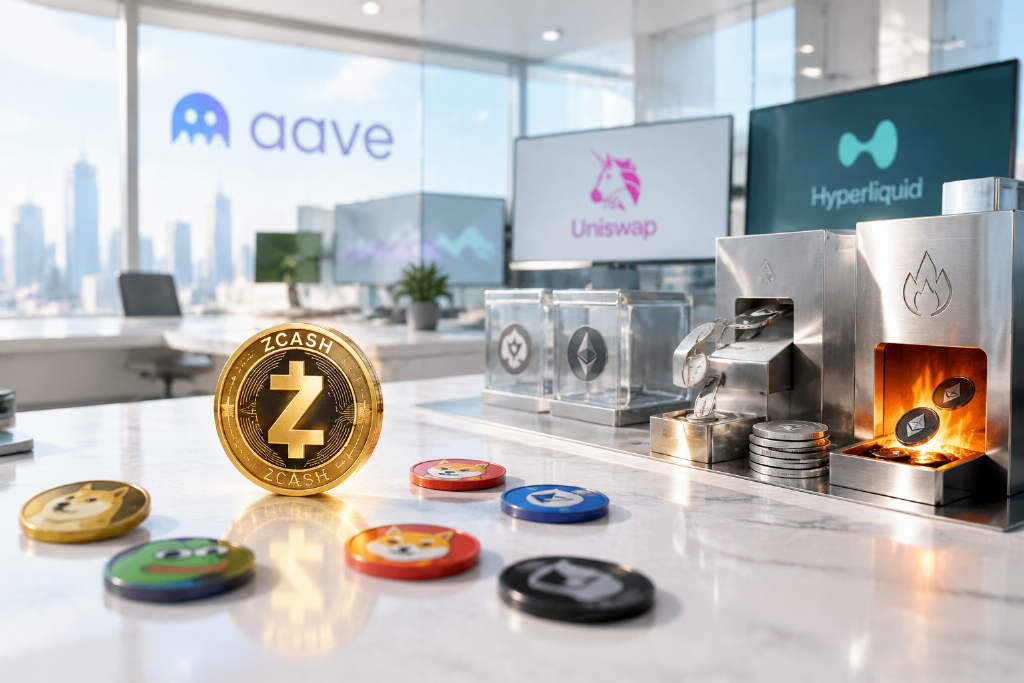
A market analysis translated and published by TechFlowPost says this altcoin cycle is diverging from earlier ones. Instead of broad, indiscriminate flows into meme tokens, capital is concentrating in areas where token utility, protocol usage, and recurring revenue are easier to measure.

The article, written by Cooper Duschang and translated by TechFlow, focuses on three themes: the strength in privacy coins and meme coin infrastructure, the shift from meme speculation to revenue-generating protocols, and the rise of token buybacks funded by protocol income.
A narrower, more selective altcoin rally
The report says BTC accounts for about 56% of the total crypto market capitalization. Historically, market attention has centered on Bitcoin returns and macro conditions first, with capital then rotating into large-cap crypto assets such as BTC, ETH, and SOL before moving farther out on the risk curve into altcoins.
This time, the pattern is less straightforward. The article argues that altcoins are at times drawing as much attention as, or more attention than, some large-cap assets. In the recent market rebound, interest in altcoins has not spread evenly across the board. It has clustered around a small number of sectors and protocols.

That concentration is central to the report’s argument: traders are paying less attention to narrative alone and more attention to whether a protocol has products people use, fee streams it can keep, and mechanisms that return value to token holders.
Privacy coins: Zcash leads with a 218% YTD gain
The article says blockchain’s pseudo-anonymous design still leaves transaction counterparties, spending patterns, and other user information visible enough to limit some sensitive onchain activity. It presents Zcash as one of the leading privacy-focused networks addressing that problem.
Zcash, which forked from the Bitcoin codebase in 2016, introduced optional private transactions and address types. According to the report, Zcash is up 218% year to date.
Citing Talos CM Market Data Pro, the piece says ZEC futures broke out in October 2025, with open interest rising above $300 million before 2026. After a reversal associated with negative funding rates, open interest continued to climb and has now moved past $2 billion.

The report points to two privacy features inside the Zcash system: shielded pools and shielded transactions. Shielded pools are described as providing customized cryptographic security and privacy properties. Shielded transactions use zero-knowledge proofs to keep participants, transaction amounts, and other details hidden.
In 2026, shielded ZEC supply reached a record high, with slightly more than 30% of total ZEC supply held in shielded or private addresses, the article says. Shielded transactions accounted for 52% of Zcash transaction volume. It adds that usage surged in August 2026 as interest returned to the broader crypto market.
Meme coins: launch platforms attract users, but the sector remains uneven
The report says meme coins have historically helped bootstrap liquidity and attract capital to networks. What is gaining traction now, it argues, is infrastructure tied to specific ecosystems. Users have mainly shifted toward Pump.fun on Solana and Pons on Robinhood Chain, while the PUMP token is up 134% year to date.

Even so, the article stresses that performance within the meme coin category is far from uniform. It cites the MSCI Datonomy sub-sector, where the median meme coin return for the year is a loss of 27%. A few winners stand out, but the median token in the group is still down.
The report also says some successful meme projects are using new distribution structures. One approach is to build pools that pair a meme token with tokenized equities. The article says this model has become popular on Robinhood Chain and is designed to influence the circulating supply of the tokenized stock while lifting the prices of both assets.
As an example, the piece describes a developer creating a MEME/AMC tokenized stock (AMC) pool on Uniswap. Users buy AMC and swap through the pool to acquire MEME. As more AMC accumulates in the pool, the amount available for exchange falls, which can push MEME higher. If investors then compete to get exposure to MEME, the limited supply of tokenized AMC can also lift the price of the stock token.
To meet demand for AMC, authorized market makers would have to buy AMC shares on traditional exchanges, tokenize them, and sell them to buyers, according to the article. The intended effect is to create buying pressure on AMC stock by pulling the tokenized version away from the price of the underlying shares.

Revenue-generating protocols move to the center
On the other side of the market, the report says investors are allocating to protocols that have already shown they can monetize services. That list includes some meme coin launch platforms, but also lending protocols and decentralized exchanges.
For Uniswap, the article points to the UNIfication proposal, which would allow the protocol to collect a portion of trading fees from v2 and v3 pools. With the fee switch turned on, the report says, Uniswap could fund additional projects, incentives, and other initiatives tied to protocol growth. In August 2026, v3 pools on Ethereum accounted for about 47% of Uniswap trading volume.
Lending markets are presented as another example of durable protocol economics. The piece says each Aave lending market includes a reserve factor, which takes a portion of interest paid by borrowers and routes it directly to the Aave treasury. Because of price stability and deeper liquidity, stablecoin borrowing remains especially popular.
On Ethereum, five stablecoins on Aave accounted for about 68% of total fee revenue, the report says. On an annualized basis, Aave is projected to generate roughly $47 million in revenue from its Ethereum lending protocol.
Buybacks and burns become a visible value-return mechanism
The article says one increasingly common use of protocol revenue is to buy tokens back in the open market and then burn them or remove them from circulating supply. More protocols, it says, are announcing buyback programs as a way to return value to holders.
Hyperliquid is one of the main examples. The report says Hyperliquid continues to use revenue to repurchase and burn HYPE. It lists several sources of protocol income:
- Trading volume from HyperCore markets, HIP-3 HyperEVM markets, and HIP-4 event markets, where part of the trading fees is managed by Hyperliquid.
- HIP-1 and HIP-3 auctions, in which builders bid HYPE to win the right to deploy spot or perpetual markets on HyperEVM, with the winning HYPE bids burned.
- USDC as AQAv2, described as an Aligned Quote Asset v2. For every $1 of yield generated from supported Treasury and short-duration assets tied to USDC on Hyperliquid, Circle and Coinbase are said to share about 90% of reserve income with Hyperliquid.
- HyperEVM fees collected from interactions on the network, which can be earned by Hyperliquid validators participating in network security.
The report adds that other revenue-producing protocols, including Uniswap and Aave, are also buying back and burning tokens. On Ethereum, Uniswap has already burned more than $12 million worth of UNI, according to the article.

It also says the latest guidance from the U.S. Securities and Exchange Commission supports token buybacks by functioning protocols without treating those buybacks as securities.
The report’s takeaway
The article concludes that the recent altcoin advance is more concentrated than in prior periods and is being viewed as higher quality. Meme coins still make up part of the move, but capital is also rotating into protocol tokens tied to dominant themes, products that generate revenue, and systems that reinvest earnings or use them for token buybacks.
Its core message is direct: in this cycle, narrative alone is no longer enough. The protocol ledger matters more.
