
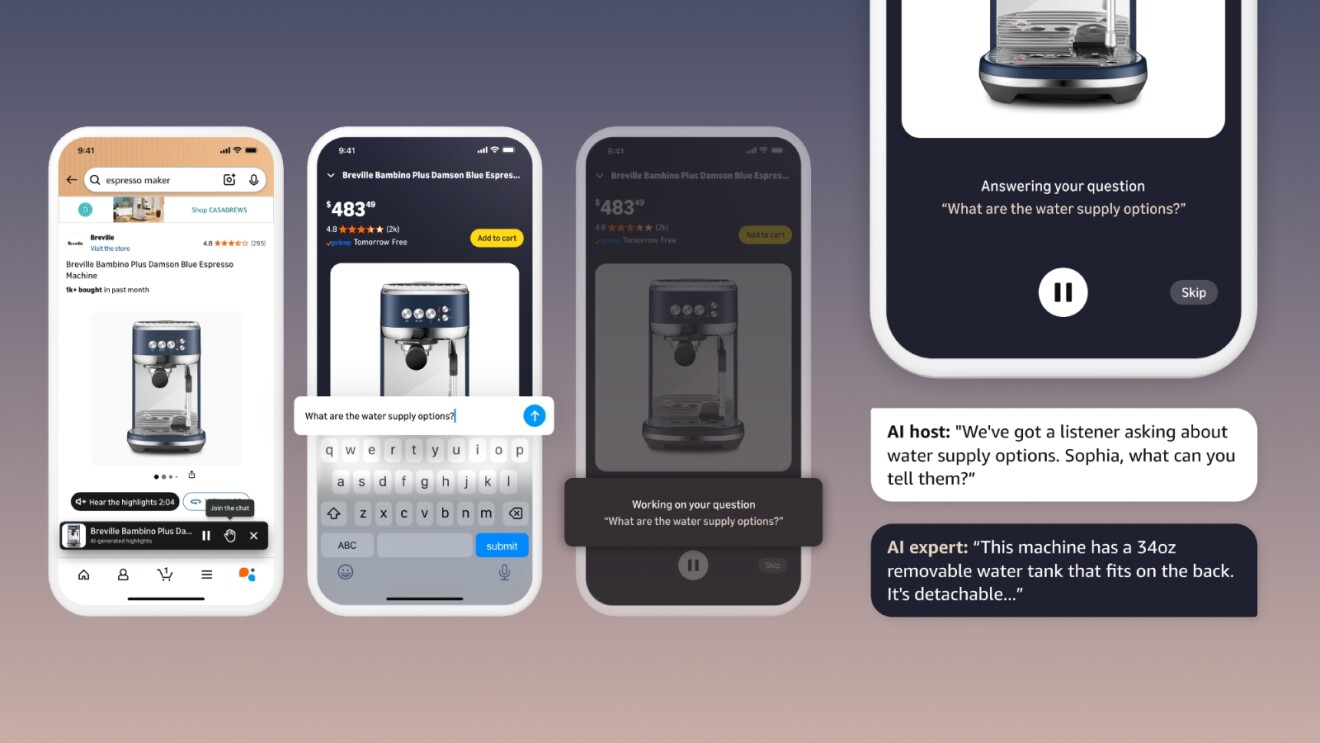
Amazon has added “Join the Chat” to product pages in its U.S. shopping app, expanding its existing “Hear the Highlights” feature from a one-way audio summary into a live two-way AI shopping conversation. Shoppers can listen to an AI-generated overview of a product and then continue with follow-up questions by voice or text, with responses built from product attributes and customer review content.
From a short audio recap to an interactive exchange
The user flow is simple. On a product page, shoppers tap the “Hear the Highlights” button below the product image to hear a brief spoken summary, then select the “Join the Chat” icon to ask questions. Amazon said the system adjusts each reply based on the previous prompt and tries to avoid repeating information already given.
In the company’s example, a shopper asking whether a coffee machine is suitable for beginners would not get a generic product-page description. Instead, the AI would pull from real user feedback and usage experience to shape the answer. That makes the tool something different from a voice version of search.
Another layer in Amazon’s AI shopping stack
Join the Chat is part of a broader buildout rather than a standalone release. Amazon’s generative AI shopping assistant Rufus, launched in February 2024, serves as the base of that system. According to the company, Rufus had more than 250 million users by the end of 2025, drove an estimated $12 billion in incremental sales, and delivered conversion rates 60% higher than traditional search.
Beyond Rufus, Amazon has rolled out Interests, Help me decide, Hear the Highlights, and now Join the Chat. With Alexa+ also being upgraded, the company’s AI commerce toolset now spans product discovery, personalized surfacing, decision support, spoken summaries, interactive Q&A, and voice-based ordering. The shopping path is being compressed inside Amazon’s own app.
Closed ecosystem strategy versus open commerce protocols
While Amazon is tightening its in-house AI stack, other players are pushing cross-platform frameworks. The source material says Google announced the Universal Commerce Protocol in January 2026, working with retailers including Shopify, Walmart, and Target to build a shared AI commerce standard. In September 2025, OpenAI introduced the Agentic Commerce Protocol and integrated it with Stripe, allowing ChatGPT to complete checkout for users.
The shared idea behind those efforts is to let AI agents operate across multiple platforms. Amazon has not joined any cross-platform protocol so far. That stance fits its existing model: logistics, payments, advertising, and cloud infrastructure through AWS are all tied into its own ecosystem. Opening the door to third-party AI agents would mean exposing pricing data, inventory data, and user behavior data to a wider set of participants. McKinsey estimates global AI agent commerce could reach $3 trillion to $5 trillion by 2030.
For now, both Hear the Highlights and Join the Chat are available only in the U.S. Amazon shopping app, and voice summaries have not been enabled on every product page. Amazon has not announced a timetable for expansion into other markets.