
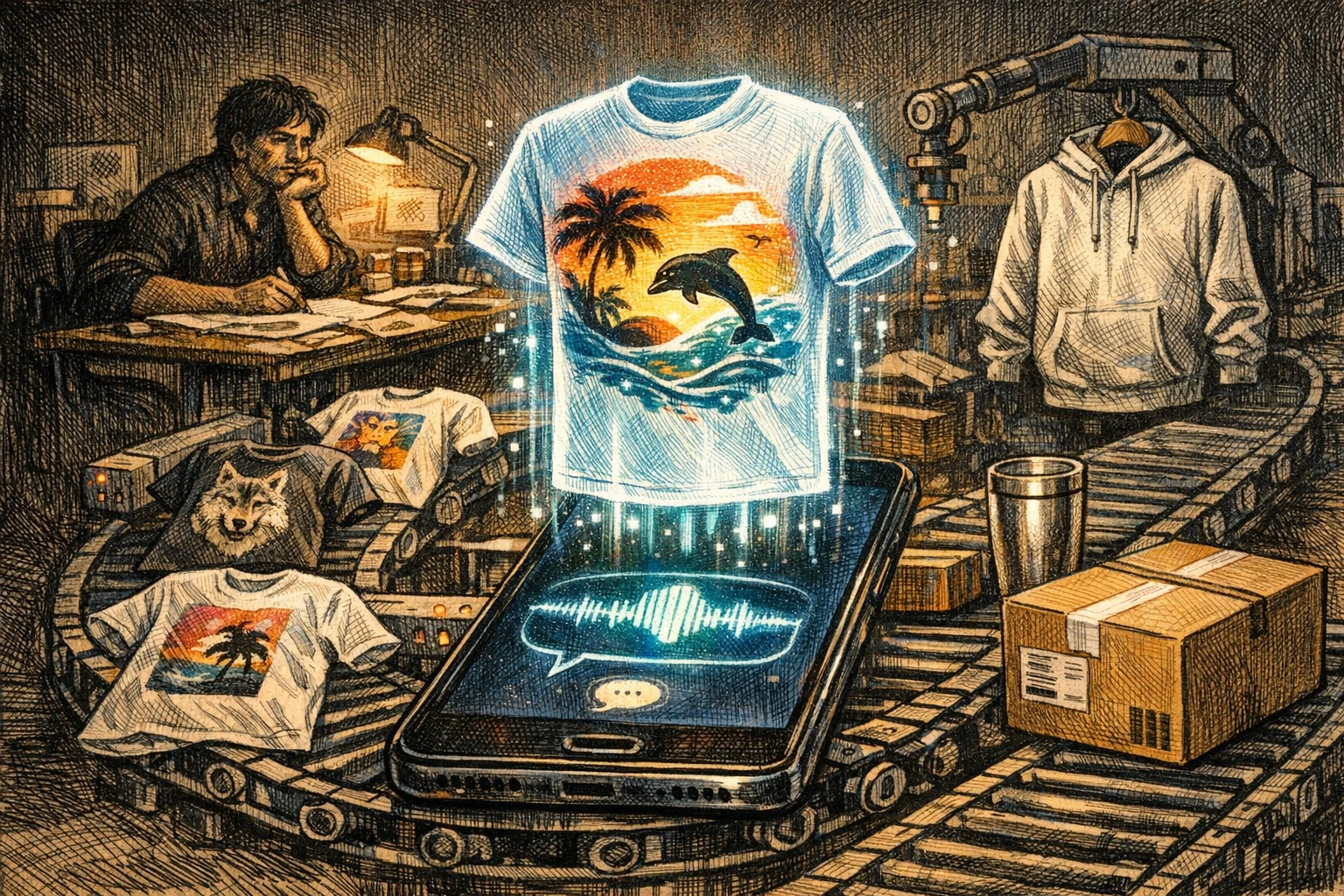
Amazon on Monday launched a new feature that lets anyone design custom T-shirts, hoodies, and other merchandise using AI prompts via Alexa in the shopping app. The designs are produced through Merch on Demand and delivered via Prime. No design software or seller account required; the AI tool itself is free, users pay only the product price.
The global print-on-demand market is valued at roughly $13 billion to $15 billion. Traditionally, users with ideas but no design skills had to pay creators or designers. Amazon now fills that gap with AI: the barrier shifts from "can I use design software" to "can I describe an idea."
From Prompt to Checkout: Alexa-Powered AI Design
Users tap the Alexa icon in the shopping app or search "customize" to enter a prompt, such as "a T-shirt with my dog's portrait" or "a custom hoodie for a family reunion." The system generates a preview; users can refine it via suggested actions or typing, then add to cart. Designs can also be shared via link, allowing multiple family members to place their own orders.
Supported items include T-shirts, V-necks, long sleeves, polos, quarter-zips, jerseys, hoodies, sweatshirts, tanks, raglans, plus tumblers and water bottles. It's a "print whatever you imagine" AI customization system backed by Amazon's existing print-on-demand infrastructure—items are produced only after purchase, with zero inventory risk. Previously, such infrastructure mainly served independent creators on platforms like Redbubble and Printful. Amazon now connects AI generation directly to production.
130 Billion Market vs Amazon Shopping App Traffic
Redbubble, Bonfire, Spring, and Fourthwall all bank on the creator-as-middleman model. But scale differs enormously: the print-on-demand market, estimated at $13-$15 billion in 2026, is projected to reach $46.4 billion by 2031, $57.5 billion by 2033, and $118.8 billion by 2035. This is a fast-growing but fragmented space, and Amazon is leveraging its massive shopping app traffic—monthly active users are tens of times larger than any standalone POD platform—to capture the next decade's growth. When design requires nothing more than describing an idea, the creator's role as intermediary may erode.
Unresolved Copyright Friction: Who Owns AI-Generated Designs?
Amazon's announcement highlights "lowering barriers" and "personalization," but sidesteps a critical question: what data trained the AI model generating those designs? Under U.S. law, purely AI-generated works without substantial human creativity typically lack copyright protection. Designs created via Alexa likely belong to no one legally. For consumers, that may be irrelevant. But for independent artists whose work was scraped to train such models, it's a different story. Redbubble and similar platforms now require sellers to label AI-generated content and assert "sufficient originality." Amazon's announcement avoided the issue entirely. What emerges is a business chain that benefits consumers, unsettles artists, and pressures competitors—all legally permissible, at least in the United States.