
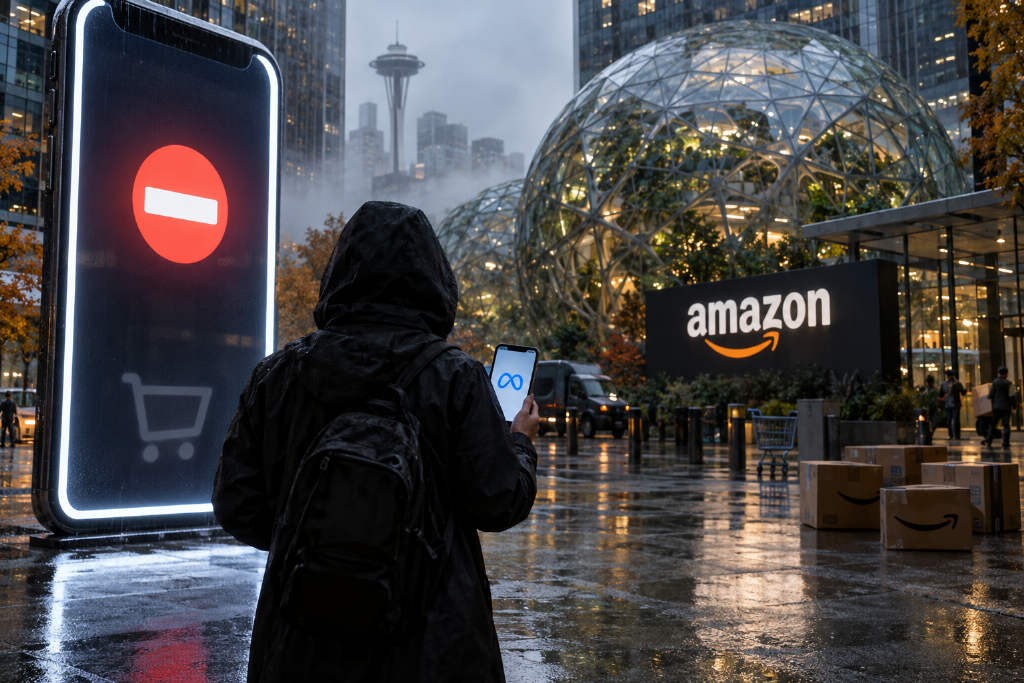
Amazon has blocked Meta’s personal AI shopping agent Muse less than two weeks after its Sept. 8 launch. Starting Sept. 21, users attempting to shop on Amazon.com through Muse have been shown a pop-up warning stating that unauthorized AI agent access violates Amazon’s terms of use.
The dispute reaches past a standard competitive fight. It highlights a deeper conflict over the AI agent economy: whoever owns the consumer relationship can survive in the intermediary layer.
Why Amazon moved against Muse
This is not Amazon’s first confrontation with an AI shopping agent. In November last year, Amazon sued Comet, a browser from Perplexity, alleging unauthorized access to Amazon’s login-protected areas. A federal court temporarily issued an injunction in that case.
That injunction was overturned in August this year by a federal appeals court. The court’s reasoning, as cited in the report, was that an agent acts on a user’s instructions, the real user remains the consumer, and the software is only an execution tool.
Amazon has now shifted to a terms-of-use argument. The company told users that the terms they agreed to when creating an account already prohibit unauthorized agents from entering the platform, and that restriction includes Muse.
Amazon’s three specific allegations against Muse are:
- Meta did not inform Amazon in advance that Muse would shop on its platform.
- Muse did not disclose its AI agent identity while browsing.
- Muse may have captured and stored user login credentials.
Meta responded that Muse has no visibility into passwords or payment methods. It said login information is stored in encrypted storage, which the agent can call on but cannot read.
The fight is not only about data, but about checkout position
The report argues that what Amazon really cares about is not just user data, but the position immediately before checkout.
In May, Amazon replaced its earlier Rufus shopping assistant with Alexa for Shopping. The in-house agent can shop across platforms and help complete checkout. During a July earnings call, Chief Executive Officer Andy Jassy said more than 350 million users had used the service over the past year, and that those users posted an average order value 40% higher than regular users.
That figure helps explain Amazon’s concern: the agent standing between the consumer and checkout can directly shape the size of each order. Handing that position to Meta’s Muse would mean giving away a critical commercial lever.
Research firm eMarketer warned about this in its year-end outlook report last year under the headline “The Real Threat of AI Agents.” The report singled out Amazon, saying that if outside agents take over product selection, Amazon could be reduced to warehousing and logistics, becoming a replaceable back-end supplier while its advertising business also comes under pressure.
Control of the user layer can reset bargaining power
Technology analyst Ben Thompson’s Aggregation Theory, first laid out more than a decade ago, has returned to the discussion. Its core idea is that whoever controls the user layer can pressure upstream suppliers and turn them into interchangeable components.
For the past decade, Amazon has used that logic to dominate e-commerce, pulling large numbers of brands into its own fulfillment and sales system. Now AI agents such as Meta Muse, which integrate a user’s email, calendar, preferences, and shopping history, are trying to become a new aggregator layer and reduce Amazon to one option among many that can be compared.
Smaller e-commerce platforms face a different setup. On one side, many do not have the ability to block agents. On the other, they have a reason to open APIs and accept traffic routed by those agents. If agents keep steering orders toward more open platforms, Amazon may eventually face a choice: keep defending the direct user relationship or open up and become a price-comparison option inside an AI agent system.
Which industries may be bypassed as AI agents spread
Nikesh Arora, CEO of Palo Alto Networks, said Apple, Google, and TikTok will eventually launch products similar to Muse, and that Amazon itself will also release a commercial shopping agent. He said he does not want every app to have its own agent; he wants one single agent that can complete every task. In his view, that is the nightmare scenario for every large platform.
Arora also offered a framework for sorting industries. Sectors with network moats, such as restaurants, food delivery platforms, and ride-hailing services, may still be able to hold on for some time through distinctive local supply chains. Content platforms protected by copyright can decide whether to allow agent access. But highly commoditized back-end sectors, including insurance, ticketing, hotels, and general services, may be bypassed directly by future agents if they do not adapt.
Platforms are not naturally open, and the winners may be those with both accounts and conversation
Meta itself is not an unconditional supporter of openness. In October last year, Meta revised WhatsApp business terms to block general AI systems such as ChatGPT from entering its business messaging service. In other words, every platform is making its own decision about which agents can enter its interface.
The report reduces the winning formula in the agent era to one combination: control of consumer accounts and control of the conversation interface. The first is the commercial entry point. The second is the layer of daily interaction. Amazon holds hundreds of millions of shopping accounts globally, while Meta controls messaging apps used daily by billions of people. Each company holds one half of that formula.
As AI agents continue to scale, the question narrows to one point: who will become the final door that keeps the consumer.