
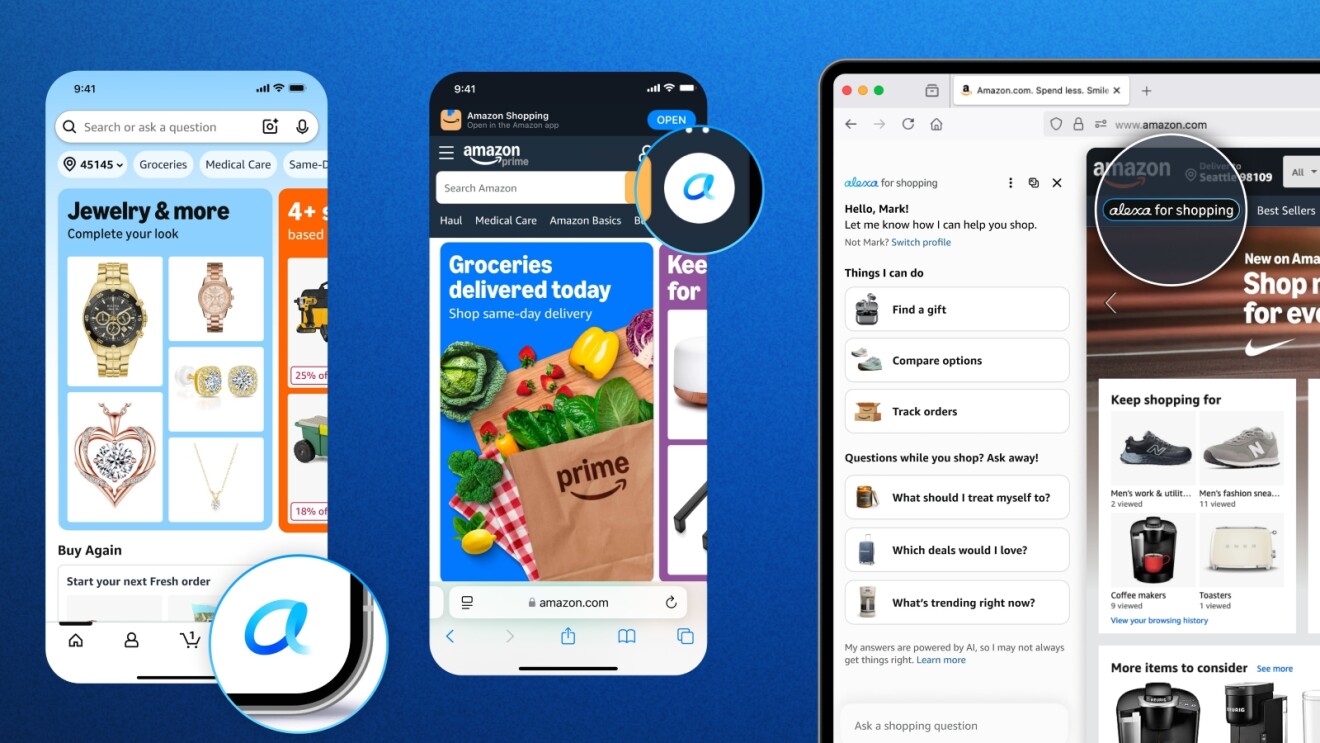
Amazon has officially launched Alexa for Shopping, powered by Alexa+, replacing the Rufus generative AI shopping assistant introduced in 2024. This time, Amazon aims not just to help users choose, but to execute purchases directly — including across third-party websites.
From 'Help Choose' to 'Help Buy': Alexa for Shopping Goes All-In
Rufus was a shopping research tool: users asked questions, it returned comparisons and recommendations, leaving the final decision to humans. Alexa for Shopping operates on a different logic — compressing decision friction and automating purchases. The new assistant supports voice and touch, working across phones, desktops, and Echo Show devices. Users can ask “What skincare routine is good for men?” or “When did I last order AA batteries?” and the system generates personalized shopping guides based on purchase history and preferences.
Features include product comparison, price tracking, recurring orders (e.g., pet food, paper towels), and conditional triggers such as “Add this sunscreen to cart if it drops below $10.” Those capabilities are integrated into a single conversational interface, tied to user history at a depth Rufus never achieved.
Two days before the Alexa for Shopping launch, Amazon expanded its 30-minute delivery service Amazon Now to dozens of U.S. cities on May 12. On April 28, it had also introduced AI-driven audio Q&A on product pages. Three moves in quick succession outline the pace of Amazon’s 2026 AI retail strategy.
Buy for Me: AI Agents Shop Across Platforms
The most contentious feature is Buy for Me. It allows Alexa for Shopping to act as a user's agent to complete purchases on third-party online retailers outside Amazon. Users never leave the Amazon interface; for Amazon, its AI layer now intermediates transactions at other retailers. The design logic positions Amazon as a broker for all online shopping, not just a marketplace.
Some retailers had already expressed opposition months earlier. According to a CNBC report in January 2026, Buy for Me sparked backlash before its official release. Core concerns: who controls user shopping data, behavioral patterns, and payment information when an AI agent mediates the transaction? For Amazon, each third-party purchase completed via Alexa for Shopping is a data collection node. For retailers, it means an Amazon viewing window inserted into their own transaction flow.
The Boundary of AI Autonomy: How Much Authority Do Users Grant?
Buy for Me also raises questions about the design limits of AI autonomy. Conditional triggers ("Buy when price drops to X") and recurring orders presuppose a principal-agent relationship: users authorize the AI to execute transactions autonomously under specified conditions. Logically, this is an efficiency gain, but it escalates the system's role from "suggesting" to "executing." When the shopping assistant shifts from advisor to agent, the nature of privacy concerns changes. Rufus needed user query preferences; Alexa for Shopping needs full purchase history, payment authorization, and access to third-party retailer platforms. Amazon has yet to disclose details of Buy for Me's authorization mechanism or how user data is protected in cross-platform transactions. Whether retailers and users accept this redefined boundary of convenience remains an open question.