
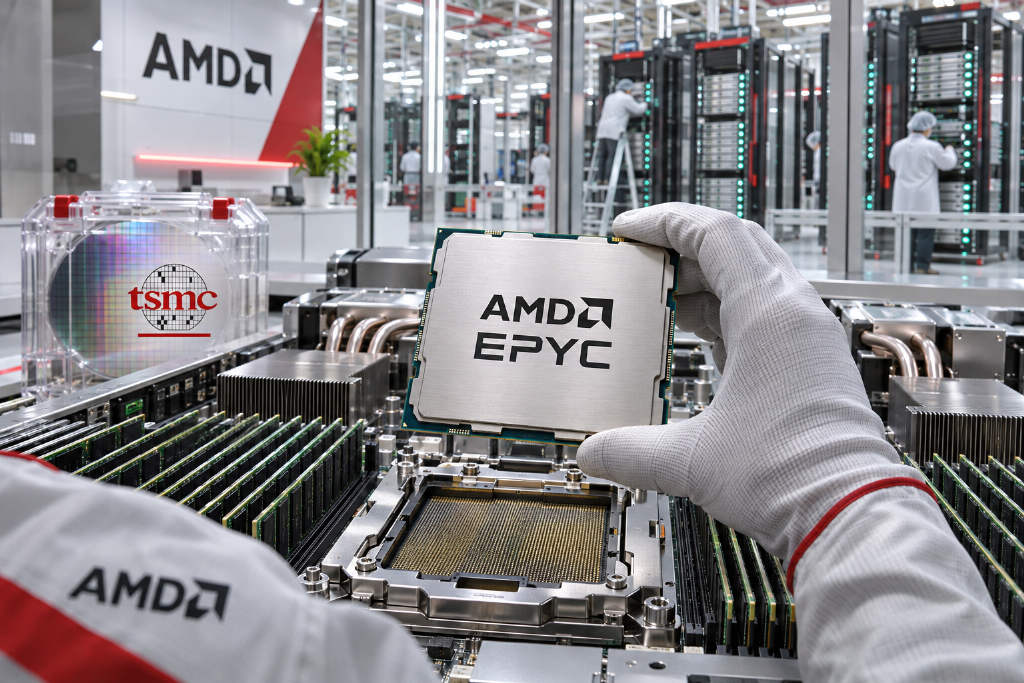
Venice SP7 platform begins shipments
AMD has begun shipping the SP7 platform for its sixth-generation EPYC server processor, code-named Venice. The processor is one of the first data-center CPUs to use Taiwan Semiconductor Manufacturing Co.’s (TSMC) 2nm, or N2, process. Venice also incorporates TSMC’s CoWoS-L advanced packaging technology.
AMD’s next enterprise platform, SP8, is expected in the first half of 2027. Verano and Venice-X are scheduled to ship in the second half of 2027. Verano is set to use TSMC’s N2P process, while AMD’s next Zen 7 architecture has been reported to move to the more advanced A14 process in 2028.
Up to 256 cores for Agentic AI workloads
Venice combines the Zen 6 and Zen 6c core architectures. Its chiplet design integrates as many as eight compute dies, known as CCDs, and two I/O dies, or IODs. The compute dies use TSMC’s N2 process, while the I/O dies are built on a 6nm process. CoWoS-L is used to bring the components together in the package.
The processor can be configured with up to 256 cores and 512 threads. A high-frequency version reaches up to 5.3GHz. AMD is positioning the configurations for different workload requirements, including large-scale parallel computing and low-latency applications.
Zen 6 is focused on high frequency and low-latency computing. Zen 6c is optimized for cloud and large-scale parallel workloads. AMD says the SP7 platform delivers up to twice the overall performance of the previous-generation Turin platform, while performance per watt for general-purpose computing workloads rises by 40%.
Taiwanese suppliers join the advanced-packaging chain
The new EPYC generation is also creating opportunities for Taiwan’s advanced-packaging suppliers. According to the Commercial Times, ASE Technology Holding (3711) and Siliconware Precision Industries are participating in the development and validation of wafer-level 2.5D Bridge interconnect technology. Powertech Technology (6239) has completed validation of panel-level embedded fan-out bridge, or EFB, interconnect technology.
2.5D Bridge technology uses bridge structures to connect separate chips and improve data transmission between them. EFB integrates the bridge interconnect into a panel-level packaging process, offering a possible integration approach different from a conventional package substrate.
As data exchange requirements grow between CPUs, GPUs and high-bandwidth memory, advanced packaging is becoming a factor in overall server CPU performance, rather than a consideration limited to GPUs.
Helion targets rack-scale AI infrastructure
AMD is extending its server strategy beyond individual processors to complete AI infrastructure racks. On Nov. 10, the company announced the Helion rack architecture for enterprise Agentic AI deployments. The first products are expected to begin shipping in November.
More than 10 rack configurations have already passed certification. The partners include Taiwan-based server manufacturers Hon Hai Precision Industry (2317), Quanta Computer (2382) through its QCT unit, Wiwynn (6669), Inventec (2356) and Gigabyte Technology (2376).
Helion is not intended to replace GPU racks. It is designed to supply the CPU capacity required for AI Agent task execution. AMD divides AI infrastructure into several computing layers: GPU training and inference, CPU-based Agent task execution, and database, caching and enterprise applications. In that structure, Helios handles large-model training and inference, while Helion handles Agent tasks.
Helion is available with liquid cooling, air cooling, and mixed CPU-GPU configurations. The Helion Liquid rack consumes about 120kW, while Helion Air uses about 60kW. The mixed configuration can support up to 16 Instinct MI350P GPUs.
In Taiwan’s thermal-management supply chain, Auras Technology (3017), Coolermaster (3324) and CCI? (8996) have also been identified by institutional investors as companies to watch. Their related products include thermal modules, cold plates, manifolds and heat exchangers.



