
AMD is pushing into the top end of AI infrastructure with a higher price tag than many had expected. Citing a recent Futurum report, Wccftech said the AMD Helios rack is expected to be priced at $5 million to $5.5 million per rack, versus an estimated $3.5 million to $4 million for Nvidia’s second-generation Vera Rubin rack. That would put Helios about 40% above the Nvidia system.

The report said AMD appears to be moving away from the strategy of winning share mainly through lower pricing. Instead, the company is leaning on tighter system integration and differentiated specifications to compete for enterprise AI budgets. AMD has long been viewed as an alternative to Nvidia in the AI accelerator market, and the maturity of its ROCm software ecosystem has often been a central question in that comparison. Helios, with a materially higher expected price, signals that AMD believes it now has room to ask for a premium.
That said, the price range is not an official AMD list price. Futurum’s estimate is based on bill-of-materials cost analysis, and actual selling prices could still shift depending on competitive pressure and customer bargaining power.
Helios combines AMD’s hardware and software stack in one rack-scale system
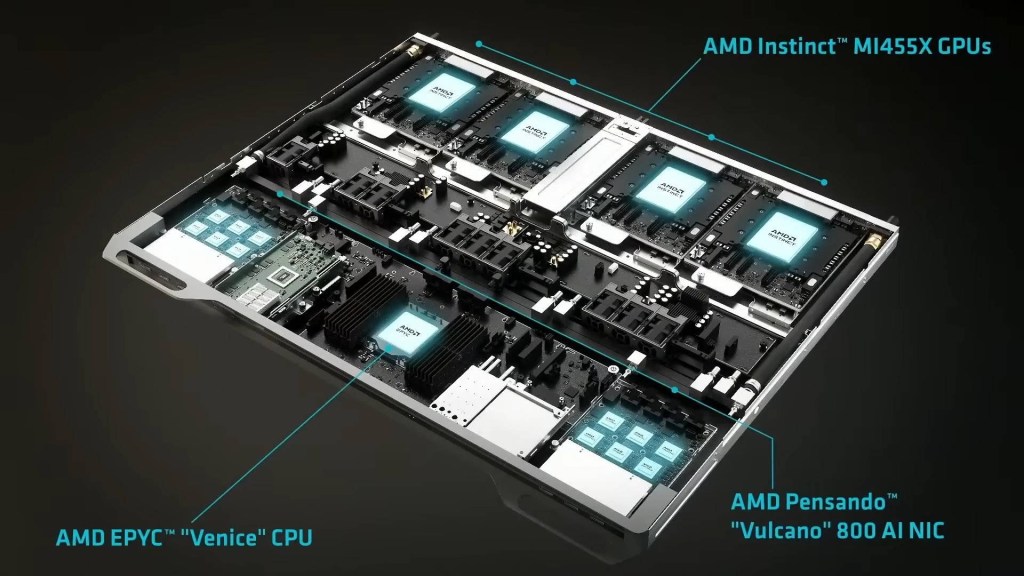
Helios is AMD’s first rack-scale, full-stack platform designed specifically for AI workloads. The system brings together several AMD product lines under a single architecture, spanning six layers: GPU, CPU, networking, DPU, interconnect and software.
At the compute layer, Helios uses the AMD Instinct MI455X GPU based on the CDNA 5 architecture. The chip delivers 40 PFLOPS of FP4 performance and 20 PFLOPS of FP8 performance, with 432 GB of HBM4 memory and 19.6 TB/s of memory bandwidth.
General-purpose compute is handled by the sixth-generation AMD EPYC Venice processor, built on TSMC’s 2 nm process and the Zen 6 core architecture. The top configuration reaches 256 cores and 512 threads, using eight compute chiplets paired with two large I/O dies.
On networking, Helios includes the AMD Pensando Vulcano 800 AI NIC, which provides 800 Gbps of Ethernet throughput. According to the report, scale-out bandwidth reaches as high as 2.4 Tbps per GPU, and the product is described as the only AI NIC on the market currently at that level.
Pensando Salina DPU handles front-end networking, security and storage offload, with 16 Arm N1 cores built in. The full platform uses AMD Infinity Fabric for chip-to-chip interconnect, while the software layer is managed through AMD ROCm.
Against Vera Rubin, AMD gives up some raw throughput and gains on memory capacity
A side-by-side comparison between the AMD MI455X and Nvidia Vera Rubin shows a split in design priorities rather than a clean win for either side.
- Vera Rubin reaches 50 PFLOPS in FP4 performance, ahead of MI455X at 40 PFLOPS.
- Rubin also leads in HBM4 bandwidth at 22 TB/s, compared with 19.6 TB/s for MI455X.
- MI455X posts 20 PFLOPS in FP8 performance, above Rubin’s 17.5 PFLOPS.
- On HBM4 capacity, MI455X carries 432 GB, which is 50% more than Rubin’s 288 GB.
The report points to memory capacity as a major factor in large language model inference workloads. A larger HBM4 pool on a single GPU allows more model parameters to fit on one device, reducing cross-node traffic, bandwidth consumption and latency. That is presented as one reason AMD can support a higher price point for Helios.
In practical terms, the two systems appear to favor different workloads. Vera Rubin has the edge in pure compute density, while Helios is positioned more strongly for deployments where very large model memory requirements matter most.
Microsoft Azure is the first confirmed deployment
Whether Helios can hold that pricing in the market will depend on customer demand. So far, AMD’s order picture looks encouraging. Microsoft has been identified as the first purchasing customer and said it will deploy Helios racks in Azure AI services.
The customer list also includes OpenAI, Meta, Oracle, Celestica, Nutanix and the U.S. Department of Energy, spanning cloud platforms, enterprise IT and government users.
Microsoft Azure’s position as one of the world’s largest cloud platforms gives the initial deployment added weight. The inclusion of OpenAI also draws attention to potential use in AI training and inference infrastructure.
Whatever the final transaction price turns out to be, the customer lineup already suggests that AMD is trying to reposition itself in the AI infrastructure market through a higher-priced, higher-spec offering.