
Advanced Micro Devices is moving beyond its legacy identity as a CPU and gaming chip maker and pushing deeper into an AI infrastructure stack that spans CPUs, GPUs, networking, rack-scale systems and software. In FY2026 third quarter results cited by MSX Research, AMD reported revenue of $13.377 billion, up 45% year over year and 16% from the prior quarter, above the roughly $13.06 billion market expectation. Adjusted EPS was $2.09, up 74% from a year earlier and ahead of the roughly $1.94 consensus mentioned in the source.
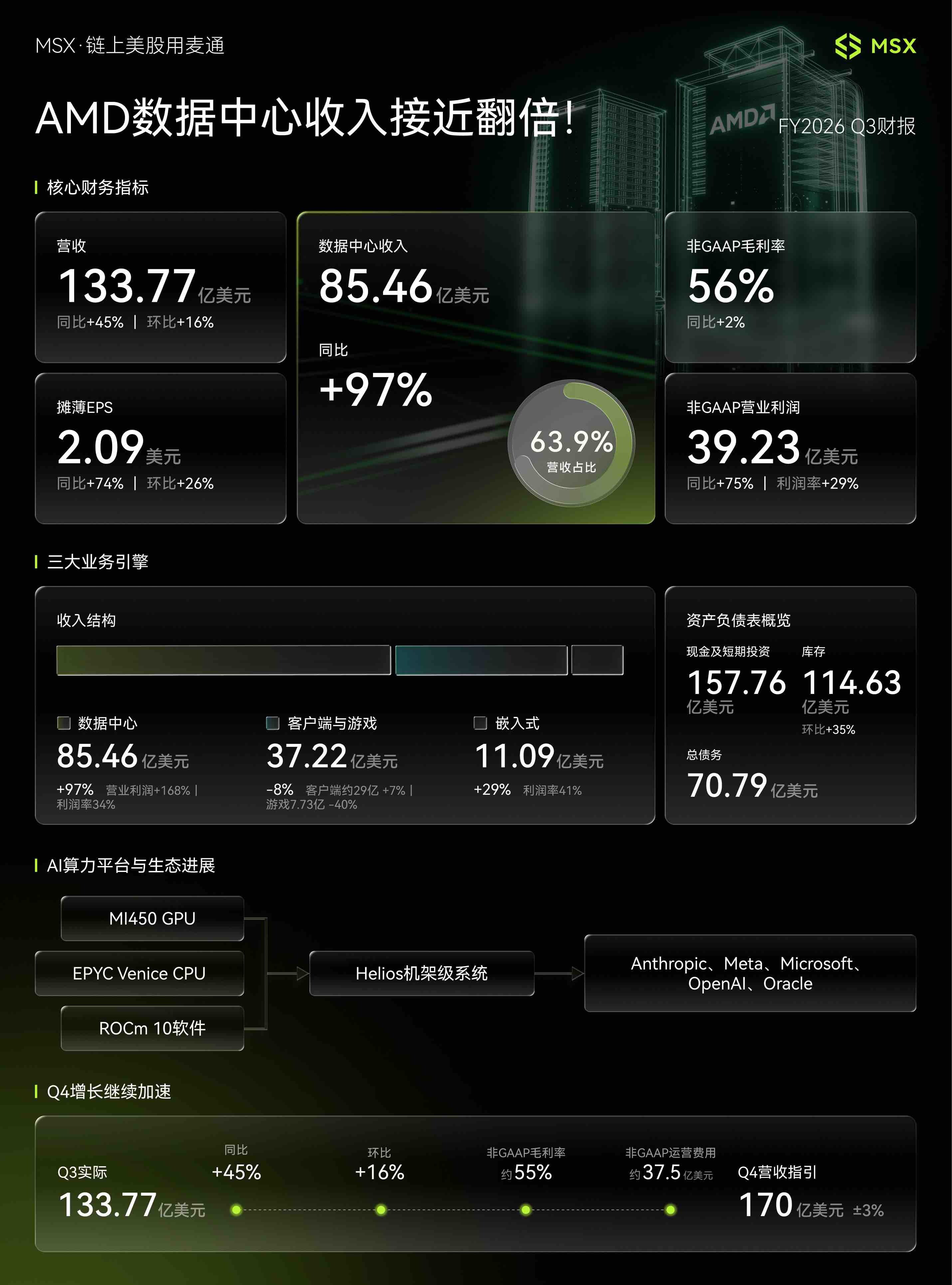
GAAP operating income reached $2.832 billion, up 123% year over year. Adjusted operating income was $3.923 billion, up 75%, and adjusted operating margin improved to 29% from 24% a year earlier.
Data center business led the quarter
The most important part of the report was the data center segment. Third-quarter data center revenue rose to $8.546 billion, up 97% year over year and 27% quarter over quarter, representing about 64% of AMD’s total revenue. Segment operating income climbed to $2.882 billion, up 168%, while operating margin increased from about 25% a year earlier to about 34%.
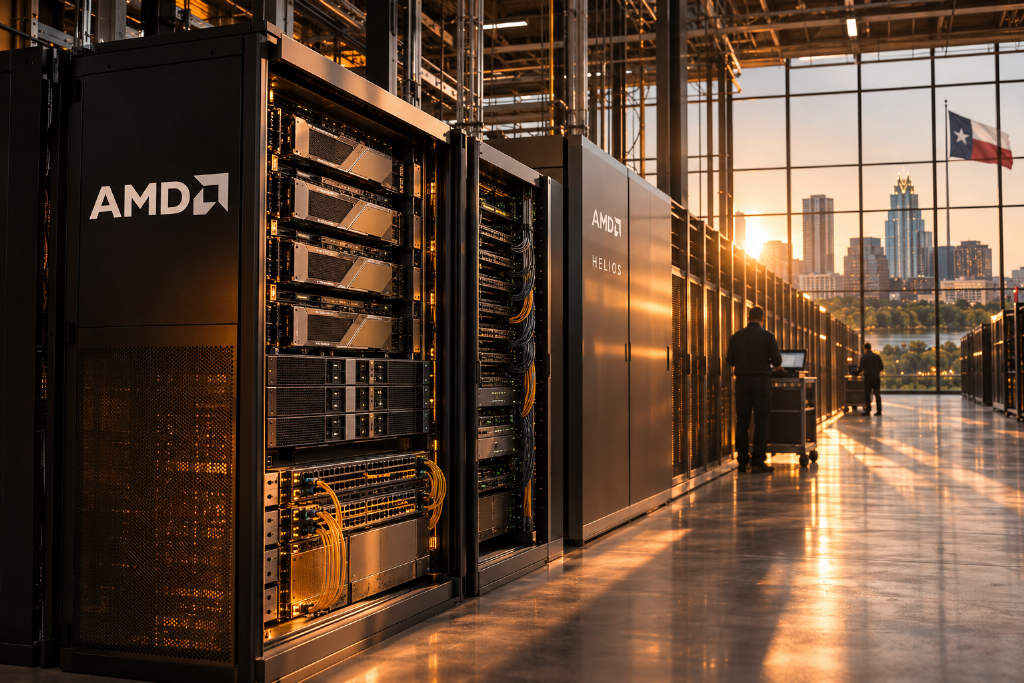
AMD said the growth came from both EPYC server CPUs and Instinct AI GPUs. The company has started ramping MI450-series GPUs and Helios rack-scale systems. Anthropic, Meta, Microsoft, OpenAI and Oracle Cloud Infrastructure are already running models or workloads on the first Helios systems. The next-generation Venice EPYC server CPU has also entered its production ramp.
Q4 guidance topped the market expectation cited in the report
AMD expects fourth-quarter revenue of about $17 billion, plus or minus 3%, implying a range of about $16.49 billion to $17.51 billion. The midpoint is above the roughly $16.23 billion market expectation cited in the article. Based on that midpoint, fourth-quarter revenue would increase about 66% year over year and about 27% from the prior quarter.
Management said fourth-quarter data center revenue is expected to grow about 50% sequentially, and AI GPU revenue is set to exceed server CPU revenue for the first time. The company also said total revenue in 2027 is expected to grow by more than 80%, server CPU revenue is expected to nearly double, and the data center business is expected to contribute more than 80% of company revenue. After the earnings release, AMD shares rose about 7.5% in after-hours trading at one point.
Key operating and cash flow figures
- FY2026 Q3 revenue was $13.377 billion, up 45% year over year and 16% quarter over quarter.
- The market expectation cited in the source was about $13.06 billion.
- Data center revenue accounted for about 63.9% of total revenue.
- Data center operating income was $2.882 billion, up 168% year over year.
- Data center operating margin was about 33.7%, versus about 24.7% a year earlier.
- Client and gaming revenue was $3.722 billion, down 8% year over year and 3% quarter over quarter.
- Within that segment, client revenue was $2.949 billion, up 7% year over year.
- Gaming revenue was $773 million, down 40% year over year.
- Client and gaming operating income was $573 million, down 34% year over year.
- Embedded revenue was $1.109 billion, up 29% year over year and 14% quarter over quarter.
- Embedded operating income was $453 million, up 60% year over year.
- Embedded operating margin was about 40.8%.
- Third-quarter operating cash flow was $1.202 billion.
- Capital expenditures were $648 million.
- Free cash flow was $554 million, below $1.530 billion a year earlier.
- Free cash flow margin was about 4%.
- Cash, cash equivalents and short-term investments totaled $15.776 billion at quarter end.
- Total debt stood at $7.079 billion, including $4.75 billion in senior notes financing completed in August.
- The prior market expectation for Q4 revenue was about $16.23 billion.
- Q4 adjusted gross margin guidance was about 55%.
- Management expects the data center business to account for more than 80% of company revenue in 2027.
- AMD shares rose about 7.5% in after-hours trading at one point after the earnings release.
MSX view: three growth curves
MSX Research said AMD now has three growth curves. The first is EPYC. Even though AI data centers rely heavily on GPUs for compute, each GPU system still needs CPUs for system scheduling, network management, storage access, data preprocessing and a wide range of general-purpose computing tasks. As AI clusters get larger, demand for high-performance server CPUs also rises.
In MSX’s view, AMD’s EPYC business benefits from two trends at the same time: continued share gains in the traditional server CPU market and rising total server demand as AI data centers expand. The next-generation Venice processor will use the Zen 6 architecture, and AMD expects production to scale further in the fourth quarter. Management’s expectation that server CPU revenue will nearly double by 2027 suggests the company does not see AI-related CPU demand as a short-lived effect.
The second growth curve is Instinct GPU. MSX described the MI450 series as a key product in AMD’s effort to narrow the gap with Nvidia. Instead of mainly selling standalone accelerator cards, AMD is now delivering MI450 and Helios as complete rack-scale systems that combine GPUs, EPYC CPUs, networking chips, interconnects, cooling systems and ROCm software on one platform.
That shift matters because large AI customers are no longer just buying chips. They are buying computing systems that can be installed, connected and put to work on models right away. Rack-scale products also carry larger contract values and place higher demands on supply-chain coordination, networking technology, software compatibility and delivery execution. AMD said Anthropic, Meta, Microsoft, OpenAI and Oracle Cloud Infrastructure are already running models or workloads on the first Helios systems, which MSX said shows the product has moved beyond demonstration and into customer validation and early deployment.
The third growth curve is a full AI platform. MSX said AMD previously relied more heavily on customers to source CPUs, GPUs and other components separately before server makers integrated them. Now the company is moving up into Helios rack systems while also filling in networking, software and dedicated inference chips. AMD has released ROCm 10 and introduced the Helion reference architecture for agentic systems. It also plans to acquire World Labs and Taalas. According to the source, World Labs would add capabilities in spatial intelligence and world models, while Taalas focuses on custom inference chips.
Expenses, warrants and inventory remain key watch points
MSX also pointed to new risks tied to that strategy. First, AMD now has to invest across GPU architecture, CPUs, networking, software, rack design and customer support, increasing both R&D and operating complexity. Adjusted operating expenses rose 29% year over year to $3.560 billion in the quarter.
Second, some large AI agreements include customer warrants. AMD recorded about $1.097 billion in non-cash charges related to changes in the fair value of customer warrants during the quarter, widening the gap between GAAP and adjusted profit. MSX said warrants can help AMD lock in major customers, but they may also create potential equity dilution. Whether those agreements create value for shareholders depends on comparing the revenue, profit and cash flow generated by those customers with the cost of the warrants and related investment.
Third, revenue and profit growth have not yet translated into free cash flow at the same pace. AMD posted adjusted net income of $3.471 billion in the third quarter, but free cash flow was only $554 million. MSX said the main reason was not operating weakness. Instead, the company is building inventory and expanding working capital ahead of a rapid ramp. Inventory increased by about $2.995 billion in the quarter, and accounts receivable rose by about $1.928 billion. Accounts payable increased by about $2.313 billion, offsetting part of the cash use. Quarter-end inventory reached $11.463 billion, up 35% from the prior quarter.
MSX said it is commercially reasonable for AMD to prepare chips, packaging, memory and system components in advance of large-scale ramps for MI450, Helios and Venice. If fourth-quarter and 2027 orders are delivered as planned, that inventory should convert into revenue and cash flow. If customer data center launches are delayed, supply chains become mismatched or product demand changes, elevated inventory could also slow turnover and raise impairment risk. In that reading, inventory growth is both a leading signal for faster future revenue and a risk indicator that needs continued monitoring.
MSX said the market’s main question in the past was whether Instinct products could move from limited trials to large-scale procurement. Now, data center revenue has nearly doubled, MI450 and Helios have started contributing revenue, several top-tier customers have entered system validation and deployment, and fourth-quarter data center revenue is expected to rise another 50% sequentially.
About MSX and the risk notice in the source
The article describes MSX as an RWA trading platform offering spot and derivatives trading for nearly 400 tokenized stocks and Pre-IPO assets, alongside services tied to U.S. equities spot and perpetuals, crypto-to-crypto trading, Pre-IPO products and research.
MSX also said macroeconomic conditions and the U.S. stock market can be highly volatile, and that the material is provided for academic and research observation only and does not constitute investment advice.



