

Buying clinical-stage weight-loss drugs is becoming a new use case for crypto payments. A Bloomberg report published on July 20 said the trade is now running at a pace that would exceed $100 million a year, with many buyers coming from outside the crypto world.
One example in the report was a 49-year-old U.S. marketing director who had long dismissed Bitcoin as having “no underlying value.” This year, he spent several days opening accounts, buying crypto, and learning how to transfer it, all to buy 20 vials of an experimental weight-loss drug from a seller in China.
A first Bitcoin transfer driven by price
The buyer Bloomberg interviewed was identified as Zach, who did not disclose his last name for privacy reasons. He lives in the U.S. Pacific Northwest and was trying to get retatrutide, Eli Lilly’s experimental weight-loss drug. The compound is a triple agonist targeting GIP, GLP-1, and glucagon receptors.
Eli Lilly released Phase 3 trial data in March showing weight loss of as much as 28% over 80 weeks at the highest dose. The drug has not been approved by the U.S. Food and Drug Administration, or FDA, and is not available through authorized channels.
After searching for months, Zach found a Chinese seller willing to provide 20 vials of what the seller claimed was the compound, roughly a one-year supply, for $240. By comparison, buying through U.S. middlemen would have cost him $300 a month, or $3,600 a year.
The seller had one condition: payment in Bitcoin only.
Bloomberg said Zach had previously grouped Bitcoin with speculative assets. The price difference changed his mind. “The spread was so dramatic, it felt like the risk was worth taking,” he said. The seller sent him a webpage explaining how to buy and transfer Bitcoin. A few days later, Zach had opened a Coinbase account, bought Bitcoin for the first time, sent it to the seller, and received the package a week later.
Why peptides end up relying on crypto rails
Peptides are short chains of amino acids involved in regulating a range of physiological processes. They have moved into the mainstream over the past two years along with the weight-loss drug boom. Approved injectables such as semaglutide, sold as Wegovy, and tirzepatide, sold as Zepbound, are themselves peptide drugs.
Outside those approved products, though, a large volume of similar compounds with no full validation of human safety or efficacy is sold online. These products are typically marketed as “research chemicals,” with labels stating that they are not approved by the FDA and are not for human or animal use. They are often shipped directly from overseas labs, with no prescription and no insurance involved.
Because the claimed health benefits are unproven and the legal and regulatory risks are high, banks and card networks are often unwilling to serve these sellers. Shut out of the conventional payments system, more of them have moved to Bitcoin-only sales.
Even within crypto, there is a split. Bloomberg cited data showing that among sellers with average transaction sizes above $1,000, stablecoins have overtaken Bitcoin as the preferred payment method. At the smaller retail end, where buyers look more like Zach, Bitcoin remains the main option.
Growth is real, but crypto is still a small part of the market
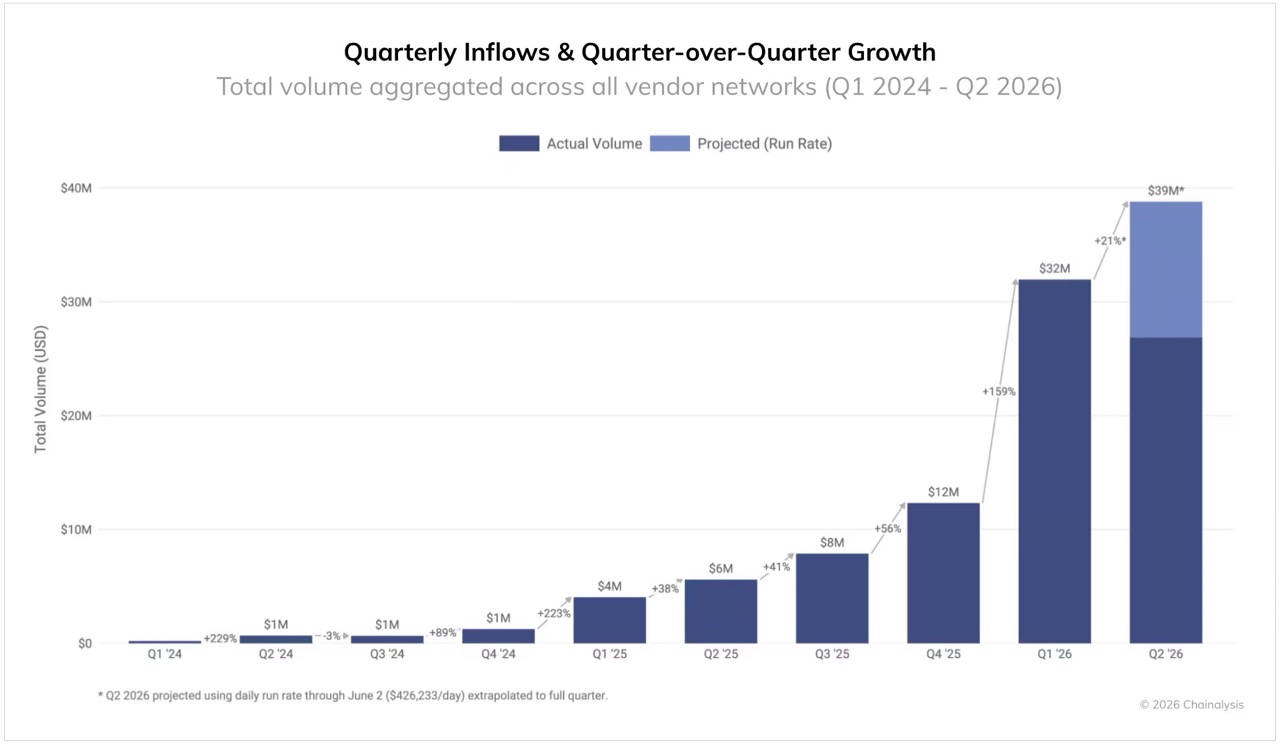
Blockchain analytics firm Chainalysis said gray-market peptide sellers received $32 million in crypto payments in the first quarter of 2026, up 700% from a year earlier. That was also a 159% jump from the previous quarter’s $12 million. At that recent pace, annualized volume is already above $100 million.
TRM Labs used a different methodology, combining on-chain analysis with research into public information tied to manufacturers of drug precursors. On that basis, it estimated $41.4 million in crypto inflows to the sector in 2025, up 20% year over year.

Ari Redbord, TRM Labs’ global head of policy, said, “This market is huge and expanding. I’m not sure there is another pharmaceutical market in the world growing as fast as peptides.”
The report sketches an unusual overlap in buyer profiles: gym regulars, podcast listeners, and middle-aged people trying to lose weight are showing up in a market more commonly associated with gray-economy demand.
Still, crypto remains a small slice of the whole. Investors in the sector estimated the total peptide black market at between $1 billion and $3 billion, leaving crypto payments as a relatively limited part of the trade.
A Manhattan gathering where crypto and peptides meet
One of the more vivid scenes in Bloomberg’s report took place in a Manhattan bar decorated with crypto memorabilia. More than 100 people packed into a hot room for a talk on peptides.
The event was hosted by DeSciNYC, a monthly meetup for science enthusiasts with the slogan “science is for everyone.” Previous topics have included longevity, CRISPR gene editing, AI and science, the microbiome, bioelectricity, tardigrades, cellular metabolism, academic publishing fraud, and prediction markets.
The peptide session was titled “Peptides 101.” The speaker was Julius Ritter, a founder of California Peptide Club in his twenties who also runs a longevity-focused meal delivery company and operates a hackathon house in San Francisco. He spent an hour walking through peptide chemistry, possible uses, some of the risks, and several specific products, then lifted his black T-shirt and injected himself on stage to applause.
The scene points to something broader than payment mechanics. The connection between crypto and this market is not only transactional. It also reflects overlapping communities. DeSci, longevity circles, biohackers, and self-optimization communities already intersect heavily, and crypto participants are common within those groups.
Regulatory change in the U.S. could reduce the need for crypto
Bloomberg also said the U.S. is moving in the direction of legalization.
The FDA is convening an advisory committee to discuss whether some popular peptides should be allowed to be produced legally in the United States. U.S. Health and Human Services Secretary Robert F. Kennedy Jr. has publicly backed that direction, saying legalization “would help move demand off the black market.”
Lee Rosebush, president of the American Peptide Medicine Association and an advocate for tighter oversight, described the current market as the “Wild West.” In his view, stricter rules could push out vendors operating under research-use labels and make safer products easier for patients to access.
If that path is opened, crypto’s role in this market could become awkward. Much of its current share exists because traditional payment channels are absent.
As for Zach, Bloomberg said he plans to stop buying. He said he has already reached his target weight.