
Steven Cress, head of quantitative research at Seeking Alpha, says investors may be asking the wrong question about artificial intelligence. The issue, in his view, is no longer whether AI will reshape the economy, or when. It is whether the financial system supporting that shift has become more aggressive than the underlying economics.

His argument is not that AI demand is fake. He says the demand is real, and so is the capital spending. What deserves closer scrutiny is the financing structure behind the buildout, especially as chipmakers, cloud providers, AI developers and data center operators become more tightly linked through investments, long-term capacity agreements and direct financial support.
Real demand, but a harder financing question
Cress points to the scale of spending already in motion. Nvidia posted $96.2 billion in revenue in its latest quarter, up 106% year over year. Data center revenue rose 117% to $89.0 billion. Alphabet expects roughly $195 billion to $205 billion in capital expenditures in 2026, while Microsoft expects about $175 billion.
Building AI infrastructure requires spending on GPUs, data centers, networking gear, power, cooling and the systems needed to keep that compute running. At the same time, the financial relationships inside the AI stack are becoming more entangled. That does not mean the boom is over, he says. It does mean investors should start asking how much of the growth priced into AI stocks comes from sustainable demand that can stand on its own financing, and how much depends on continued access to very large amounts of capital.
Why he compares today to 1997, not 1999
Many investors compare the current AI cycle with 1999. Cress thinks 1997 is the better reference point, and that the comparison may look even clearer as the market moves toward 2027.
In 1997, the internet and telecom buildout was real. Large companies were investing heavily in networks, fiber and equipment on the expectation that internet usage and data traffic would keep rising sharply. The harder question was whether every participant in that expansion would earn an adequate return on capital.
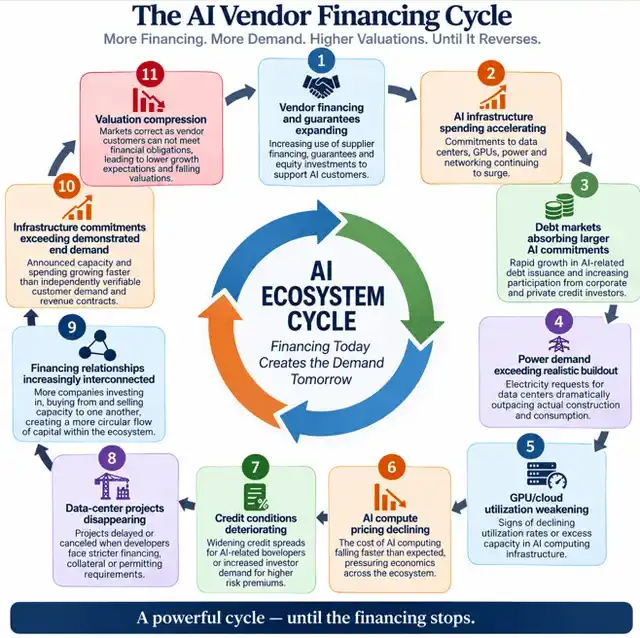
One early warning sign from that period, he says, was the growing role of vendor financing. As banks and other traditional lenders became less willing to take risk, manufacturers and suppliers increasingly financed customer purchases themselves, helping smaller telecom operators and downstream beneficiaries keep buying equipment.
In May 1997, Nortel said more than 80% of its customer financing commitments had gone to major PCS operators, totaling about $1.7 billion. As competition in telecom expansion intensified, the practice spread. By 1999, Lucent management was presenting that kind of financing as a competitive advantage that helped emerging wireless operators secure funding.
The point is not that the market was already at its peak in 1997. It was not. The Nasdaq did not top until March 2000. That is exactly why Cress sees 1997 and 1998 as a more useful comparison for the current AI phase.
Higher funding costs raise the stakes
Cress also notes a key difference between then and now. In 1997 and 1998, the Federal Reserve target rate was 5.50%. Today it is 4.00%. But inflation was not the same problem then. Now it remains well above the Fed's 2% target. July PCE inflation came in at 3.7%, with core PCE at 3.3%. After stronger-than-expected August jobs data and a firmer economy, the Federal Open Market Committee voted unanimously at its September meeting to raise rates by 25 basis points. He describes that as the first rate increase in more than three years and a possible start to a new tightening cycle.
Long-term funding is not cheap either. The 10-year U.S. Treasury yield is around 4.80%, a level rarely seen since 2007 outside 2023. So while nominal rates are below the late-1990s peak, the backdrop is different. AI expansion is happening while inflation is still elevated, markets are still dealing with the prospect of tighter policy, and long-end yields are already near levels associated with the TMT era.
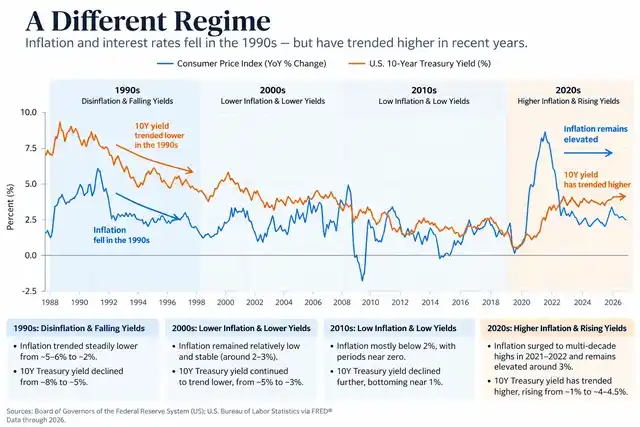
That matters because once capital becomes harder or more expensive to obtain, the market gets a cleaner look at the strength of organic demand. Cress says AI-related debt issuance has already exceeded $220 billion so far in 2026. Higher rates make infrastructure financing more expensive and weigh on the valuations of technology stocks whose investment case depends heavily on discounting future earnings and cash flow.
Financial excess, he argues, often starts before the underlying operating metrics fully break down. That is why he asks whether the market is seeing a return of TMT-style financial behavior.
Nvidia is not only selling chips
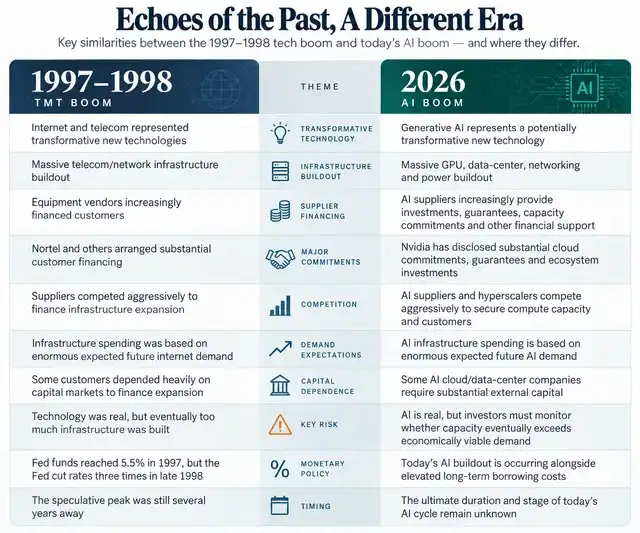
When traditional financing becomes more expensive, smaller companies often turn to cash-rich technology giants. In the AI ecosystem, Cress says, Nvidia has taken on that role. The company still sells the GPUs and networking gear that power large AI systems, but its latest quarterly filing also shows deeper financial ties to the rest of the supply chain through product commitments, cloud agreements, equity investments and guarantees.
He compares that position with Cisco during the rise of the internet. In the late 1990s, Cisco sat at the center of data and IP networking. By the second quarter of 1998, it held more than 71% of the global router market by revenue. Just as it was difficult to participate in the internet buildout without Cisco equipment, it is difficult today to scale AI workloads without Nvidia GPUs.
Cress says investors should get comfortable with a simple idea early: the technology can be right while the investment can still be wrong. The internet did reshape the global economy, and he says he rarely doubts AI will do the same. That still does not mean every company involved in the buildout will be a winner. Most did not survive the dot-com era, and he sees Nvidia as the right place to start when drawing that line in the current cycle.
$366 billion in future commitments
As of July 26, 2026, Nvidia had $279 billion in supply and capacity commitments, up from $119 billion in the prior quarter. It also had $29 billion in cloud service commitments, $25 billion in committed equity investments, and $25 billion in data center lease commitments that had not yet started. Including $8 billion in capital expenditures, total future commitments came to about $366 billion.
Cress says a large share of that $279 billion has not yet been realized. These are agreements signed to secure manufacturing capacity, storage and other mechanical components of AI systems, not cash that has already been lent out or paid. Many of those agreements can still be modified, adjusted or canceled.
Nvidia has also developed a pattern with some AI cloud companies in which the customer buys Nvidia hardware and Nvidia, in turn, agrees to buy the customer's "software," meaning cloud compute. Nvidia describes that as a win-win because it helps different parts of the supply chain secure the compute they need. As of July 26, 2026, its total cloud commitments stood at $36 billion, with $29 billion still outstanding.
In practical terms, Cress says, Nvidia is helping finance the supply chain while also agreeing to become a customer of some of the buyers of its hardware. The company has a clear incentive to keep the AI buildout from failing. Spending today can support larger revenue tomorrow. But that leaves investors with a difficult question: how much AI demand comes from customers that can finance and monetize infrastructure on their own, and how much has been effectively financed into existence by the supplier itself?
Financing can accelerate real demand. It can also make the same demand appear more durable, or larger, than it really is.
SB Energy, OpenAI and cloud contracts
In August, Nvidia provided guaranteed credit support of up to $105 billion for roughly 4.25 gigawatts of data center capacity at SB Energy's PORTS Technology Campus in Ohio. The campus is expected to host Nvidia compute infrastructure, and OpenAI signed a 20-year lease as a customer. The guarantee is set to be drawn in stages as the data center is completed, and Nvidia's exposure declines as OpenAI begins paying rent on its own.
Cress says Nvidia remains highly profitable and the company has emphasized strong customer demand and a solid sales pipeline. His concern is at the margin. Once suppliers begin investing in their own customers, the line between selling because demand exists and creating demand through the sale becomes less clear.
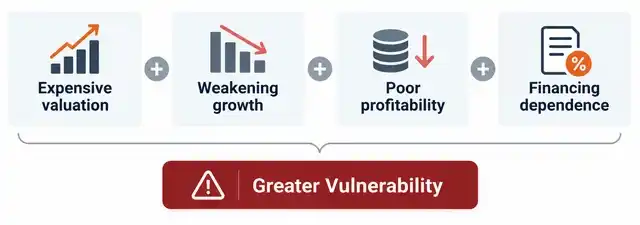
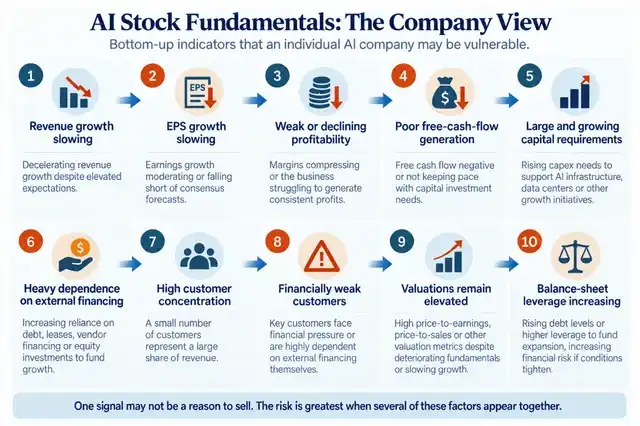
That does not lead him to dismiss the AI theme. It leads him to a more selective stance. Not every company involved in the AI buildout carries the same level of risk. A company with strong profitability, healthy cash flow, a solid balance sheet and growth that supports its valuation is very different from one with slowing growth and a business case tied heavily to infrastructure that has not yet been built. Any one of those factors alone may not sink a stock. The bigger vulnerability appears when several of them start to overlap.
Two Reuters reports and a more tangled chain
Cress also cites two Reuters reports. On Aug. 27, 2026, Reuters reported that Nvidia had paused some financing arrangements designed to support smaller AI cloud companies. Under the proposed structure, Nvidia could sell GPUs to cloud providers and potentially lease back idle compute if those customers could not sell capacity.
On Aug. 31, Reuters reported that Anthropic had agreed to buy about $35 billion in cloud computing from Nvidia-backed cloud provider Lambda and planned to buy another roughly $45 billion in cloud compute from Nscale.
He draws two lessons from those reports. First, AI developers expect very large demand for cloud compute over the next several years. Second, the internal links across the AI ecosystem are only getting deeper.
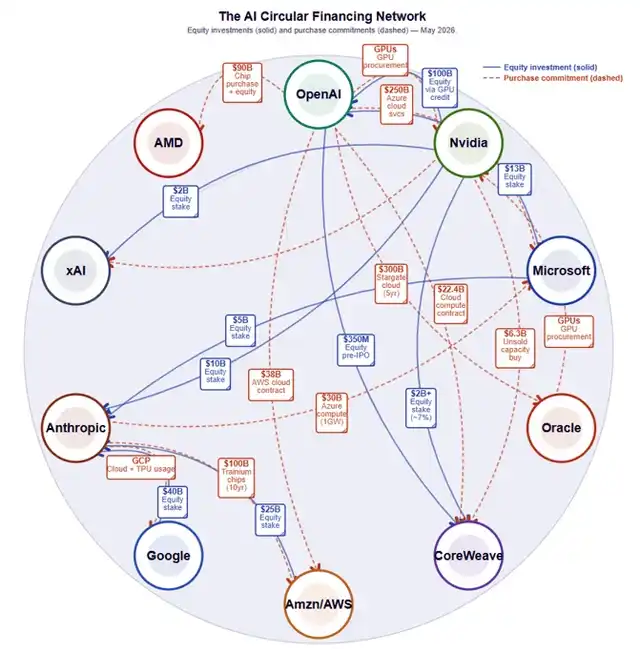
The more interconnected the system becomes, the harder it is to isolate the true underlying financial position of any one company. Surging demand, whatever its source, can bring more investment and create the conditions for more supply and faster growth. The reverse can also be true.
What Nortel and Lucent still show
At the peak of the TMT cycle, Nortel and Lucent looked like the era's version of Nvidia and Broadcom, Cress says. In 1999, the two companies together controlled 53% of the North American optical transport market and generated more than $12 billion in sales. The market itself grew 56% that year, driven by aggressive network expansion, which he sees as a rough parallel to today's data center buildout.
From 1997 to 2000, telecom competition became so intense that capital expenditures rose from about $56 billion to nearly $120 billion, or roughly 33% of industry revenue. Capital spending was growing about 30% year over year while retail sales were rising only about 10%. Lucent and Nortel eventually overexpanded and their shares fell sharply.
His point is not that history will repeat in a simple way. It is that financing can accelerate a legitimate boom as long as real demand keeps pace. Once the capital threshold tightens or the cost of capital rises, the true strength of organic demand becomes easier to see. Data center construction is still accelerating today, and the risk that "ghost demand" distorts the picture is rising with it.
Why this cycle may still be different
Cress is careful to note that 2026 is not 1997. During the TMT boom, investors often valued companies on eyeballs, traffic and clicks even when revenue and profits were thin. In AI today, he says, demand is real, revenue growth is real, and profits and cash flow are real as well.
He adds that Seeking Alpha Quant currently rates Nvidia a Strong Buy, the first sustained Strong Buy rating on the stock in three years. A large part of that improvement comes from valuation compression combined with earnings growth that has outpaced the share price. Nvidia's valuation factor score has improved from F six months ago to C, while its growth score has strengthened from A- to A+.
In his view, the market has already priced in a meaningful share of the risk tied to Nvidia's large cash commitments across ecosystem investments, financing and other obligations. That concern has taken some heat out of AI stocks and made valuations more attractive than they were in June or during parts of 2025.
He says Nvidia's price-to-earnings multiple now trades at a discount relative both to the sector and to its own five-year historical average. Markets have a way of adjusting through history and memory. As concerns about financing, leverage and excessive AI spending become more widely recognized, investors demand lower valuations and firmer evidence of earnings growth. That repricing can remove part of the bubble risk before the underlying fundamentals deteriorate. For now, he says, Nvidia's fundamentals have not deteriorated. Its growth still runs well ahead of the broader sector and its own five-year average.
Do not abandon AI, but do not concentrate blindly
Cress's conclusion is not to walk away from AI. It is to avoid excessive concentration. He says the current setup looks a lot like 1997: real technological change, fast demand growth and, because of that, the possibility of financial excess. The technology can be right. The long-term opportunity can be large. The investment can still go wrong.
That is why he argues diversification matters more than ever. Investors can keep exposure to the strongest AI opportunities while filling out the rest of a portfolio with companies that have stronger fundamentals, steadier dividends and durable growth. In that framework, returns come from more than one narrative. They come from earnings growth, profitability, valuation, cash flow and sustainable dividends as well.