
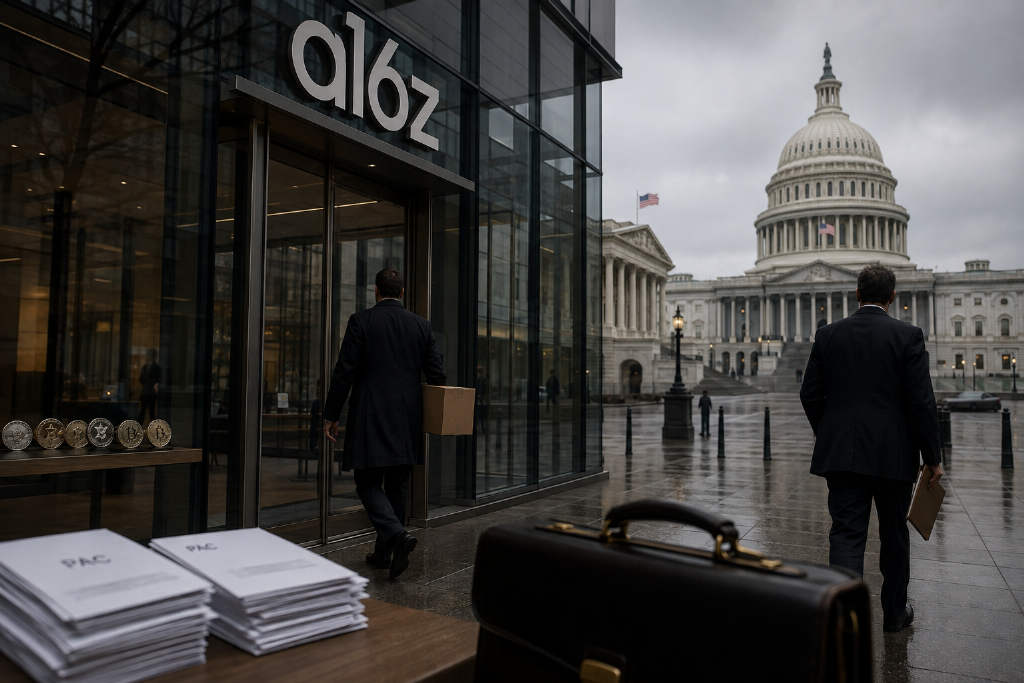
Technology writer and former Glitch CEO Anil Dash says the venture capital business has changed so deeply that it no longer deserves the name. In a published opinion piece, he describes it instead as "cancer capital."
Dash singles out Andreessen Horowitz, or a16z, along with co-founders Marc Andreessen and Ben Horowitz. He writes that the firm and its two founders have poured $115.3 million into the current U.S. midterm election cycle, nearly double the $63 million figure he cites for 2024 and more than any billionaire donor in the country, including Elon Musk.
Dash argues today’s industry is no longer traditional venture capital
In Dash’s telling, the common image of venture capital is simple: investors commit large amounts of money to help founders build young companies. What operates in public now, he says, is something else: a small group of billionaires using the venture capital label to advance an agenda that is hard to regulate and hard to resist.
He frames that critique as firsthand, not distant commentary. Dash says he has raised tens of millions of dollars as a startup chief executive and has also handled hundreds of millions in fundraising through board and advisory roles, putting him inside the same negotiations and industry circles as the investors he is criticizing.
Why he calls it "cancer capital"
Dash says venture capital was supposed to remain a small, high-risk, high-return corner of the capital markets. He compares it to a type of cell the body needs in limited quantity to function. Once that cell grows without restraint, it begins to damage the host.
For him, scale is the core problem. He writes that when a fund reaches $50 billion in assets under management and charges a 2% annual management fee, that translates to $1 billion a year for managers whether portfolio companies survive or fail. At that size, he argues, the fund is no longer truly carrying the risk of its own bets, even though it still presents itself as venture capital.
The 2019 shift in legal structure
Dash points to 2019 as a key turning point. That year, he says, top firms including a16z voluntarily gave up their legal venture capital status and registered as investment advisers. In his description, dropping the formal venture capital shell made a range of previously restricted activities lawful.
After that change, Dash says, these firms could buy shares directly from founders, hold public-market stocks without limit, and even sell shares from one in-house fund to another while booking the paper increase in value as profit, even if the portfolio company had never earned money. He adds that companies backed by these funds can also use newly raised capital to buy back stock from early investors, allowing those investors to cash out while the company itself still has no profit.
Founders become executors, while others absorb the risk
Dash argues that the balance of power has flipped as well. In the older model, founders built companies first and investors decided whether to back them. Now, he says, venture firms set out political priorities first, and "founders" are selected to carry out a small part of that agenda.
He adds that 99% of ordinary venture firms do not command this level of money or influence and are left competing on a field defined by the giants, even when they do not share the same methods.
Who takes the risk in the end? Dash points to pension funds and retail retirement accounts. As venture firms lean more heavily on those pools of capital, he argues, the public ends up holding the truly risky slice of the portfolio without fully realizing it.
He also links that dynamic to the drop in technology IPO activity. With fewer listings, funds look for ways to cash out before companies go public. In Dash’s account, that allows firms to produce large returns on paper even when the businesses involved have never made money, leaving retail investors exposed once the company finally lists.
Politics and media, in his view, still rely on an outdated story
Dash says politicians and news outlets still view venture capital through a lens formed 10 or 20 years ago, treating big firms as job creators and champions of startups. In his view, that misses the real objective: concentrating power and wealth in fewer hands.
For crypto, he says, this has become a structured political intervention
Dash argues that in crypto, the issue is no longer just an internal Silicon Valley power struggle. Of the $115.3 million he tracks, about $47.5 million went to Fairshake, a crypto policy super PAC. He describes it as a fundraising vehicle built to support or target specific candidates, independent of either major party. Roughly 40% of the total spending, he writes, was tied to crypto-related super PACs.
Within the same cycle, Dash says George Soros gave $102.9 million, Elon Musk gave $85 million, and Jeff Yass gave $81.8 million. Against that backdrop, he argues, a16z becoming the biggest donor of the cycle as a company rather than as an individual marks a shift in how political money is being organized.
Additional examples cited in the piece
Dash writes that criticism has also come from people connected to the firm. Former partner John O’Farrell, he notes, publicly accused his old firm of engaging in "political infiltration" around AI policy.
He also points to a16z’s hiring of Daniel Penny as a partner. Dash says Penny had no background in technology, finance, or startups. The event for which Penny is best known, he writes, was the death of Jordan Neely after Penny placed him in a chokehold on a New York subway car. Dash says Neely was his neighbor. Penny was later charged, and in December 2024 a jury found him not guilty of criminally negligent homicide.
Dash further cites Molly White’s Tech Influence Watch, which compared Federal Election Commission filings and found that a16z alone accounted for more than one-fifth of the political donations tracked from crypto and AI companies. The money, he says, went to candidates in both parties, at a scale far beyond the tentative political involvement associated with Mark Zuckerberg during the Obama years.
Dash’s conclusion
Dash ends with a blunt assessment: the industry once known as venture capital is no longer a financial machine for funding startups. It has become, he argues, a political machine focused on dismantling democracy and civil society.