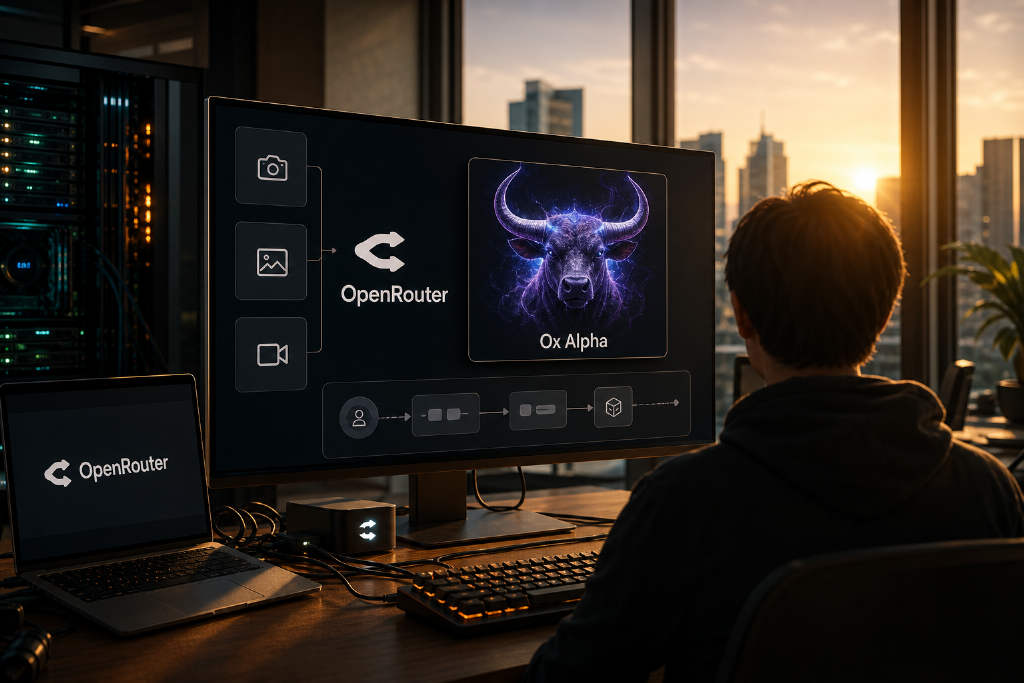
Ox Alpha, an AI model that appeared on OpenRouter on August 20 without a company name attached, is drawing attention for its coding performance and its anonymous launch. The listing describes it as a reasoning model built for coding, sustained agentic work, and production workloads. It is free to use, supports text, image, and video input, and offers a context window of roughly 1 million tokens. The model also supports tool and function calling, though its JSON output is not schema-enforced.
Benchmarks have added to the buzz. On DeepSWE, a coding benchmark based on real GitHub issues, developer Ben Davis reported an 80% first-pass score on a 10-task sample, ahead of Claude Fable 5 at 65% and GPT-5.6 Sol at 52%. Ox Alpha still had no listing on Artificial Analysis or LMSys Arena as of August 22.
Attention has also focused on who built it. Patrick Collison called the model “very impressive” on X after Stripe agreed to acquire OpenRouter, while AI analyst Andrew Curran said people “seem less sure of anything” about its origin. Independent fingerprinting has pushed speculation toward Zhipu AI’s GLM family, but the company has not commented publicly.
Ox Alpha, an AI model that surfaced on OpenRouter on August 20 without any company name attached, is getting attention for two reasons: its coding results and its anonymous launch.
The listing describes Ox Alpha as “a reasoning model designed for coding, sustained agentic work, and production workloads,” built by a third-party provider that chose to stay anonymous during the preview. It is free to use, reads roughly 1 million tokens in a single context window, and accepts text, image, and video input while returning text. It also supports tool and function calling, although its JSON output is not schema-enforced.
That mix of features has made the model stand out to developers. OpenCode said its route could handle 100 trillion tokens a day, while Nous Research, which is offering the model free through its own portal, said it could support 1 quadrillion. Tokens are the basic unit of information a model handles, and that throughput puts Ox Alpha in the same conversation as some of the most heavily used systems in the market.
The benchmark numbers helped fuel the buzz. DeepSWE measures how often a coding agent can solve real GitHub issues correctly on the first attempt. It spans 113 tasks pulled from 91 repositories and is scored as a percentage of tasks passed. Developer Ben Davis ran an initial 10-task sample and said Ox Alpha hit 80% on the first pass, ahead of Claude Fable 5 at 65% and GPT-5.6 Sol at 52%. That figure spread quickly, even though the sample was small and could still be volatile.
As of August 22, Ox Alpha still had no entry on Artificial Analysis or LMSys Arena.
The model’s rollout was also helped by a short comment from Stripe CEO Patrick Collison, whose company agreed on August 19 to acquire OpenRouter. Collison called Ox Alpha “very impressive” in a post on X, and that single line helped push the model into a wider conversation within hours of launch.
No one has claimed the model publicly. AI analyst Andrew Curran wrote on Friday that people “seem less sure of anything” about where Ox Alpha came from.
The guessing started quickly. Developers floated Microsoft’s unreleased MAI family, Xiaomi’s MiMo line, DeepSeek, Alibaba’s Qwen, and Google’s Gemini. One developer even joked that Google might be using a rival’s stealth model as marketing for its own. Most of those guesses did not hold up.
Xiaomi’s MiMo v2.5 accepts audio input, a feature Ox Alpha does not. DeepSeek has never shipped video capability and releases open weights rather than stealth previews. Google and Qwen use different tokenizers and video encoders, which makes a direct link difficult to establish.
The remaining evidence points more toward Zhipu AI’s model family. Independent fingerprinting matched Ox Alpha’s tokenizer to GLM-5.3 across normalized tests, and its video-token spending matched GLM-5V-Turbo exactly across four separate clips. It also shares GLM’s distinctive error patterns and audio-rejection behavior.
One detail complicates a clean match: GLM-5.3 launched on August 14 as a text-only model, six days before Ox Alpha appeared with full video support. If the fingerprinting is correct, Ox Alpha may be an unreleased multimodal upgrade to that line rather than an identical copy. Some analysts have started calling that possibility GLM-5.3 Flash.
Zhipu AI has not commented publicly on Ox Alpha.
A stealth model is a frontier AI system released without attribution through a routing platform like OpenRouter, giving the lab a chance to collect real-world usage data before a public launch. The pattern has become familiar in China. Zhipu AI’s Pony Alpha was identified as GLM-5 within five days in February, Xiaomi’s Hunter Alpha turned out to be MiMo-V2-Pro in March, and Meituan let its Owl Alpha run anonymously for two months before confirming it as LongCat-2.0 in June.
Ox Alpha is live now on OpenRouter under the model ID stealth/ox-alpha, and it is also available free through OpenCode, Cline, and Nous Portal. OpenCode said the free window would last about a week from the August 20 debut, putting the likely cutoff around August 27. After that, if the recent pattern holds, someone may finally put a name to it.
This article was originally published by Bit.Fan. For more cryptocurrency news and market insights, visit www.bit.fan. Disclaimer:
The market information, project data, and third-party content displayed on this platform are for industry information sharing only and do not constitute any form of investment advice or return commitment.
Cryptocurrency trading carries high risks. Users should fully assess their risk tolerance and make independent decisions. All profits, losses, and legal responsibilities are borne by the users themselves.