

Anthropic has published a long-form explanation aimed at clearing up a common misunderstanding in Claude Code: switching to a bigger model does not automatically fix poor results. The company said many cases users described as Claude getting “dumber” were tied to the Effort setting rather than the underlying model.
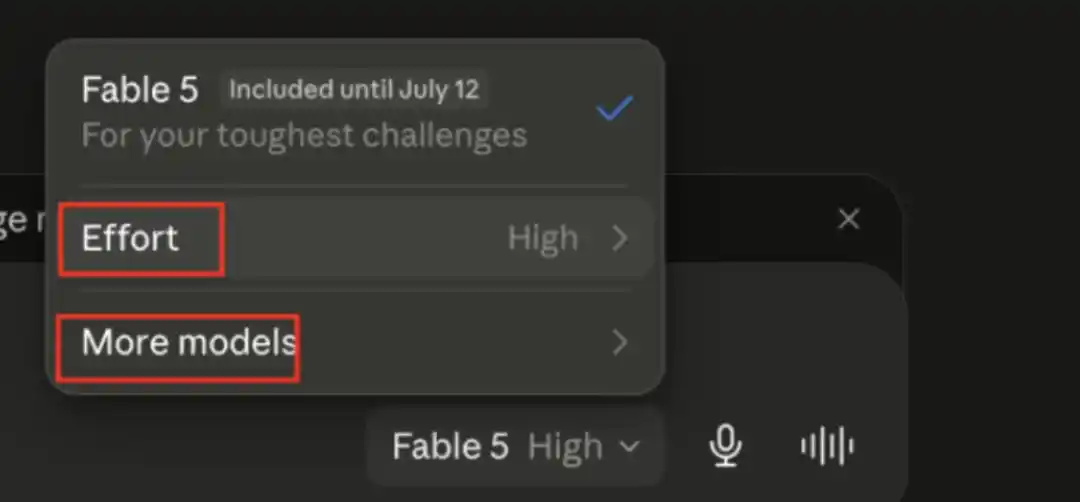
The company focused on two Claude Code controls that users often mix up: Model and Effort. Anthropic’s summary is simple. Model changes the “brain,” while Effort changes the amount of work Claude is willing to do on a given task.
March setting change triggered the backlash
Anthropic linked the confusion to a wave of complaints from developers in March. Users said Claude Code had started skipping files it should have read, failing to run tests it should have run, abandoning tasks midway, and asking for more information instead of pushing forward.
One of the sharpest public criticisms came from AMD AI lead Stella Laurenzo, who said she reviewed logs from 6,852 conversations on GitHub and found Claude’s amount of thinking had fallen 67% compared with the period before February. She wrote that Claude could no longer be trusted for complex engineering work.

According to Anthropic, the change behind that reaction was not a silent model downgrade. On March 4, the company lowered the default Effort level in Claude Code from high to medium in order to reduce latency. Anthropic said the change was listed in its update log, but many users did not notice it and only saw weaker execution in practice. The default was switched back on April 7, and all subscribers received a usage reset.
Model sets capability, Effort sets task intensity
In Anthropic’s explanation, a model is a fixed set of weights. Once training ends, that knowledge and capability boundary is locked in. Prompts, CLAUDE.md instructions, and code pasted into context can guide the model during inference, but they do not alter the weights themselves. For that reason, changing the model addresses whether Claude can do something at all.
Anthropic gave the example of a library that did not exist when a model was trained. A user can provide documentation in context and Claude may use it correctly for that request, but the model does not permanently learn it. The company said the same logic helps explain why a model may confidently call an API that does not exist: the output is assembled from prior patterns in the weights, not from a durable update to the model.
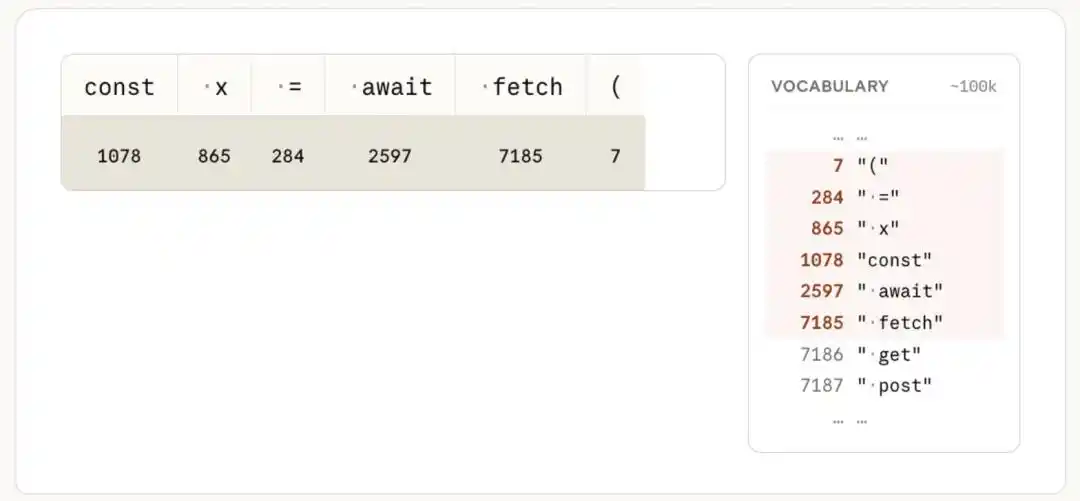
The post also described the mechanics underneath the interface. Code such as “const x = await fetch” is first broken into tokens and mapped to integers in the vocabulary. Anthropic wrote that const maps to 1078, await to 2597, and the vocabulary contains roughly 100,000 entries. The model does not read raw text as humans do. It processes numerical token sequences and predicts output one token at a time, recomputing the sequence at each step. A 200-token response means roughly 200 rounds of computation.
High Effort means more work, not just more waiting
Anthropic said users often reduce Effort to a simple “think longer” knob, but that misses the point. The setting controls how much work Claude puts into the task: how many files it reads, whether it runs tests, whether it performs extra verification, and whether it carries a multi-step assignment through to completion before returning.
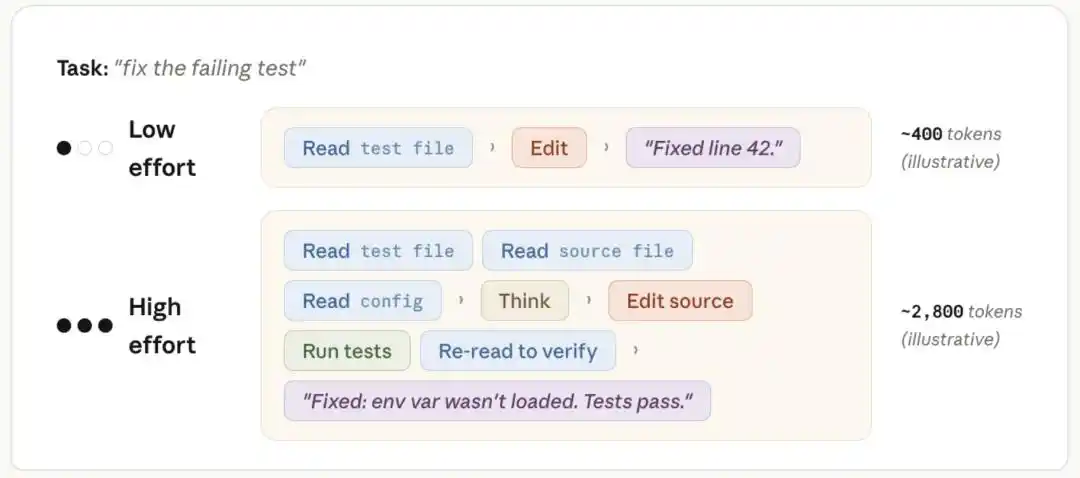
At low Effort, Claude is more likely to answer quickly and ask the user for more context. At high Effort, it is more likely to inspect information on its own, use tools more often, and push through longer task chains. Anthropic said Effort is not just a token cap. It is a behavioral signal that shapes text generation, tool use, and extended reasoning.
The company included a chart showing that, for the same prompt, a high-Effort path can generate about seven times as many tokens as a low-Effort path. Anthropic said the extra tokens are spent reading files, running checks, and validating results repeatedly.
Anthropic’s decision rule: capability gap or not enough effort
The company said users should not start by switching models when Claude gets a task wrong. The first step is to inspect the context: whether the prompt is clear, whether the right tools are available, and whether CLAUDE.md is aligned with the task. Anthropic said many reports of Claude becoming “dumber” begin there rather than in model choice.
If the context is in order, the next question is whether Claude does not know how to do the task or simply is not putting in enough effort. The latter tends to show up when Claude skips files it should have read, avoids tests it should have run, or returns midway through a refactor to ask questions. In that case, Anthropic said users should raise Effort.

If Claude has enough context, appears to have tried, and still fails even when the request is rephrased, the problem is more likely capability. In that case, increasing Effort will not help and a stronger model is the correct choice.
Why a smaller model can still win
Anthropic used a comparison among Sonnet, Opus, and Fable to make the distinction more concrete. Sonnet was described as a versatile generalist with an entire afternoon to work through a codebase, run it, and check it again. Opus was framed as an expert with only five minutes, bringing experience and instinct that the codebase itself does not contain, but without enough time to inspect everything. Fable was presented as the specialist called in when everyone else is stuck, able to spot a problem quickly even with limited time.
That framing leads to a point Anthropic said many users miss: a high-Effort Sonnet can outperform a low-Effort Opus on many tasks. The company also said Fable shows the widest gap on long and multi-step work, and in some internal tests there were tasks that neither Opus nor Sonnet could reach at any Effort level.
From model rankings to agent orchestration
Anthropic tied the discussion to a broader shift in AI coding. The company argued that the field is moving away from a simple contest over the strongest model and toward the practical skill of orchestrating agents well. Instead of picking one model for everything, users may need to assign different roles and Effort levels to different tasks.
Anthropic said small edits can go to Sonnet at a low setting for speed and lower cost, while major refactors may justify stronger models at higher Effort. Long-running autonomous jobs also need enough Effort budget to work properly.
The company pointed to the ultracode option in Claude Code’s Effort menu as a product version of that idea. Anthropic said ultracode gives Claude xhigh effort and, when the task is substantial, the authority to decide whether to spin up a team of agents and split the work in parallel.
Seen from that angle, the March dispute was less about an invisible drop in model intelligence and more about a setting many users had not been watching. Anthropic’s message is that knowing how to assign work is starting to matter as much as knowing which model name to click.
References
- Anthropic blog: https://claude.com/blog/claude-model-and-effort-level-in-claude-code
- ClaudeDevs on X: https://x.com/ClaudeDevs/status/2074900291062034618?s=20
- Anthropic documentation: https://platform.claude.com/docs/en/managed-agents/multi-agent
The MarsBit article said the piece originated from the WeChat account New Intelligence, written by ASI Qishilu and edited by Yuanyu.