
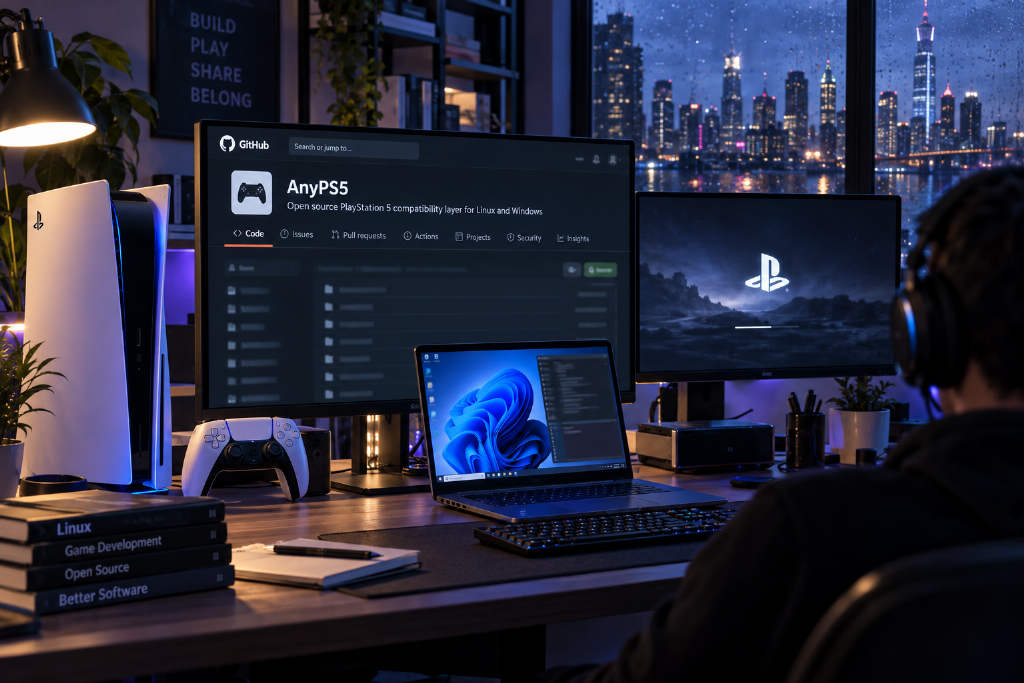
Open-source project AnyPS5 has reached about 2,000 GitHub stars, along with 141 forks and 602 commits, as it gains attention for a method that tries to run PlayStation 5 games on PC without following the usual emulator model.
The repository’s author, who uses the name boykopovar, describes it in the README as a 「Tool for automatic executables porting to Linux and Windows」. The idea is to take decrypted PS5 executables and turn them into native programs for Windows and Linux rather than simulate a full PS5 environment.
A translation path instead of full console emulation
AnyPS5 is positioned closer to Wine or Proton than to a traditional emulator. Because the PS5 uses an AMD Zen 2 processor based on the x86-64 architecture, the project starts from the premise that a PC does not need to spend resources emulating a completely different instruction set.
On the GitHub page, the project says it reads PS5 game executables and converts them into native formats that Windows or Linux can run directly. Its shader pipeline recompiles shaders into SPIR-V for Vulkan. The relinker is described as handling Zen 2-specific instructions that games may use, including EXTRQ, INSERTQ, MOVNTSS and MOVNTSD, while also supporting Intel instruction conversion and stub generation.
The shader recompiler can already output SPIR-V. If developers enable the ANYPS5_ENABLE_SPIRV_TOOLS build option, the output is checked with SPIRV-Tools for validation. The project also includes its own implementation of PRX system libraries with dynamic linking support, which means it does not require a separate runtime process.
That design choice is a key distinction from a pure emulator. An emulator tries to recreate the entire console as a contained environment. AnyPS5 is trying to transform PS5 code into software that can execute on a PC as a native program.
Current progress stops short of a public release
The author says the project can currently reach _start, complete stack unwinding and exception handling, and 「reaches main」. The project page also states that one actual game already 「reaches the logo, main menu, and gameplay with audio」.
That does not mean broad playability. Some games, including Demon’s Souls, need an extra skip-sce-module argument to bypass a specific system module. For build requirements, Linux uses GCC, while Windows requires a specified version of MinGW-w64.
Even with those milestones, AnyPS5 has not published a formal release so far. The author’s stated threshold is to wait until the first game can boot completely before putting out version one. Hardware outlets including Tom’s Hardware and VideoCardz covered the project on the same day, though attention alone does not establish that games are generally playable.
The harder part is not the CPU
The report argues that cutting out CPU emulation removes only one part of the problem. The larger obstacle is the PS5 software stack itself: thousands of operating system library calls, plus proprietary graphics and audio APIs. Those pieces still have to be implemented through the relinker and PRX layers one by one, so progress depends on stub completion rather than processor similarity alone.
The article also says AnyPS5 does not include, distribute or require any copyrighted software, firmware, keys or proprietary libraries. Still, users need to supply a decrypted PS5 executable before the tool can do anything with it. That requirement ties the project to the broader console jailbreak ecosystem.
Legal pressure remains a live issue
AnyPS5 is released under GPL-2.0 and carries a disclaimer, but that does not settle the legal question around projects in this category. The report points to two recent examples from the Nintendo ecosystem: Yuzu reached a $2.4 million settlement and shut down after being sued in 2024, while the Ryujinx team stopped development in the same year after contact from Nintendo.
For now, AnyPS5 remains a closely watched technical demonstration rather than a finished consumer product. The author has tied the first release to one clear benchmark: one game must boot fully before that version goes out.