
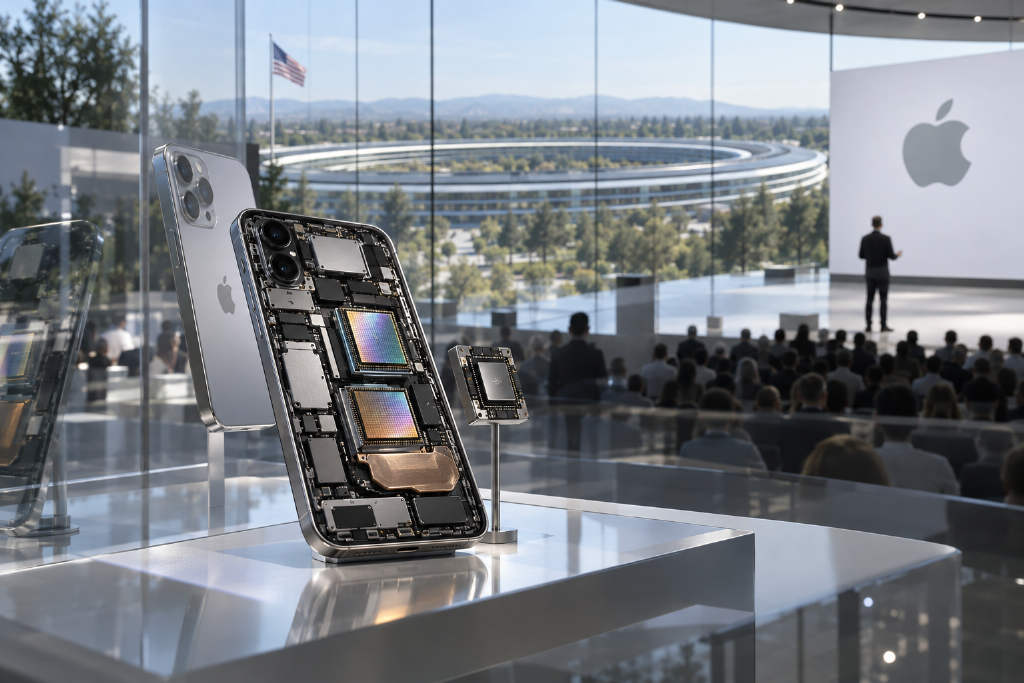
Apple unveiled the A20 Pro, a new flagship smartphone system-on-chip, at its latest iPhone launch event. The company also introduced a custom C2 modem. The presentation was the first led by new Chief Executive Officer John Ternus.

Apple said the A20 Pro is the first 2 nm chip ever used in an iPhone. Its first 2 nm chip overall was the M6, announced in August, which is set to make its debut in the Mac Mini later this month. Like the M6, the A20 Pro comes with dual neural engines and new CPU and GPU cores.
According to Apple, the A20 Pro will power the new foldable iPhone Duo as well as the iPhone 18 Pro and iPhone 18 Pro Max.
A20 Pro specifications and performance claims
The new SoC features a 6-core CPU. That includes two Apple “super cores,” which the company said are 20% faster than the previous generation, plus four efficiency cores with neural acceleration. Apple described it as a “desktop-class” processor and called it the fastest CPU in a smartphone.

The chip also carries a 7-core GPU. Apple said graphics performance is up 40% from the previous generation, with higher bandwidth and a new neural accelerator that doubles FP8 compute speed.
A20 Pro includes new dual 16-core neural engines, for a total of 32 cores. Apple said the design speeds up on-device AI models and computational photography, and delivers AI processing performance that is 2x that of the A19 Pro. The company also said memory bandwidth is up 50%, making it the widest memory interface in an iPhone to date.
Packaging and thermal redesign
Apple said it changed the chip package so that the silicon sits away from the SoC thermal path, allowing the silicon to connect directly to the vapor chamber. Compared with the 17 Pro, the vapor chamber has three times the surface area and uses more graphite and copper, along with 80% recycled stainless steel.
The redesigned thermal system centers on a next-generation vapor chamber whose surface area is three times larger than the prior generation, Apple said. The chamber continuously circulates deionized water to improve heat dissipation, helping the A20 Pro sustain higher performance for longer periods under heavy workloads.

To make that possible, Apple reworked the physical packaging of the A20 Pro. The older InFO_PoP package has been dropped in favor of WMCM, short for Wafer-Level Multi-Chip Module. In simple terms, DRAM is no longer stacked on top of the A20 Pro. Instead, it is placed laterally beside the chip.
Apple said that layout leaves more room for SoC cooling, reduces thermal interference from DRAM and improves sustained performance. The company did not disclose more detailed specifications for the A20 Pro at launch.
Apple said the new package, new thermal materials and the larger vapor chamber together lift sustained iPhone performance by 40% from the previous generation, which it described as the highest sustained performance ever in an iPhone. The company also said that represents up to a 40% sustained-performance gain over the iPhone 17 Pro and a 2x gain over the iPhone 16 Pro.
Battery life figures and device lineup
Apple also said the efficiency of the A20 Pro and a new battery design extend battery life. The company said the iPhone 18 Pro can deliver 36 hours of video playback, while the iPhone 18 Pro Max can reach 45 hours. Based on what Apple described as proprietary testing and data from real-world phone use, the company said the iPhone 18 Pro lasts 24 hours per charge and the iPhone 18 Pro Max lasts 30 hours per charge.

C2 modem and wireless connectivity
Alongside the SoC, Apple introduced the new C2 cellular modem as a replacement for Qualcomm alternatives. Apple said the C2 delivers much faster upload speeds than the C1X, cuts power use by 15% and adds millimeter-wave support in the United States.
Apple on the same day announced the new iPhone 18 Pro models and the iPhone Duo, the company’s first foldable iPhone. Apple said both the iPhone 18 Pro and the iPhone Duo come with the custom C2 modem and support 5G connectivity.
Before the launch, there had been rumors that Apple’s in-house C2 would not support U.S. millimeter-wave 5G and that the company would again rely on Qualcomm to fill that gap for U.S. carriers. Apple’s announcement indicates that millimeter-wave support is present, at least in that market.

At the same time, Apple’s press release for the iPhone 18 Pro and Pro Max, as well as the technical specification pages for the two phones, appear to show that the C2 modem is limited to the smaller iPhone 18 Pro model, while the iPhone 18 Pro Max uses a Qualcomm modem. The original report said the reason for that distinction is unclear given that the two devices are otherwise nearly identical in features.
Apple said the C2 uses AI technology to improve cellular quality and reliability, and now supports millimeter-wave in the United States. U.S. specifications list bands n258, n260 and n261, along with sub-6GHz 5G and 4×4 MIMO. U.K. specifications list only sub-6GHz.
Both models also include the N1, an Apple-designed wireless networking chip that supports Wi‑Fi 7, Bluetooth 6 and Thread.
S11 and more detail on WMCM
Apple also introduced the S11, a chip designed for the Apple Watch Series 12 and Ultra 4. It includes two efficiency cores, a single-core GPU and a 4-core AI accelerator.

On WMCM, the original report said the package uses MUF, or molded underfill, which combines underfill and molding processes into one approach.
The report described WMCM as an upgraded version of Taiwan Semiconductor Manufacturing Co.’s InFO-PoP packaging technology, integrating advanced packaging methods such as CoW and RDL. By packaging the logic die and DRAM horizontally, it replaces the traditional vertical stack in an effort to improve thermals and performance. The report also said WMCM is an advanced packaging technology jointly developed by TSMC and Apple and designed specifically for Apple, making it another highlight of the A20 beyond the 2 nm process.
The report cited industry sources saying WMCM could support thinner packaging and integrate more memory, which would matter for future edge AI workloads with tougher computing and efficiency demands. Chip industry analysts cited in the report described the shift as a necessary upgrade for high-performance computing needs in the AI era.
Analysts cited in the report also said WMCM is among the early packaging approaches that blur the usual boundaries of traditional packaging. They said it could eventually be used in iPhone packaging, with a design logic that resembles high-performance computing: moving from stacked packaging to smarter integration, reducing bottlenecks, improving yield and preventing thermals from becoming the limiting factor.

The report said WMCM is not a single standalone technology but a mixed design philosophy. One widely circulated description in the report compares WMCM to a hybrid of InFO and CoWoS concepts: InFO showed how far fan-out can go, CoWoS showed how integration can scale for performance, and WMCM aims to combine those benefits while avoiding the full complexity and cost of traditional interposer-heavy methods.
From a packaging perspective, the report said WMCM has several structural advantages. By integrating memory directly into the module, it reduces the need for separate components and removes the conventional interposer or substrate. The use of molded underfill materials also simplifies the stack, cuts material consumption and process steps, and may free up internal space for other parts such as a larger battery.
The original article was published by the WeChat account Semiconductor Industry Watch (ID: icbank) and credited to its editorial team, before being carried by MarsBit.