
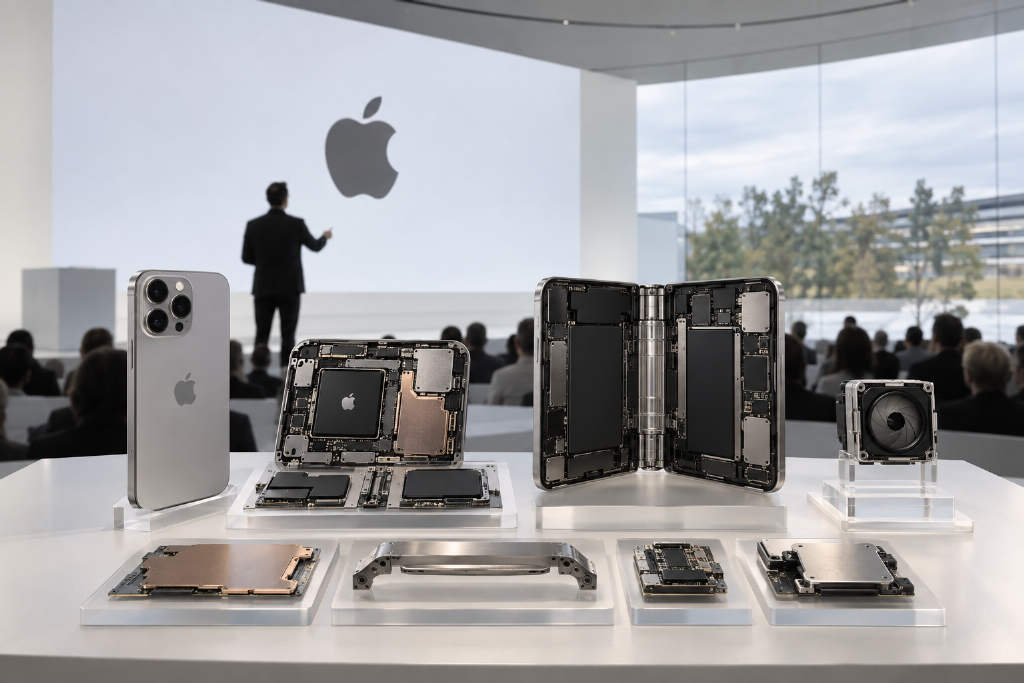
Apple’s fall product launch materials included more granular hardware detail than usual, spelling out process technology, packaging design, vapor chamber size and modem power use in numeric terms. What the company did not provide was the name of a single supplier.
The release points to changes in specifications and component structure. It does not identify who is making the parts behind them.
A20 Pro moves to 2 nm, with no foundry named
Apple said the A20 Pro is "built using the latest 2-nanometer process technology," but did not name any chip foundry. The wording keeps with Apple’s long-standing practice of not disclosing manufacturing partners in launch materials.
For the chip itself, Apple listed a 6-core CPU, a 7-core GPU and a new dual 16-core Neural Engine, for 32 cores in total. The comparison baseline is the A19 Pro. Apple said the GPU is up to 40% faster, AI processing performance has doubled, and memory bandwidth is 50% higher. The CPU now integrates the neural accelerator into the cores.
Memory is moved out of the thermal path as packaging changes
One of the most technical lines in the release describes a custom package derived from Apple’s M-series chips. In that layout, the silicon die and memory sit side by side, allowing memory to be removed from the chip’s thermal path.
That is a packaging change rather than a process change. Instead of stacking memory above the chip, Apple is placing it next to the silicon, which lets the processor make direct contact with thermal hardware. The trade-off is a larger horizontal footprint. Apple’s description in the same section also ties into the reported 50% gain in memory bandwidth.
Apple did not say who supplies the memory.
Vapor chamber area triples from the prior generation
With memory no longer blocking the thermal route, the A20 Pro can sit directly against a new vapor chamber. Apple said the chamber uses a new material and has three times the surface area of the iPhone 17 Pro generation. The company said that lifts sustained performance by as much as 40% versus the previous generation and called it the highest sustained performance ever in an iPhone.
iPhone Duo uses the same A20 Pro and the same custom vapor chamber approach. Apple described the package as being inspired by its M-series chips. The thermal challenge is shared across the foldable model and the Pro devices, though the foldable has to manage that class of cooling inside a thinner body.
C2 modem adds mmWave for the first time
C2 is Apple’s third-generation in-house cellular modem. Apple compared it with C1X and said upload speeds are noticeably faster, power consumption is down 15%, and mmWave is supported in the U.S.
That makes mmWave a first for Apple’s own modem line. The previous C1X supported only Sub-6GHz. The source article also noted that a MacRumors report published in September 2025 identified that gap as a key difference between C1X and the modem used at the time in iPhone 17 Pro.
Apple did not say whether all modems used in iPhone 18 Pro and iPhone Duo are supplied internally, and it did not mention any outside modem supplier.
Another chip, N1, is Apple’s in-house wireless networking chip covering Wi‑Fi 7, Bluetooth 6 and Thread. Both new phones include it.
2TB arrives in the iPhone lineup
Storage on iPhone 18 Pro, Pro Max and iPhone Duo starts at 256GB and goes up to 2TB. That 2TB tier is new. In Taiwan, the 2TB version of iPhone Duo is priced at NT$118,900.
Raising the top storage tier by one step increases NAND content per device. Apple did not disclose the cost structure of the 2TB version or the source of its NAND supply.
3D-printed titanium enters a production structural part
The iPhone Duo chassis uses grade 5 titanium with a mirror-polished finish. Its hinge cover is a 3D-printed part with a micro-sandblasted surface, and the bottom section includes an added titanium plate for reinforcement. Apple also said the hinge cover uses 100% recycled titanium.
Using 3D printing in a load-bearing hinge component, rather than only in small internal parts, is one of the clearest manufacturing changes described for the device. Apple did not provide capacity plans or identify the hinge manufacturer.
On displays, the inner screen uses a nano-texture surface and integrates a FaceTime camera below the panel. The front glass is Ceramic Shield 2, which Apple said has three times the scratch resistance of the previous generation. Apple did not disclose the sources of either the display panel or the cover glass.
Variable aperture is a new mechanical camera module
The 48MP Fusion main camera on iPhone 18 Pro now includes variable aperture. Apple said the system uses six laser-cut blades and a new rotor mechanism, switching among ƒ/1.48, ƒ/1.8, ƒ/2.8 and ƒ/4.0.
It is the first time an iPhone camera module has included a moving aperture structure. In the source account, that was described as a shift from the mostly fixed-aperture designs used in smartphone main cameras, adding a miniature mechanism that repeatedly actuates inside the module. Apple did not publish a service-life specification for that mechanism.
What Apple did not disclose
According to the source article’s review of the release, Apple did not address the following points at all: foundry source, memory and NAND suppliers, foldable display and cover-glass suppliers, hinge manufacturer, the chassis thickness of iPhone Duo, and production-capacity planning for the products in the lineup.
The release, in other words, offers signals at the specification and structural level: a move to a new process node, a change in packaging architecture, larger thermal surface area, mmWave added to Apple’s in-house modem, a higher per-device storage ceiling, and 3D printing used in structural hardware. It does not say which companies will benefit from those shifts.