


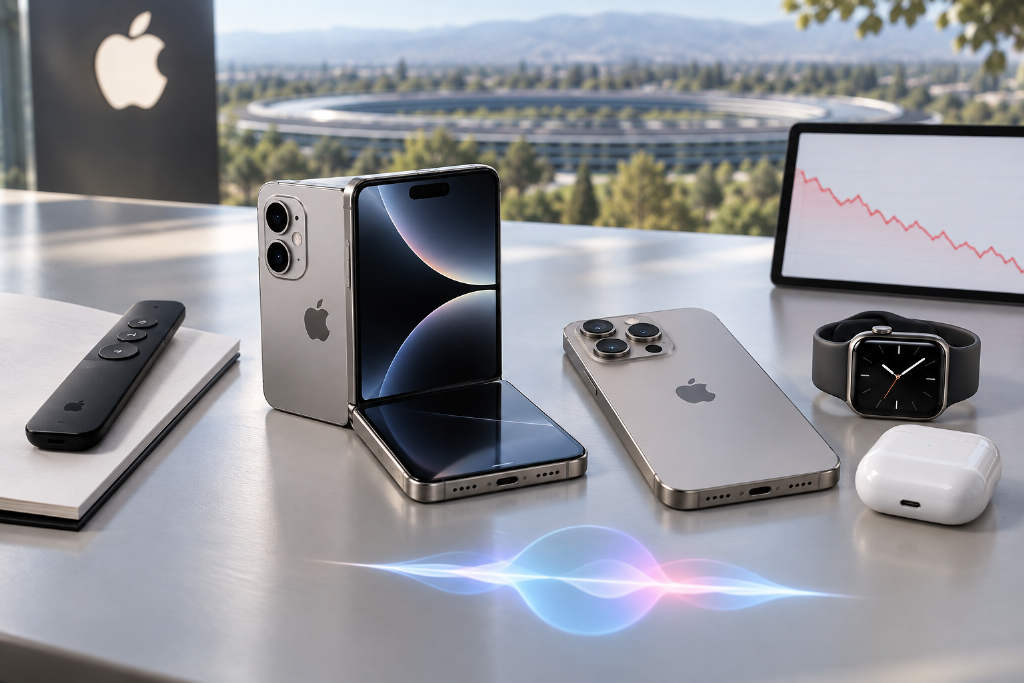
Apple introduced its first foldable phone at its Sept. 9 event, but the stock reaction was restrained. The company unveiled the iPhone Duo, iPhone 18 Pro, iPhone 18 Pro Max, Apple Watch Series 12 and AirPods 5. BiyaPay market data showed AAPL closed at $315.34 that day, down 0.28%.

The contrast stood out. Apple entered a new hardware category with the foldable iPhone, yet investors did not assign a higher valuation right away. The question is no longer whether Apple has new products to show. The market is watching whether those products can open a new upgrade cycle, whether AI can turn into a better user experience, and whether Tens can show that Apple’s next phase goes beyond the supply-chain discipline and services growth associated with the Tim Cook era.
The article notes that this kind of event is not only about AAPL. In the BiyaPay app, users can track AAPL alongside other U.S. tech stocks, Hong Kong-listed consumer electronics names, and crypto assets such as BTC and ETH. BiyaPay describes itself as a global one-stop asset allocation platform covering digital assets, U.S. stocks, Hong Kong stocks and fiat exchange. Around information-heavy catalysts like product launches, watching price moves across several markets can make it easier to tell whether money is trading product expectations, the AI narrative, or broader risk appetite.
Tens' debut put Apple’s direction under closer scrutiny
This launch drew attention not only because of the devices, but also because of the person on stage. With Tens succeeding Cook, Apple has entered a different narrative phase. Under Cook, Apple’s strongest traits were its supply chain, margins, inventory management, services ecosystem and shareholder returns. His operating discipline was a key reason Apple maintained high profitability for so long.
At the same time, investor criticism over the past few years has been clear: hardware innovation had slowed, Apple’s AI rollout lagged ecosystems led by Microsoft, Google, Meta and Nvidia, and iPhone growth leaned more heavily on existing users upgrading their devices. That is why Tens’ first launch event mattered. The market was not mainly judging presentation style. It was looking for signs that Apple may be changing how it approaches growth.
Based on his background, that expectation is easy to understand. Tens comes from hardware engineering and has been involved in key product lines including the Mac, iPad and Apple Silicon. That makes investors more inclined to connect him with a return to a product-driven story. The debut of the iPhone Duo during his first event carried symbolic weight. It looked less like a routine refresh and more like a message to the market: the iPhone can still take a new shape, and Apple is still willing to enter a category it had not personally stepped in to define before.
Symbolism alone will not be enough for the market. The next phase will depend on practical questions: whether the foldable can sell in meaningful volumes, whether pricing can hold, how supply-chain yields develop, and whether users are willing to pay a premium for the new form factor.
iPhone Duo is the main attraction, but also a pricing test
According to Apple’s official information, the iPhone Duo is Apple’s first foldable iPhone. It has a 7.6-inch inner display when unfolded, a 5.4-inch outer display, an A20 Pro chip and multitasking support. Pricing starts at $1,999, with preorders opening on Oct. 16 and general availability beginning on Oct. 23.
The importance of the product goes beyond Apple finally releasing a foldable. It also combines some iPhone and iPad use cases into a single device. Foldables have long been a story pushed by Android vendors, but the obstacles have been plain: bulk, visible creases, app adaptation, durability and price all limited mass-market adoption. Apple enters with advantages in hardware-software integration, ecosystem adaptation and a high-end user base. It also faces an obvious challenge, because a $1,999 starting price puts the device well above the normal flagship smartphone range.
That makes the iPhone Duo look like a test of the premium segment. If it can unlock demand among core users, it could drive two changes. First, Apple could push iPhone average selling prices higher and ease pressure from slower smartphone shipment growth. Second, the foldable format could create a new entry point for multitasking, gaming, video, office work and AI assistants, strengthening the stickiness of Apple’s ecosystem.
If sales remain mostly limited to early adopters and fail to trigger a sustained replacement wave, the contribution to Apple’s financial results would likely be modest. That helps explain why the stock was not pushed sharply higher after the event. The product is new enough. It has not yet proved that it can create a new cycle.
AI moved to the front of the stage, but investors still want evidence
AI was the other key theme of the launch. Apple expanded its Apple Intelligence and Siri AI push across the iPhone Duo, the iPhone 18 Pro lineup and iOS 27. Based on Apple’s official description, Siri AI will launch in beta with iOS 27 and will focus on understanding personal context, reading on-screen content, performing actions across apps, and emphasizing privacy and on-device processing.
Apple’s route differs from Microsoft, Google and Meta. Rather than leading with a large-model platform or selling AI as a cloud service to enterprises, Apple is trying to push AI back into its device ecosystem. The company is not arguing that it has the biggest model. It is arguing that its AI is closer to personal daily use. Strategically, that fits Apple’s DNA. The iPhone, Apple Watch, AirPods, Mac and iCloud together form a high-frequency device network. If Apple can place AI deeply into those products, the result could in theory be closer to everyday demand than a standalone chat tool.
The problem is that the market is no longer satisfied with AI as a story on its own. Over the past year, AI trades have moved from who has a model to who can monetize it, and from who is willing to invest to who can generate returns. Microsoft has cloud revenue and Copilot. Google has search, cloud and Gemini. Meta has ad efficiency improvements. Nvidia has chip demand and data-center revenue. Apple’s AI logic is slower to pay off and depends more on future device upgrades and deeper services penetration.
That is a central reason AAPL traded quietly after the launch. Investors accept that Apple has strengths in AI on the device side, but they still want clearer markers: whether iPhone replacement rates can rise, whether services revenue can accelerate, whether Siri AI can materially change user habits, and whether expensive hardware can lift profits in a durable way.
Why AAPL did not rise after the event
The post-event dip does not mean the market rejected Apple’s new products. A better reading is that much of the information had already been priced in. A foldable iPhone, higher pricing for the iPhone 18 Pro, AI-focused Siri, and new Apple Watch and AirPods models had all been widely anticipated. Once the event actually happened, money shifted to a more direct comparison: was the surprise large enough, and did the launch reduce risk in any meaningful way?
Apple did present a new hardware form factor and a new AI entry point, but it did not immediately answer the market’s biggest concern, which is earnings elasticity. Public market data shows Apple’s market capitalization remains above $4 trillion, with its price-to-earnings ratio at a relatively high level. At that scale and valuation, investors ask more from Apple than they do from an average company. A smaller company may get a stock jump from one innovative product. With Apple, investors are asking whether that product can support revenue growth for the next several years, expand the ecosystem’s profit pool, and improve long-term competitiveness in the AI era.
In that sense, Apple does not lack attention. What it lacks is a new growth answer that can later be confirmed through earnings.
Supply chains and Hong Kong-listed names may be repriced as well
The impact of Apple’s launch is not limited to AAPL. It can also flow through to supply-chain companies and consumer electronics names listed in Hong Kong. If the iPhone Duo scales, the most directly affected links would include foldable displays, hinges, titanium structural parts, thermal components, camera modules, batteries and advanced packaging. Continued upgrades to the camera system, chips and thermal design in the iPhone 18 Pro lineup could also push the market to revisit Apple suppliers with stronger pricing power and higher technical barriers. Many consumer electronics companies in Hong Kong and mainland China often move in the short term with expectations tied to Apple’s product cycle.
Still, that trade cannot be judged by launch-day attention alone. The core variables in the Apple supply chain are order volumes, production yield, value per device and margins. If foldables stay a small-batch premium product, the benefit to suppliers would be more structural than broad. If the format expands into a wider product line next year, the industry’s earnings leverage would look more visible.
For the market, the launch is better viewed as a starting point. The real tests come later, in preorder data, launch performance, supply-chain scheduling and the next earnings report.
Three questions Apple now has to answer
After the event, Apple still faces three major questions.
- Can foldables open a new premium replacement cycle? The $1,999 starting price means the iPhone Duo is not a mass-market device. It is more of a product aimed at testing the ultra-premium segment. Strong early demand could bring higher ASP and stronger brand pricing power. Weak demand would leave it closer to an image product.
- Can AI become a habit rather than a launch-stage label? Apple’s AI advantage lies in devices and privacy, but the market will ultimately judge whether users actually rely on it daily, whether developers are willing to adapt their apps, and whether services revenue benefits from it.
- Can Tens build a new layer of investor trust? In the Cook era, investors trusted Apple to make money. In the Tens era, the market still needs to be convinced that Apple can redefine products. That shift will not be settled by a single keynote, but this event did at least provide a new window for observation.
Apple did not lack highlights at this event. The iPhone Duo is one of the company’s rare new hardware forms in years. The iPhone 18 Pro lineup kept the premium strategy intact. Siri AI also put AI in a more central place in Apple’s product story. The lack of a clear stock rally showed that investors have moved into a more demanding phase.
For Apple, the event creates expectations. The stock tests them. Tens has completed his first appearance, but the harder exam starts now. Preorder figures, sales performance, user feedback on AI features and the next quarter’s earnings will determine whether this marks the start of a new cycle or simply a more polished version of a familiar Apple story.