
Apple reported fiscal fourth-quarter 2026 results on Nov. 2, with revenue of $114.48 billion, up 12% year over year, and above the LSEG estimate of $113.39 billion. Diluted earnings per share came in at $2.10, ahead of the $1.99 consensus.
The market reaction centered less on the beat and more on what came next. Apple said gross margin for the December quarter is expected to fall to 45% to 46% from 47.9% in fiscal Q4 because of rising memory chip costs. Services growth is projected at 8% to 9%, below analysts’ expectation of about 10.7%.
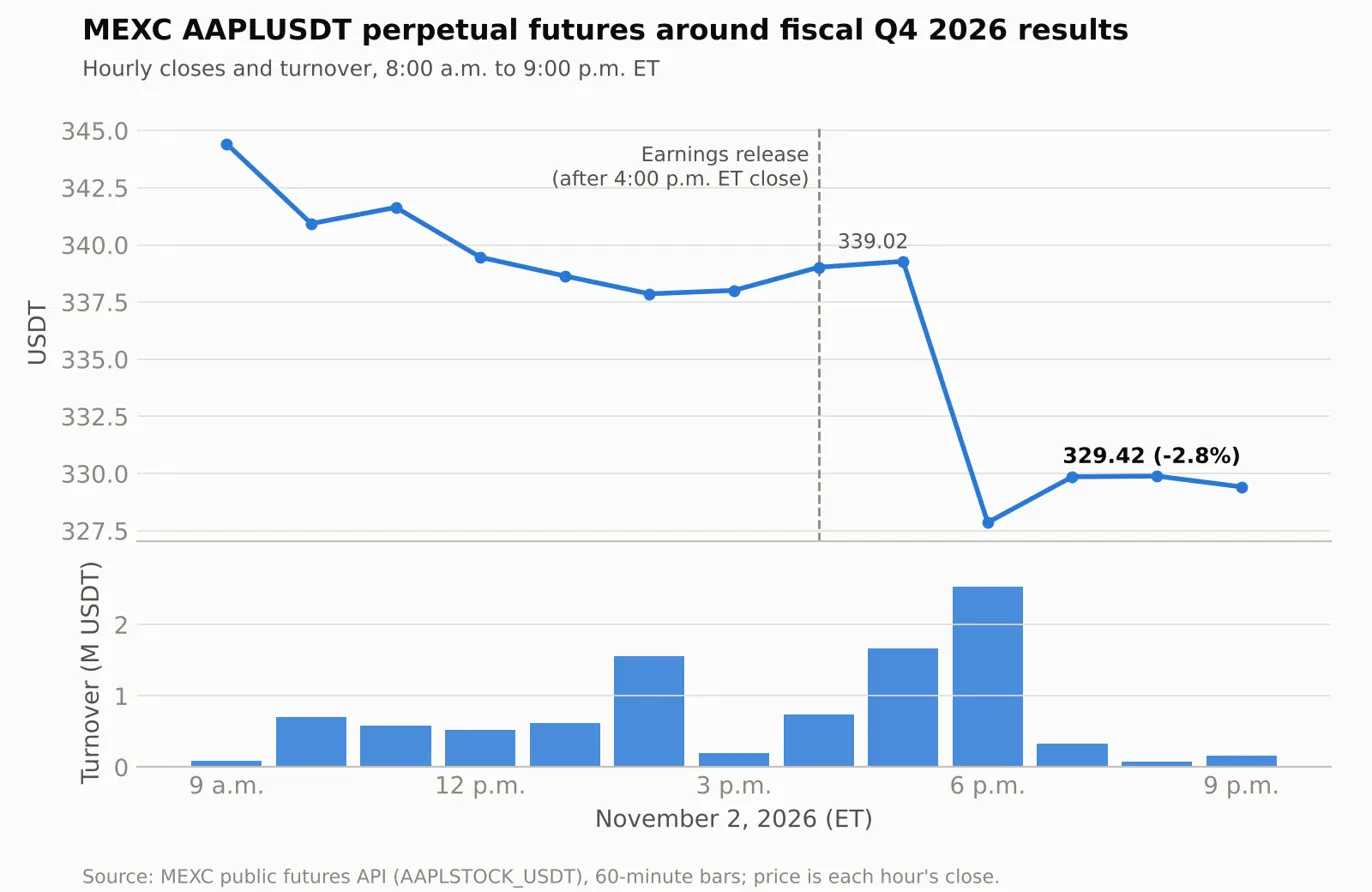
According to Reuters, Apple shares were little changed after the earnings release and then fell about 4% during the earnings call. On MEXC, the AAPLUSDT perpetual contract was down 2.8% as of 21:00 ET.
Fiscal Q4 2026 results versus expectations
Apple beat expectations on both revenue and EPS in the quarter.
- Revenue: $114.48 billion versus an LSEG estimate of $113.39 billion.
- EPS: $2.10 versus $1.99 expected. The figure included a $0.05 contribution from tariff refunds; excluding that item, EPS still topped expectations.
- iPhone: $57.58 billion versus an LSEG estimate of $56.54 billion, up 17.5% year over year.
- Services: $31.57 billion versus an LSEG estimate of $31.58 billion, up 9.8% year over year.
- Gross margin: 47.9% versus 47.5% expected, with tariff refunds contributing about 1 percentage point.
- December-quarter guidance: revenue growth of 7% to 10%, Services growth of 8% to 9%, and gross margin of 45% to 46%. The Services outlook came in below expectations.
Guidance, not the beat, drove the stock move
The report extended Apple’s streak of beating expectations. The article said Apple has now topped revenue and EPS estimates for 13 straight earnings reports. Even so, in the previous 12 cases, the stock fell after earnings eight times.
The same article pointed to guidance as the more important variable. In the five earlier reports where Apple’s guidance came in below expectations, the stock fell every time. This quarter followed that pattern.
The December-quarter gross margin outlook of 45% to 46% is 2 to 3 percentage points below the 47.9% posted in fiscal Q4. It is also below the 50.1% Apple reported for the June quarter. Services growth guidance of 8% to 9% is lower than the 9.8% growth Apple just reported for fiscal Q4.
Management comments on the earnings call
Chief Financial Officer Kevan Parekh said on the earnings call that the gross margin outlook mainly reflects higher memory costs, with some additional cost tied to scaling Siri AI.
John Ternus, appearing on an earnings call for the first time as CEO, said changes in memory chip pricing are unlike anything the company has seen before and that costs are expected to keep rising. He also said Apple is seeing memory costs above June-quarter levels and expects them to continue rising beyond December.
Ternus said those higher memory costs would be partly offset by price increases and by inventory purchased earlier at lower prices. He also described the new iPhone Duo as the most transformative iPhone since the original iPhone and said supply is currently constrained.
Tariff refunds also lifted the quarter’s reported figures. Apple said tariff refunds added about 1 percentage point to gross margin and $0.05 to EPS, and that the company has already recovered most of those refunds, meaning that support is not expected to repeat.
Segment revenue: iPhone and Mac up, iPad and wearables down
The following figures came from Apple’s fiscal Q4 2026 earnings release.
- iPhone: $57.58 billion, up 17.5% year over year, a record for a September quarter.
- Mac: $10.79 billion, up 23.7%.
- iPad: $6.23 billion, down 10.4%.
- Wearables, Home and Accessories: $8.30 billion, down 7.9%.
- Services: $31.57 billion, up 9.8%, a record high.
By geography, Greater China revenue rose 21.0% to $17.54 billion. The Americas grew 10.2%, Europe rose 11.5%, and Japan slipped 1.4%.
Net income increased 11.8% to $30.71 billion. Apple returned $28 billion to shareholders during the quarter and declared a dividend of $0.27 per share, payable on Nov. 16 to shareholders of record as of Nov. 12.
For the full fiscal year 2026, revenue rose 15.1% to a record $478.83 billion, while diluted EPS increased 20.4% to $8.98.
December quarter guidance
Apple’s guidance for the December quarter, which is fiscal first quarter 2027, was as follows:
- Revenue: growth of 7% to 10% year over year. Parekh said this would be the highest-revenue quarter in Apple’s history.
- Services: growth of 8% to 9%.
- Gross margin: 45% to 46%.
- Operating expenses: $20.4 billion to $20.8 billion.
- Tax rate: about 17%.
How this compares with prior post-earnings reactions
The article said Apple had beaten revenue and EPS expectations in each of the previous 12 earnings reports before this one.
- Beats: revenue and EPS topped expectations in all 12 prior reports.
- Stock reaction: the shares rose the next day only four times and fell eight times, with an average move of 2.3%.
- Guidance pattern: in all five cases where guidance missed expectations, the stock fell.
The most comparable prior report, according to the article, was in July. Apple beat expectations then as well, but guided September-quarter revenue growth to 9% to 11%, below expectations of about 12%, and the stock fell 7.4% the next day.
This time, revenue guidance was relatively solid, but gross margin and Services guidance missed expectations. The stock reaction started during the earnings call rather than immediately after the release.
MEXC reaction in AAPL-linked contracts
MEXC’s AAPLUSDT trades around the clock, allowing price action during the earnings call to be tracked into the Asian morning. The article cited MEXC public futures API data covering hourly closes and turnover from 08:00 to 21:00 ET on Nov. 2, 2026.
On price action, the contract closed at 339.02 USDT in the 15:00–16:00 ET hour. One hour after the earnings release, it was flat at 339.28. During the earnings-call hour, the contract rose as much as 2.8% to 348.44 USDT, then fell to a low of 324.23 USDT, a 4.4% drop, before closing that hour at 327.86. As of 21:00 ET, it was at 329.42, down 2.83%.
On trading activity, turnover was about 1.67 million USDT in the hour of the earnings release and about 2.53 million USDT during the earnings-call hour, equal to 6.5 times and 9.9 times the prior 24-hour hourly average, respectively.
On premium to index price, the deviation between each hourly close and the index price stayed within about 15 basis points, indicating the contract tracked Apple’s after-hours stock move closely.
On funding, AAPLUSDT settles every eight hours. Each settlement over the past two days was 0%, including the first settlement after the earnings release at 00:00 UTC on Nov. 3.
Ways to track AAPL on MEXC
The article said the AAPLUSDT perpetual contract on MEXC offers a 24/7 market for tracking Apple around earnings and outside Nasdaq trading hours. It also referred readers to MEXC’s stock futures trading guide for operational details.
In MEXC spot trading, users can also gain Apple-related exposure through AAPLON, described in the article as a tokenized form of Apple stock. For qualified users who want to hold stocks, MEXC RealStocks is another route, with availability and supported securities to be checked directly.
The article also noted that perpetual contracts do not grant shareholder rights, including dividends, and involve funding, leverage and liquidation risk.
Key points repeated in the FAQ section
The FAQ section restated that Apple’s fiscal Q4 2026 revenue of $114.48 billion beat the LSEG estimate of $113.39 billion, while EPS of $2.10 topped the $1.99 consensus. iPhone revenue beat expectations and Services was roughly in line.
On why the stock fell despite the beat, the article pointed to Apple’s forecast that December-quarter gross margin would drop from 47.9% to 45% to 46% because of higher memory costs, while Services growth of 8% to 9% was below analysts’ expectation of about 10.7%. Shares fell about 4% during the earnings call.
The FAQ also said Apple expects fiscal first-quarter 2027 revenue growth of 7% to 10%, Services growth of 8% to 9%, and gross margin of 45% to 46%. It repeated that tariff refunds added $0.05 to EPS and about 1 percentage point to gross margin in fiscal Q4, and that Apple has already recovered most of those refunds.
On historical performance, the article said Apple had beaten expectations in each of the previous 12 reports before this one, yet the stock fell the next day eight times. In all five cases where guidance missed expectations, the stock declined.



