


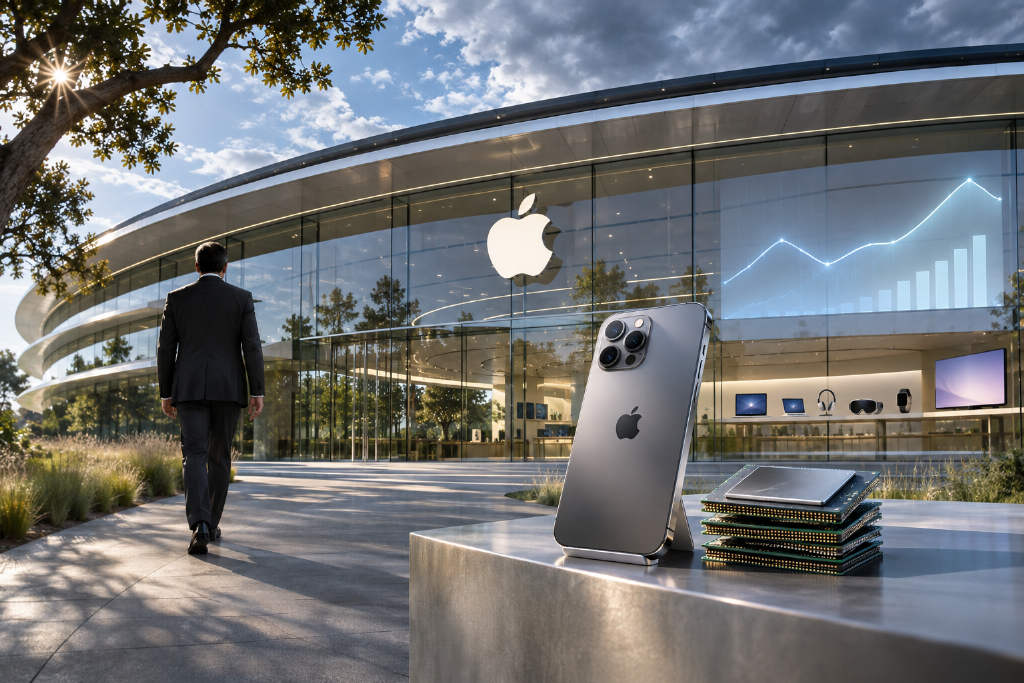
Apple has reclaimed the title of the world’s most valuable company at a time when other Silicon Valley giants are ramping up AI capital spending. Its more restrained approach to capex, paired with strong cash generation, helped push its market value back to No. 1 globally and briefly above $5 trillion. That position is now facing a sharper test.
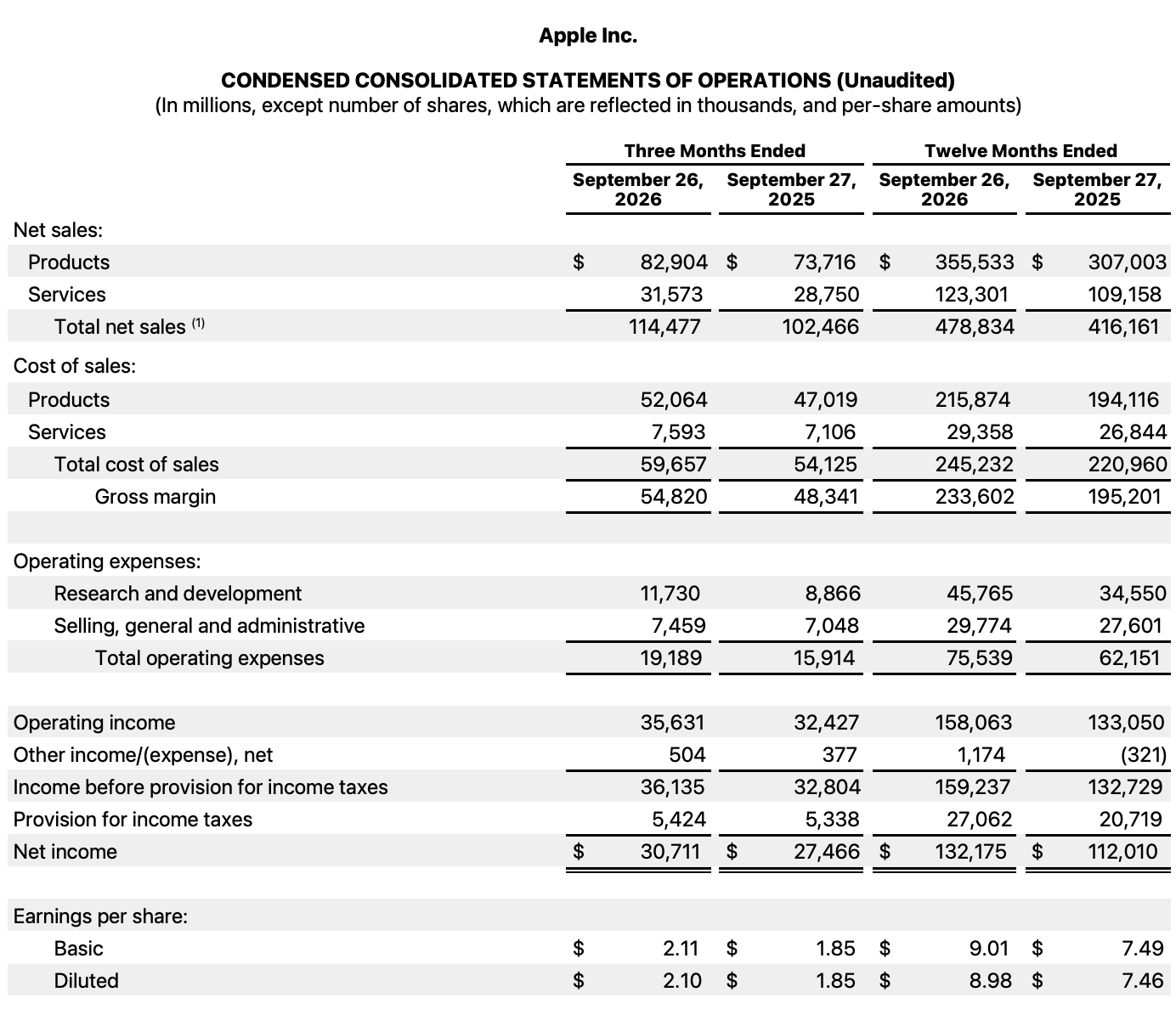
After the U.S. market closed on Nov. 3 Beijing time, Apple released results for fiscal 2026 fourth quarter and full year. The report was the first under John Ternus, who succeeded Tim Cook as chief executive in September 2026. Revenue and net income both beat Wall Street expectations, yet the stock reversed in after-hours trading after briefly rising 0.4%, at one point falling more than 4%. As of 9:30 a.m. Beijing time on Nov. 3, Apple shares were indicated at $328.81, down 2.81% after hours.
From the late-June low, Apple’s stock had gained 25% over the past four months, adding about $1 trillion in market value. But at roughly 36 times forward earnings, a level the article says sits in the 99th percentile of Apple’s own history and about double the S&P 500, the room for disappointment has narrowed.
Free cash flow remains the foundation of Apple’s valuation
On headline numbers, Apple closed fiscal 2026 with a strong set of results. For the quarter ended Sept. 26, 2026, revenue came in at $114.477 billion, up 11.72% from a year earlier. That topped the $113.47 billion Wall Street expectation and exceeded the upper end of the company’s own 9% to 11% growth guidance.
Quarterly net income was $30.711 billion, up 11.81% year over year. Diluted earnings per share reached $2.10, up 13.51% and above the $2.00 consensus estimate.
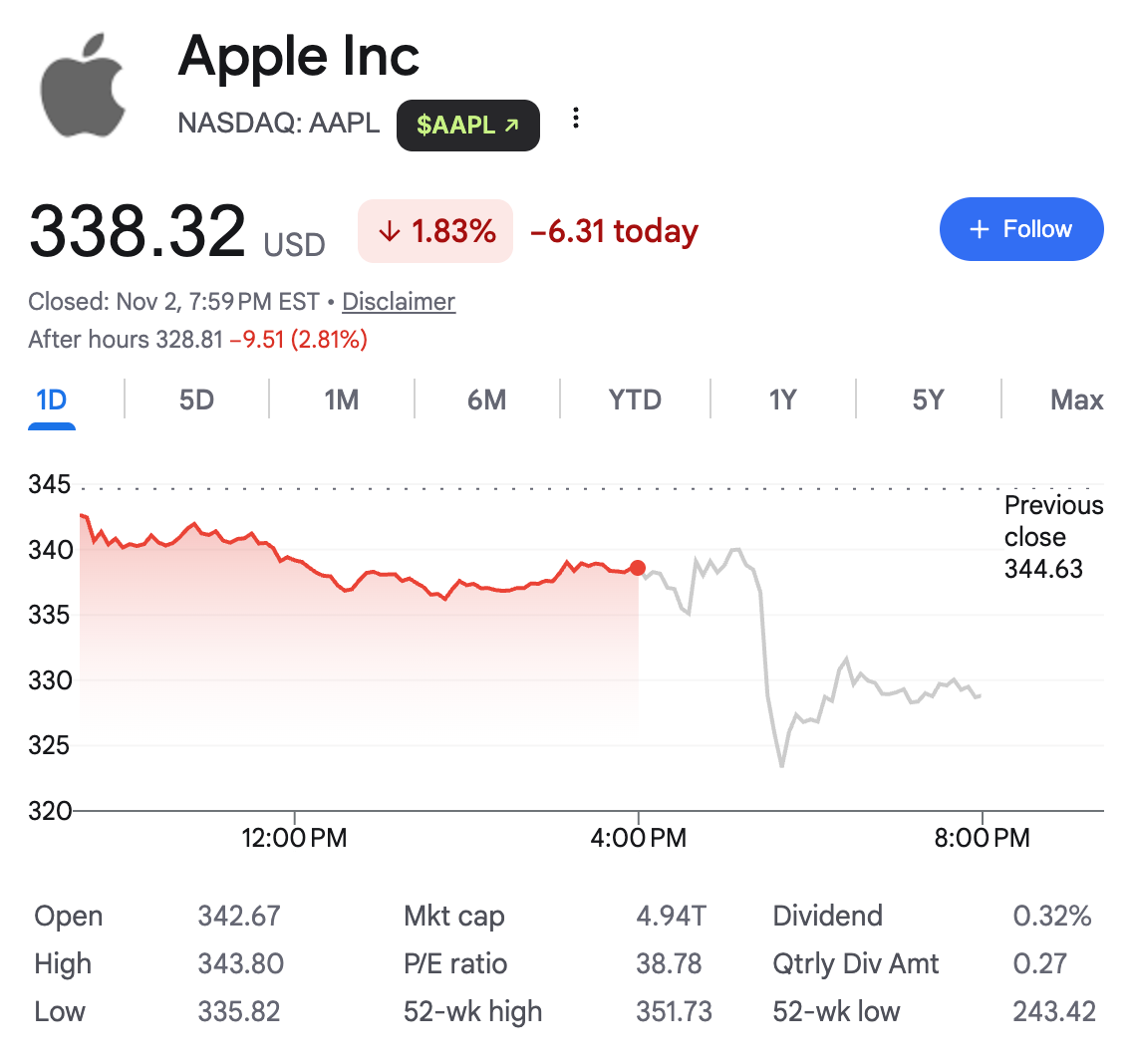
For the full fiscal year, Apple posted record revenue of $478.834 billion, up 15.06%, its best annual sales growth since 2021. Net income for the year rose 18.00% to $132.175 billion.
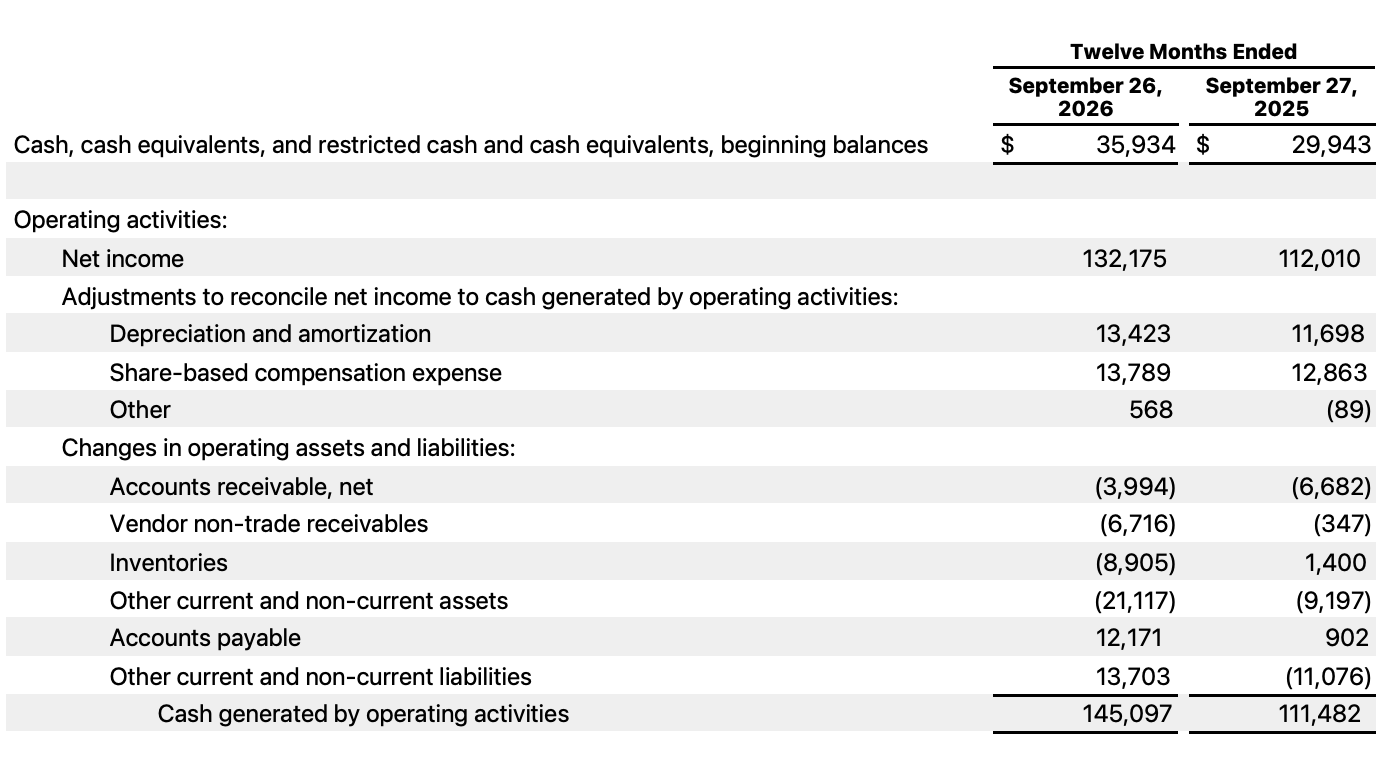
Cash flow remains the central reason Apple has been able to overtake Nvidia and return to the top of the market-cap rankings. Cash generated from operating activities reached $145.097 billion in fiscal 2026, up 30.15% from the prior year. At the same time, Apple did not follow the path taken by Google, Meta, and Amazon in sharply expanding capital spending. Its annual capex fell to $9.041 billion from $12.715 billion in fiscal 2025, a decline of nearly 29%.
That combination of high revenue conversion and relatively light capex produced $136.056 billion in free cash flow for fiscal 2026, up nearly 38%. It also supported $86.390 billion in share repurchases and $15.721 billion in dividend payments during the year.
iPhone and Mac drove growth while other hardware lines weakened
Under the surface, Apple’s hardware business showed a split picture in the fourth quarter, with iPhone and Mac carrying growth.
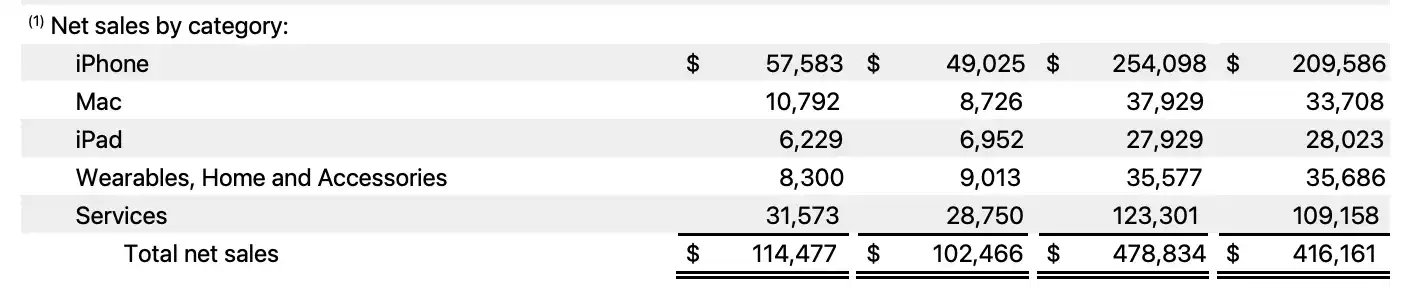
iPhone revenue rose 17.46% year over year to $57.583 billion, a record for a September quarter and above the $56.49 billion market expectation. Mac revenue climbed 23.68% to $10.792 billion, well ahead of the $9.7 billion expected by Wall Street.
The quarter did not fully capture the latest product cycle. The iPhone 18 Pro lineup was not released until Sept. 18, leaving only about nine days before the quarter ended. Apple also unveiled the iPhone Duo in September, but the device did not go on sale until Oct. 23, after the reporting cutoff, so it made no contribution to fourth-quarter revenue. Its commercial performance will show up in the next quarter instead.
According to the article, the iPhone Duo has been met with strong market interest after launch, though some early users reported screen breakage and display issues. Ternus said on the earnings call that the model is in a “supply-constrained state,” adding that only a “very small proportion” of devices had been returned or exchanged because of defects. Even so, production ramp and yield remain key issues heading into the holiday season.
Other product categories were weaker. iPad revenue fell 10.40% to $6.229 billion in the quarter. Wearables, home and accessories, including Apple Watch and AirPods, declined 7.91% to $8.300 billion. Both came in below market expectations.
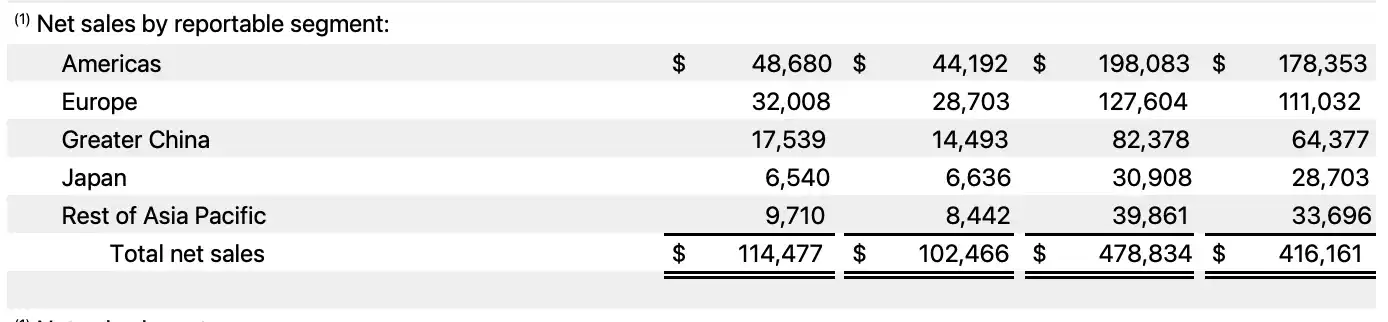
By geography, Greater China revenue was $17.539 billion in the fourth quarter, up 21.02% from a year earlier. But it fell 6.8% from the prior quarter’s $18.82 billion and missed the $18.75 billion Wall Street estimate by nearly 6.5%. At a 36x earnings multiple, even a modest shortfall in a major market can become a trigger for profit-taking.
After-hours selling centered on margin pressure and slower services growth
The after-hours decline was less about the quarter that Apple had just reported and more about the warnings management delivered on the earnings call.
The first issue was the effect of rising memory chip prices on margins. Apple’s fourth-quarter gross margin was 47.89%, with gross profit of $54.820 billion, slightly above 47.18% a year earlier. But that figure included about 1 percentage point of tariff refund benefit. Excluding that item, the operating picture was less strong than the headline suggested.
Chief Financial Officer Kevan Parekh said on the call that Apple’s stockpile of lower-cost components is being depleted quickly, forcing the company to buy memory chips at higher prices. The balance sheet already shows signs of that pressure. Inventories stood at $14.541 billion at the end of the fourth quarter, up 154.30% from $5.718 billion a year earlier. The article says that, beyond stocking up for the holiday season and a dense product slate, the addition of higher-cost memory chips lifted the inventory value. Those costs are expected to flow into cost of sales in the December quarter and squeeze profit margins.
Parekh warned that higher memory costs and the expense of rolling out Siri AI would push gross margin in the coming holiday quarter, Apple’s fiscal 2027 first quarter, down to 45% to 46%. That is 2 to 3 percentage points below the just-reported quarter and below Wall Street expectations.
The second issue was slower growth in services, one of the main pillars of Apple’s valuation. Services gross margin reached 75.95% in the fourth quarter, more than double the 37.20% margin in hardware. Even so, services revenue, while a record $31.573 billion, grew 9.82% year over year, slightly below expectations and below the 10% mark for the first time in more than three years.
Management said services growth would slow again next quarter to 8% to 9%, below the 10.7% expected by the market.
The article argues that the slowdown is not just a short-term fluctuation. Global antitrust scrutiny is continuing to weaken Apple’s ability to collect high App Store commissions. At the same time, AI-era super apps are trying to bypass Apple’s payment rails. It notes that after a dispute with Apple over trade secrets, OpenAI, whose ChatGPT app had generated meaningful in-app purchase revenue, has started directing subscribers to pay on the web instead.
The first real test of the Ternus era
Apple is also spending more on product development. Research and development expense rose 32.30% in the fourth quarter to $11.730 billion, showing heavier investment in foldable devices, touch-enabled Mac products, a smart home hub, and Siri AI.
Still, the newly launched Siri AI has not eased outside concerns. Based on the earnings call, the cost of bringing Siri AI online is already weighing on holiday-quarter margin guidance, while the product experience itself remains under scrutiny.
Over the past four months, Apple benefited from a market view that its refusal to fully join the AI spending race, combined with abundant free cash flow, made it a relative safe haven in a volatile period for large-cap tech. This earnings report, though, showed the limits of that narrative. Apple still faces cost pressure from the memory cycle upstream, and its high-margin services model is being challenged by both regulation and changes in how AI products reach users.
For Ternus, a $5 trillion valuation is not a victory lap. The next question is whether Apple can justify that premium with stronger hardware innovation and a better AI experience, rather than relying mainly on supply-chain discipline and financial returns.