


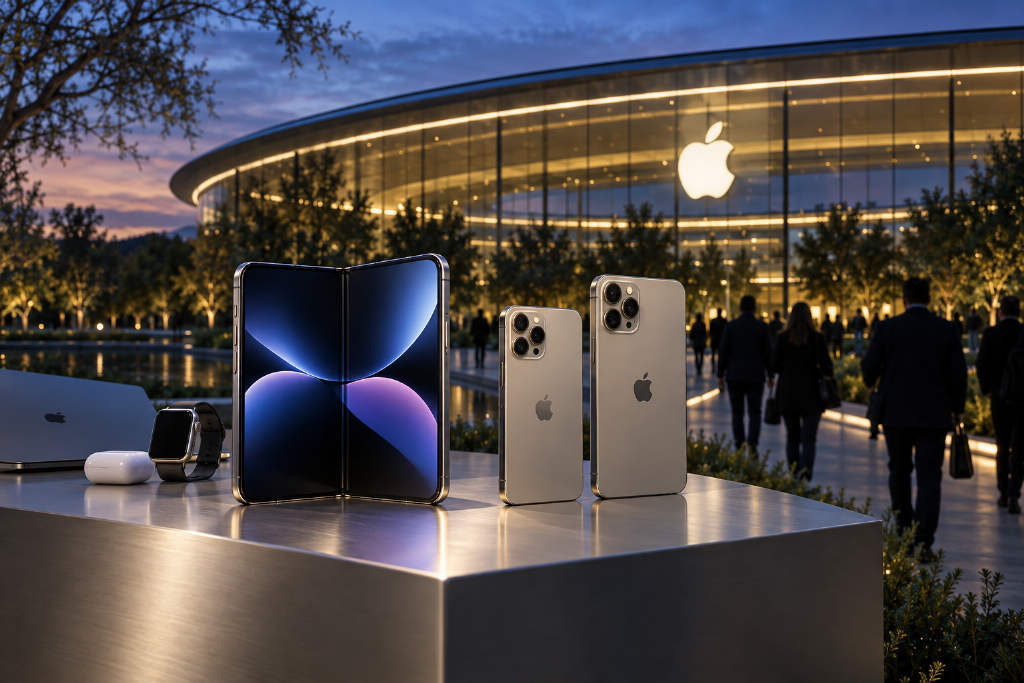
Apple’s first foldable iPhone has become the main focus of a new market note from MSX, which said the device could matter more for pricing power and ecosystem expansion than for raw shipment volume.

In its latest daily U.S. equities and RWA market commentary, MSX said Apple officially entered the foldable era on Sept. 9, when newly appointed CEO John Ternus hosted his first fall launch event and unveiled the iPhone Duo at $1,999. Apple also introduced the iPhone 18 Pro and iPhone 18 Pro Max, with starting prices raised to $1,199 and $1,299.
MSX said the bigger takeaway from the event was Apple’s effort to reset the upper bound of iPhone pricing. With the global smartphone market already mature and the iPhone still contributing nearly half of the company’s revenue, a foldable model offers Apple a way to keep growing revenue through higher average selling prices and a richer premium mix rather than through a major jump in unit shipments.
Launch details and pricing
According to the MSX note, Ternus presided over Apple’s annual iPhone launch for the first time since becoming CEO. The iPhone 18 Pro and Pro Max both start at 256GB, with pre-orders opening on Sept. 12 and retail availability beginning on Sept. 18.
The iPhone Duo is priced at $1,999 and uses a book-style folding design with an inner display of about 7.6 inches. MSX described it as the highest-priced iPhone Apple has released so far.
Historical stock pattern around iPhone launches
MSX said Apple’s launch day has not historically been a reliable catalyst for the stock. Looking at 16 major iPhone launch events, Apple shares rose five times and fell 11 times on the day, for an average return of about -0.7%.
The picture looked different over a longer window. In the 60 trading days after those launches, Apple shares rose 12 times, with an average return of about 4.2%.
The strongest 60-day performance in the data set came during the iPhone 11 cycle, when the stock gained 21.51%. The weakest came during the iPhone XR/XS cycle, when the stock fell 21.68%.
On the day of the latest event, Apple closed at about $313.55, down about 0.84%. MSX said that result remained in line with the historical pattern of softer share-price action on major product launch days. The firm added that launch day mainly reflects expectations being priced in, while the next two quarters are where investors tend to test actual sales, average selling prices, gross margin, and the replacement cycle.
Duo as an ASP driver, not just a new category
MSX said Apple remains highly dependent on the iPhone. In the latest quarter, iPhone revenue reached $54.252 billion, up 22% year over year and setting a June-quarter record. That business accounted for about 49.6% of Apple’s total revenue, with growth led mainly by Pro models.
Against that backdrop, MSX argued that the foldable launch should not be viewed simply as an added product line. The report said Apple’s central issue in recent years has not been user churn, but the fact that smartphones have become more durable and replacement cycles have grown longer. Standard upgrades in chips, cameras, and battery life can help retain users, but they do less to create a fresh reason to upgrade. A foldable design, by contrast, gives Apple a visible change in form factor.
The $1,999 price tag, in MSX’s view, shows that Apple is not trying to make Duo a mass-market product at this stage. The first generation is described as a test of ultra-premium demand: limited volumes can help Apple evaluate the foldable format, supply-chain yield, and developer adaptation while also lifting the top end of iPhone pricing. MSX said Duo could still improve Apple’s average selling price and product mix even if it remains a small share of iPhone shipments, as long as it attracts users who might otherwise have bought a Pro Max, an iPad mini, or even a thin-and-light notebook.
High price does not automatically mean high profit
MSX also warned against assuming that a more expensive phone will directly translate into stronger margins. Foldable displays, hinges, dual batteries, and added thermal structures raise bill-of-materials and after-sales costs, while first-generation yield rates often trail those of mature products.
The report said Apple’s latest hardware gross margin stood at 40.1%, well below the 75.6% gross margin for services. On that basis, MSX argued that if Duo only sells at a higher price without reaching healthy yields and scale effects, its impact on overall profitability may be less significant than its revenue contribution suggests. The note also said deliveries start only in late October, which means the device’s contribution to the current quarter may be limited.
MSX links the foldable strategy with Apple’s AI and services model
MSX said Duo should be read in the context of Apple’s broader business model, not just as a standalone hardware launch.
As the smartphone market matures, the report said routine improvements in chips, cameras, and battery life have become less effective in pulling users into earlier upgrades. Foldables offer a more direct buying case: closed, the device is still a phone; opened, it comes closer to a small tablet. Multi-window support, Apple Pencil, and half-folded use cases also push the iPhone more clearly into work, creative tasks, and large-screen content consumption.
MSX also tied the hardware shift to Apple’s AI push. In the firm’s framing, Apple is trying to use AI to optimize the user experience across scenarios. If a new Siri can understand personal information and on-screen content, if Apple Watch can organize daily information, and if AirPods can provide real-time translation, then AI stops being an isolated feature inside one device and becomes a unified entry point across the phone, watch, and earbuds. Users may switch from one device to another, but their information, tasks, and services can continue to move with them. MSX said that continuity is where Apple has an advantage over a single AI application.
From a commercial standpoint, the report said the two tracks support each other. Duo and the Pro line help lift hardware pricing, while AI can increase how often people use those devices and feed demand for iCloud, the App Store, AppleCare, and other subscription services. With hardware gross margin at 40.1% and services gross margin at 75.6%, MSX said Apple’s ideal outcome is not simply selling a more expensive Duo, but using a new form factor to trigger upgrades and then turning new users and added engagement into long-term services revenue.
Why the ecosystem angle matters
MSX said the longer-term value lies in the ecosystem. Apple already has more than 2.5 billion active devices, and each new iPhone can connect to downstream revenue streams including the App Store, iCloud, payments, advertising, and subscriptions.
The larger display, multitasking features, and Apple Pencil support in Duo create new use cases for office work, gaming, content consumption, and generative AI, the report said. If developers redesign apps for the format, the impact of Duo would go beyond a one-time hardware upgrade and could show up in more service usage time and higher value per user.
What MSX will watch next
MSX listed several markers for follow-up analysis:
- waiting times for the first deliveries;
- whether channel orders increase;
- whether Pro Max demand is materially diverted;
- whether Duo users add new services revenue.
The firm said selling at a higher price is only the first step. The bigger question is whether Apple can turn a niche, premium device into a fresh ecosystem gateway under Ternus.
IDC outlook: smartphone shipments fall, foldables still grow
Citing IDC estimates, MSX said global smartphone shipments are expected to fall 13.9% to 1.09 billion units in 2026, while the foldable segment is still projected to grow about 20%.
On that basis, the report said Duo’s significance lies more in Apple’s entry into a still-growing ultra-premium niche than in changing the shipment trend for the broader smartphone market.
About MSX
The article said MSX is an RWA trading platform offering spot and derivatives trading in nearly 400 tokenized stocks and Pre-IPO assets. It also said the platform covers U.S. stock spot trading, perpetual contracts, crypto-to-crypto trading, Pre-IPO products, and research services.
The original piece included a risk statement saying that macroeconomic and U.S. equity market volatility can be significant and that the content is for research and observation only, not investment advice.