
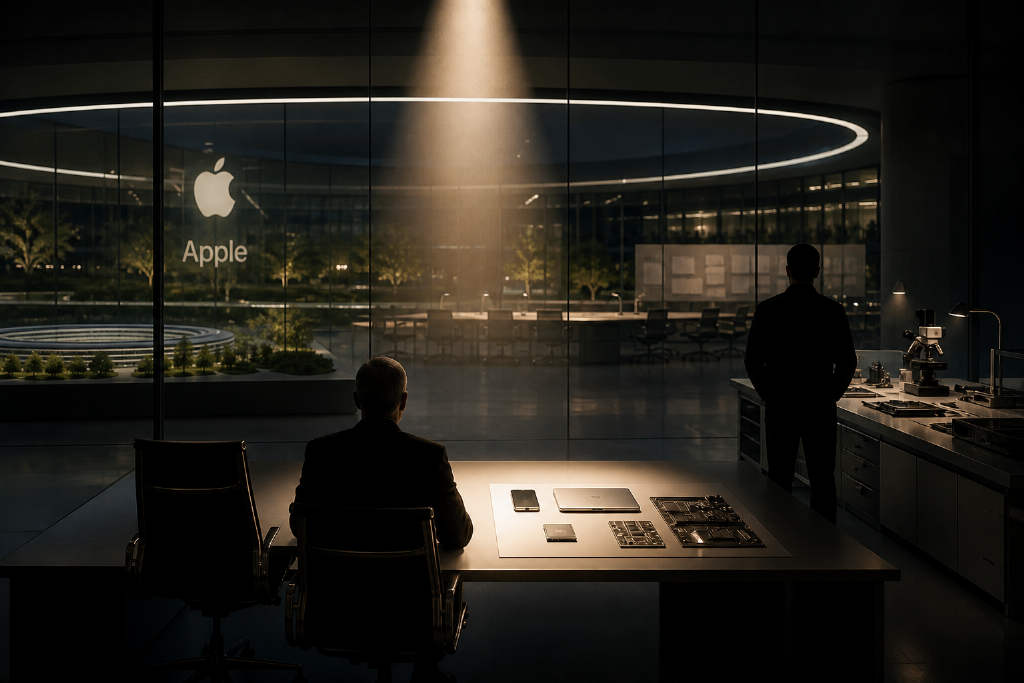
Apple is reshaping its top management team. Tim Cook, who has led the company for 15 years, will become executive chair of the board, while Senior Vice President of Hardware Engineering John Ternus, a 25-year Apple veteran, will take over as chief executive officer. ABMedia, citing CNBC analysis, said the new setup signals a shift in Apple’s operating strategy, moving away from the Cook era’s heavier emphasis on China and overseas supply chains and back toward the product design and hardware innovation focus associated with the Steve Jobs period.
Ternus steps in after 25 years at Apple
Ternus has spent 25 years at Apple and has long run the company’s hardware engineering organization. The report says he is widely seen as a "Product Guy," with a career centered on hardware and chip integration. He previously led development work tied to the MacBook Neo, iMac Pro, and Mac Pro.
ABMedia said market expectations now center on a renewed push in hardware research and development under Ternus. That includes efforts to break through current product growth constraints with new device formats such as a foldable iPhone, next-generation wearables, and robots.
Cook moves to chair role as responsibilities split
Under the new arrangement, Ternus will focus on Apple’s product roadmap, artificial intelligence integration, and hardware innovation. Cook, after leaving the CEO post, will shift to the chair role and remain focused on diplomacy, administration, and international supply-chain matters.
Apple’s AI plan centers on integrating outside models into its hardware ecosystem
In generative AI, Apple is facing pressure from OpenAI, Google, and Anthropic. The report says the company’s current approach is to commercialize large language models by integrating more mature outside AI technologies into its broad hardware ecosystem. Apple is also trying to lean on the memory and computing advantages of on-device execution powered by Apple Silicon to show performance strengths on the hardware side.
A rebuilt version of Siri based on foundation models including Gemini is described as a core part of Apple’s AI transition. Even so, Siri’s own security protections and monitoring remain under scrutiny.
Europe and China present different hurdles for Apple Intelligence and Siri
Ternus will also inherit the company’s unresolved challenges in rolling out Apple Intelligence and Siri across Europe and China.
In the European Union, the report says Apple is stuck because of regulatory restrictions and the lack of large technology partners. Apple has not made concessions in Europe, and the new AI features have therefore not been rolled out in full across the region.
In China, Apple has chosen to align itself with regulatory demands. It has promised to open Siri and integrate local large language models from Alibaba and Baidu. Although the related services have already received regulatory approval, deployment is still moving slowly.
Key pressure points in Europe
- The report describes the EU’s stance blocking Siri in the region as a particularly difficult issue for Apple.
- Europe lacks local AI model partners, making it hard for Apple to find counterparties that could ease the deadlock.
- Apple has made concessions in China, but not in Europe.
Localization pressure in China
- To secure approval for Apple Intelligence and Siri, Apple committed to opening Siri and integrating Chinese models from Alibaba and Baidu.
- That means Apple cannot maintain a fully closed, self-built AI ecosystem in the China market.
- China remains one of Apple’s most important markets. The company’s AI services have only recently received local clearance, and the broader rollout is still slow.
Siri usability remains a major test for Ternus
The report says Siri is under serious pressure not only in Europe and China, but in other markets as well. For years, users have broadly criticized Siri as not useful enough, not smart enough, and unable to connect with personal data in a meaningful way.
Ternus will need to show at Apple’s September hardware event and accompanying software updates that the rebuilt Siri, based on foundation models including Gemini, has improved substantially, avoids the weak responses that have drawn criticism, and can deliver practical value comparable with rivals such as Claude.
September event and the next hardware roadmap
Even with a strong hardware background, Ternus still faces slower growth in Apple’s online services division and changes in App Store operating strategy. The report says Apple’s services business generates annual revenue of nearly $100 billion, but the company still needs to update its monetization model, especially paid offerings such as tiered cloud services and iCloud+ subscriptions, to deal with rising operating costs linked to AI.
Apple is set to hold an event called "Surprise and Shine" on Sept. 9 this year. The expected lineup includes the iPhone 18 Pro series, Apple’s first foldable iPhone, Apple Watch Series 12, Apple Watch Ultra 4, and a new version of AirPods equipped with an infrared camera.
The follow-up roadmap includes an OLED iPad Mini and a MacBook Pro powered by the M6 chip. With Ternus taking the helm, Apple is showing a broader plan for a new round of hardware upgrades.