
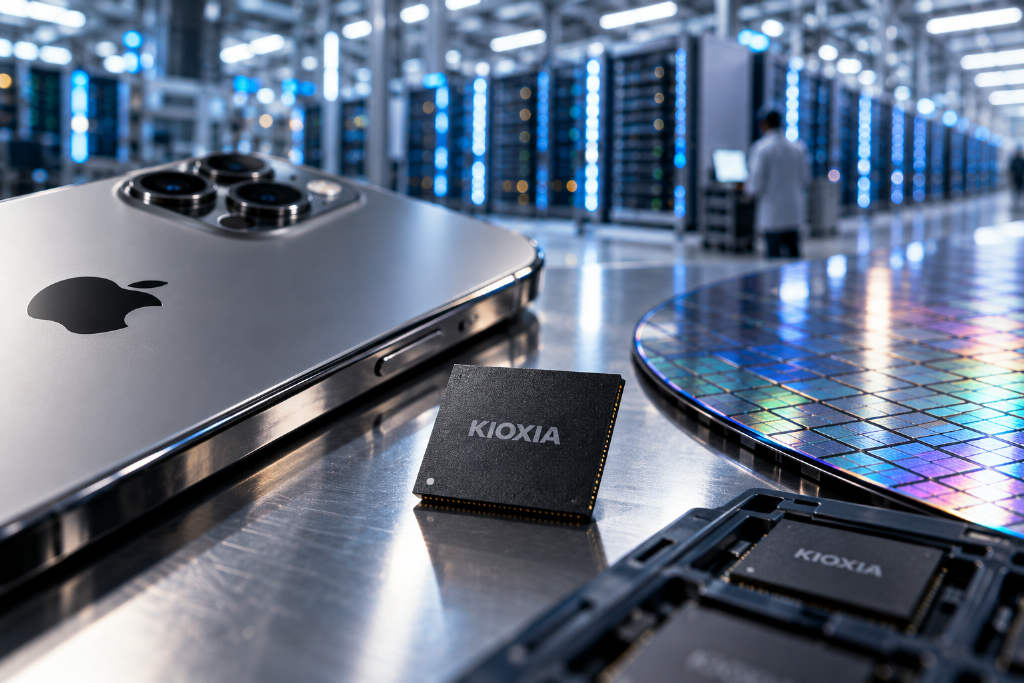
For years, memory suppliers mostly associated Apple with one thing: price pressure. That balance has now shifted. A wave of AI data center buying has pushed NAND Flash prices up roughly fivefold in a year, giving suppliers such as Kioxia leverage they had long lacked in talks with major customers.
ABMedia, citing The Wall Street Journal, reported that Apple is expected to spend $25 billion on NAND Flash this year. The same volume cost the company $6 billion in 2025. The increase has become large enough that Apple has had to pass part of the cost through to iPhone pricing.
Hyperscalers have overtaken Apple in flash buying
The key change is on the demand side. TechInsights estimates that two years ago, Apple bought nearly twice as much flash capacity as Microsoft, Amazon, Meta and Google combined. Now those hyperscale cloud operators are purchasing twice as much as Apple.
Pricing tells the same story. Flash prices fell from $68 per GB in 2005 to about $0.05 in 2023. They have since climbed to more than $0.30 per GB under AI-driven demand, a rise of about 550%. According to the report, cloud operators can absorb that increase more easily because flash accounts for a smaller share of data center build costs than it does in an iPhone, and accounting rules let them spread those costs over multiple years.
Suppliers move from being squeezed to holding the upper hand
The report said Apple previously used its scale to force suppliers to open their books and prove that no other customer was getting a lower price. Kioxia executive Scott Nelson described how bitter that relationship could become. He said that during a ride in the desert, he once shot an old iPod with a rifle out of frustration, and that the remains now sit on his desk.
That backdrop has changed. Meta, Microsoft and Amazon have all signed long-term agreements with Kioxia this year, committing to higher prices in exchange for stable supply. Those contracts also help protect supplier profitability if market conditions reverse. A few months ago, former Apple chief executive Tim Cook compared the memory price surge to a 「once-in-a-century flood」.
Apple’s storage upgrade margins are narrowing
The report said Apple has long relied on storage upgrades to generate high margins. Extra storage on iPhones and iPads carries an average gross margin of more than 80%. Using the iPhone 17 Pro as an example, the price to move to double the storage is $200. Apple’s added cost used to be about $15. It has now risen to $66.
The pressure is also showing up in retail pricing. According to the report, Apple has raised prices on almost all of its products in recent months. Average iPhone prices are up 13%, and even older models that would usually get cheaper have also been marked higher. TrendForce previously estimated that memory costs in the iPhone 18 Pro 256GB were nearly four times higher than a year earlier, lifting memory’s share of the bill of materials from about 10% to 34%.
After Apple’s Sept. 9 fall product launch, the starting price of the iPhone 18 Pro in China rose by RMB 1,000 from the previous generation to RMB 9,999. Apple said the increase was due to higher memory chip prices.
Pressure is spreading to Android vendors
ABMedia also referred to an earlier Chain News report saying Apple had accepted Samsung’s smartphone memory pricing for the first quarter of 2027, with increases of 30% to 40%. That has reduced the room Android vendors have in their own negotiations. OPPO and vivo had rejected Samsung’s third-quarter quotes, but that did not change the supplier’s stance. Xiaomi and OPPO were also reported to be cutting their 2026 shipment targets.
Supply remains tight. TrendForce data shows that DRAM and HBM capacity at Samsung, SK Hynix and Micron is almost fully locked in. NAND allocations from suppliers are only meeting 60% to 70% of customer demand. The firm expects memory demand to grow 36.2% in 2027, while supply rises 19.3%. The supply-demand gap is projected to widen from -8.1% in 2026 to -13.6%, with tight conditions potentially lasting into the first half of 2028.
Apple now faces two questions
For Apple, the issue comes down to two points raised in the report: whether consumers will extend replacement cycles as prices rise, and how long suppliers can keep their pricing leverage.
Bernstein analyst Mark Newman described Apple’s relationship with the flash industry as one of 「love and hate」. Years of aggressive pricing helped Apple shareholders, but left suppliers resentful. In a market defined by shortage, control has shifted, at least for now, to the supply side.



