
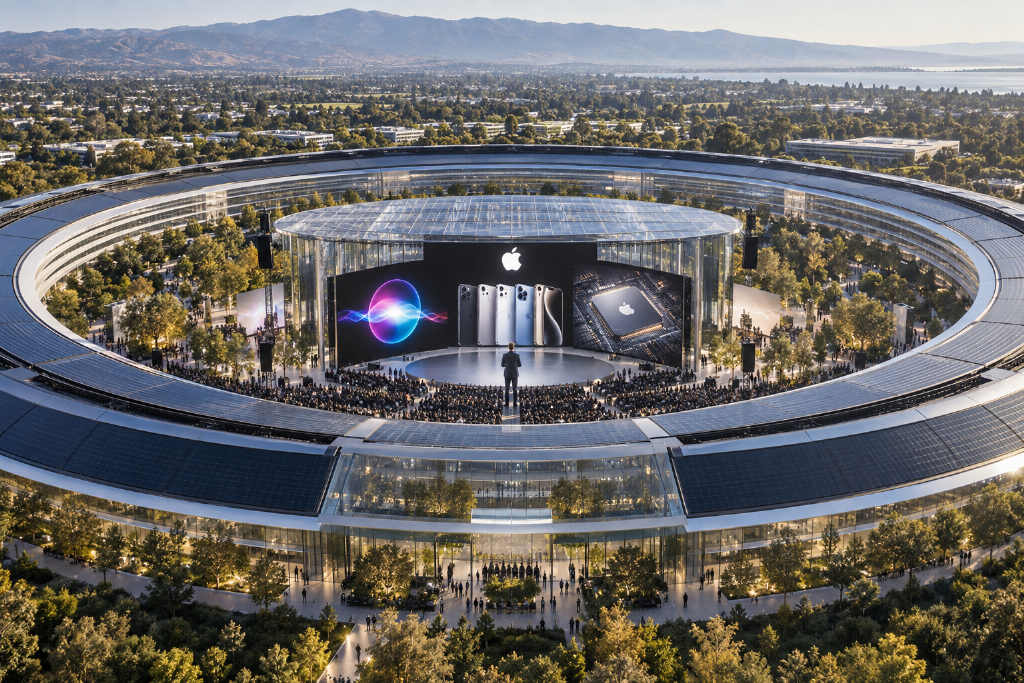
Apple on Wednesday introduced a rebuilt Siri AI assistant, its first 2-nanometer A20 Pro chip, and the iPhone 18 lineup at the "Surprise and Shine" event, the first keynote led by new CEO John Ternus.
Ternus took over as Apple chief executive on September 1. Tim Cook moved to executive chairman after 15 years running the company.
Ternus opens his first Apple keynote
The event came eight days into Ternus' tenure as CEO. On stage, he introduced a redesigned Siri and framed the presentation around what he called an "ideal" personal device, one that is "always with you, deeply personal, and able to bring intelligence to the moments when it matters most," before moving into the iPhone 18 lineup.
Referring to the A20 Pro, Ternus said, "This is the fastest chip ever put into an iPhone."
Siri AI enters beta this month
Siri AI is Apple’s largest overhaul of the assistant since Siri launched in 2011. The new version can hold conversations, understand what is on the screen, and take actions across more than 300,000 third-party apps without requiring users to restate context.
Apple first showed the assistant at WWDC in June, when it said Siri AI would run on a hybrid architecture that combines on-device models with Private Cloud Compute for heavier requests. The company did not ship those promised features until this announcement.
Apple said the new Siri AI will begin rolling out in beta starting this month on devices configured for a supported region.
The updated assistant also adds agentic features and a more fluid voice, moving away from the robotic delivery long associated with Siri since launch.
A20 Pro is Apple’s first 2-nanometer chip
The A20 Pro is Apple’s first chip built on Taiwan Semiconductor Manufacturing Co.'s 2-nanometer N2 process. Apple described it as the first smartphone chip to ship on that node. By using smaller transistors, Apple can fit more processing power into the same die area without taking on a larger thermal or battery penalty.
Apple said the chip uses a six-core CPU, split between two high-performance "super cores" and four efficiency cores, and delivers up to 20% faster performance than the A19 Pro. The seven-core GPU, up from six cores last year, is up to 40% faster. Memory bandwidth rises 50%, a key metric for on-device AI because bandwidth often becomes the bottleneck when language models run locally instead of in the cloud.
The biggest AI-related hardware change is the Neural Engine. Apple doubled it from 16 cores, a count it had kept across three chip generations, to a dual 32-core design. The company is also adding a new vapor chamber cooling system with three times the surface area of the previous design, which is meant to keep the chip running heavier AI workloads, including the on-device portion of Siri AI, without throttling.
iPhone 18 Pro, Pro Max, and the iPhone Duo foldable
The iPhone 18 Pro keeps a 6.3-inch display, while the Pro Max remains at 6.9 inches. Apple made few changes to the overall sizing compared with the iPhone 17 Pro generation, but added new finishes in Black, Silver, Glacier, and Burgundy, along with a smaller Dynamic Island.
Apple’s first foldable phone, the iPhone Duo, features a 5.5-inch cover display and a 7.8-inch inner screen that opens like a small tablet. Pricing starts at $1,999 for the 256GB version and rises to roughly $3,000 for the 2TB model. The device comes in dark blue and white and becomes the first iPhone with Apple Pencil support.
The foldable model uses Touch ID rather than Face ID. It will reach stores in October, one month later than the rest of the lineup.
iOS 27 release date and device support
Apple said iOS 27 will arrive on September 14, bringing the new Siri AI and the broader Apple Intelligence package. The operating system will run on devices going back to the iPhone 11 and the second-generation iPhone SE, but Siri AI and Apple Intelligence features will be limited to the iPhone 15 Pro and newer models.