
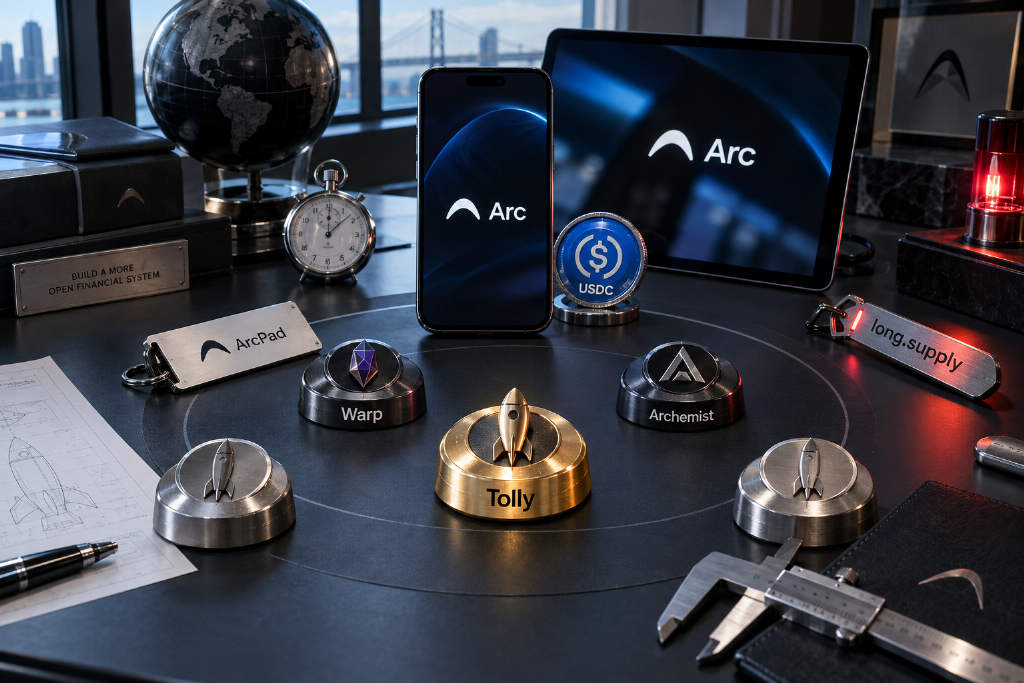
Arc’s public mainnet is set to open on Sept. 16, but the fight over launchpads is already underway. The success of Robinhood, the flywheel built by PONS, and Arc’s use of USDC as native gas, sub-second confirmation times, and institutional backing have pushed traders to focus on one question: which platform could become the next PONS.
Odaily published a roundup of the main launchpad projects now competing on Arc. It also noted that one Arc launchpad promoted earlier in the day by Bonkguy, whose X handle is @theunipcs, was being described as a scam project.
Tolly: the strongest platform so far in real trading activity
Tolly, operated under @TollyLabs, lists its official portal at https://tollylabs.com/tokens. Odaily describes it as a high-speed DEX launchpad that skips the usual bonding curve design and instead injects the full token supply directly into a permanently locked USDC pool.
The mechanism has two main parts. First, there is no graduation process and no migration. A token’s full supply is placed into the pool in the first block and trading opens immediately. Second, the fee structure is about 1%. On buys settled in USDC, about 64% goes to creators, 12% goes to holder rewards, 10% goes to the protocol, and the remainder is used to buy back and burn $TOLLY and the project token. On sells, which are settled in the project token, the entire amount is burned.
Odaily said Tolly is one of the few open-source launchpads on Arc and the closest product so far to an “Arc version of Pumps / PONS.” Community tallies cited in the article put cumulative turnover at about $1.8 million, making it the biggest channel for what the report called genuine launch buying flow on the chain. Its platform token, $TOLLY, at one point reached a market capitalization of $2.47 million.
The report also pointed to unresolved risks. A holder reward pool that had once accumulated about $1,252 has not yet fully enabled claiming, and although the contracts are open source, users still need to verify whether the locker has fully renounced owner permissions. Odaily gave it a five-star “golden dog index.”
Warp: a bonding curve model that is already live
Warp, under @circlewarp, uses the classic Pump.fun-style bonding curve structure and directs users to https://circlewarp.fun. Its pitch centers on tapping Circle CCTP so that users can buy into launches with cross-chain USDC in one step.
According to the article, Warp runs a USDC-denominated bonding curve. When a token reaches roughly $69,000 in market capitalization, it automatically migrates to WarpDex and the LP is burned. The platform also markets the expected use of Circle’s Cross-Chain Transfer Protocol, claiming support for one-click purchases with USDC bridged from other chains.
Odaily said the front end is polished and includes a terminal that scans tokens across the chain. It put cumulative turnover at about $1.5 million across roughly 172 launches. Even so, the report said the data shows heavy internal circularity: only one token graduated successfully over a six-week period, and about 84% of volume came from Warp’s own platform token, $WARP, which it said had a market capitalization of about $870,000.
The article identified two main risks. The graduation threshold is still high for most meme tokens in the current cold-start phase, and the source-chain helper contract had not previously been fully opened, which means the advertised “one-click cross-chain buy” remains more of a marketing expectation than a fully delivered feature. Odaily assigned Warp a four-star score.
Archemist: token launches through an X bot
Archemist, using the handle @Archemistdotfun, operates at https://archemist.fun and is framed as a lightweight social launchpad. Users can issue a token and spread it by tagging a bot in a post on X.
The platform offers more than one version. Its V2 setup sends tokens directly through a locked-liquidity Uniswap V3 structure. It also has a V4 Hook version that includes anti-sniping features, atomic creator co-buys, buy-side buybacks of $ARCH, and holder distributions funded by sells. Creator revenue share can be configured as high as 80%.
Odaily said Archemist lowers the barrier to launch more than most rivals and makes it easier for a narrative to spread on X and other social channels. The article put cumulative turnover at about $337,000 across roughly 49 tokens. Still, it noted a familiar weakness: about 77% of the volume depended heavily on activity in the platform’s own token.
The report added that competition among platform tokens has become intense, and some pages showed a maintenance lock state shortly before the mainnet upgrade. In Odaily’s view, the real test will come after mainnet goes live. It gave Archemist a three-star score.
ArcPad: direct issuance through Uniswap V3
ArcPad, under @arcpad_meme, points users to https://arcpad.meme. It takes a no-internal-market, zero-threshold approach and turns the full token supply into an ultra-wide, one-sided Uniswap V3 position.
Odaily said the entire supply is permanently locked into a Fee Locker, with no owner, mint or pause privileges. The price range stretches from a $3,000 fully diluted valuation to nearly $950 million FDV, a design the platform says is meant to let fees remain active across the full life cycle of a token. Trading fees are set at 1%, split evenly between the protocol and the creator, although creators can choose to give their share to holders. A roughly 2% anti-sniping cap is set per address.
The article described the architecture as very clean and code-driven, with none of the friction tied to graduation or migration. It also said community members have pointed out a strong resemblance to a PotatoPad fork on the Robinhood chain. But traction has been weak. Odaily said only 15 tokens had launched there, total turnover was still below $30,000, and protocol revenue was close to negligible.
Its concerns were centered on security depth and liquidity. The platform says it has undergone adversarial testing, but the article noted the absence of a professional audit from a top-tier security firm and said liquidity remains very thin. Odaily gave ArcPad three stars.
long.supply: stock wrappers, a custodial bridge and meme launches, with a high-risk warning
Odaily singled out long.supply, under @Longdotsupply, as a high-risk project. The platform packages Robinhood stock tokens onto Arc and then uses those U.S. equity-linked tokens as the quote assets for meme launches.
The article says the setup is straightforward in a troubling way: the team centrally custody assets on the Robinhood chain, mint matching IOU tokens on Arc, and let users use those IOUs as the liquidity pair for launchpad activity.
Odaily’s assessment was blunt. While the project leans on the narrative of launching memes against tokens tied to Nvidia or OpenAI and claims to have bridged in $2.1 million, the report said it is, in substance, a private fake bridge. It added that the backend is scheduled through a single Railway cloud service and that treasury control sits entirely with the team’s private keys.
The report listed three risk points. The team could shut down the bridge at any time and remove the real assets held on the Robinhood chain. The tokens circulating on Arc are only unofficial IOUs with no official redemption backing. And once compliant official assets go live on Arc’s public mainnet on Sept. 16, the narrative around these unofficial substitute tokens would come to an end. Odaily gave it a zero-star score and warned users not to deposit large sums.
Quick look at projects in preparation, on the long tail, or with very thin trading
Radar DEX (formerly ArcDEXScan)
Radar DEX, under @ArcDEXScan, is described as a combined market-viewing, aggregation, and Uniswap V3 locked-pool launch infrastructure product. Odaily said its token launch count appears inflated on paper, with substantial single-wallet wash activity. The project’s routing fee deductions have also drawn community criticism, making it more suitable for watching the market than for primary launch participation.
act.fun
act.fun, under @actfunxyz, is presented as a time-lock launchpad. Its rules force token launches to remain locked until 09:00 UTC on Sept. 16, when the mainnet node officially opens. Odaily said that while the project aligns itself with the timing of Arc’s public mainnet, on-chain code review shows the contract owner still retains emergency withdrawal privileges.
Minara.fun
Minara.fun, under @minarafun, is described as a platform rumored to have ties to Circle Ventures and built on Uniswap V4 architecture. The pitch is institution-grade, low-friction issuance, but Odaily noted that the rules allow creators to take as much as roughly 80% in opening allocations, a setup the article said requires caution over dumping risk.
UBI.fun
UBI.fun, under @UBIdotFUN, also uses a Uniswap V4 framework and adds a broad holder dividend mechanism. Odaily said on-chain launches and genuine turnover are both very low at this stage, and the holder reward pool is largely empty, with no real liquidity conditions formed yet.
ChainGPT Pad
ChainGPT Pad, under @ChainGPT_Pad, is positioned on the compliance side, with KYC review and allocation controls. Odaily described it as a more traditional institutional IDO platform aimed at early fundraising for serious technology and crypto projects rather than a venue for the fast retail meme-token speculation seen on instant launchpad markets.
ARCWAR
ARCWAR, under @Arcwargg, uses a competitive format where several tokens enter the arena together and weaker ones are eliminated, leaving the final winner to absorb the retained liquidity. Odaily said the mechanism is highly adversarial and unusual, but the learning curve is steep and it has not yet formed a mainstream following among launch traders.