
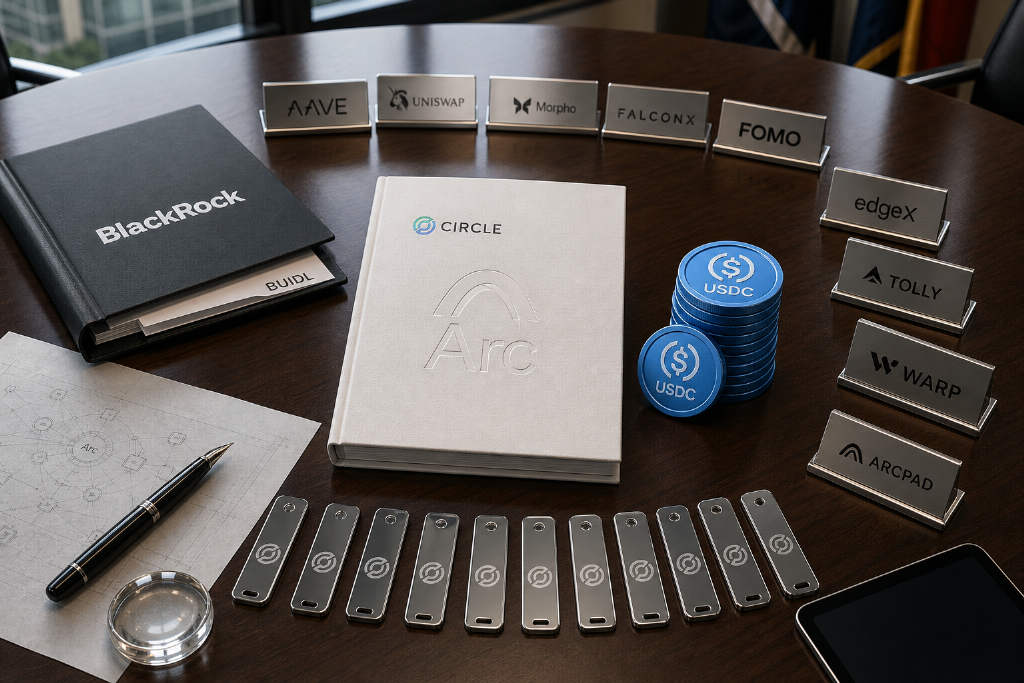
Robinhood Chain pushed daily DEX volume to $989 million within two months of launch. That result has raised expectations for the next institution-focused chain, and Circle’s Arc is about to test them when public mainnet access opens on Sept. 16.
Arc is a Layer 1 blockchain built around stablecoin finance. At launch, users will pay gas in USDC, transactions are designed to reach finality in one second, and the network will be maintained by a permissioned validator set.
Founding validators and institutional plans
On Aug. 5, Circle named 11 founding validators: BlackRock, DTCC, Galaxy, Global Payments, ICE, Mastercard, MoneyGram, SBI Group, Standard Chartered, Sumitomo Corporation and Visa.
Arc is still in its private mainnet stage, and Circle says more than 100 institutions and ecosystem teams are already building on the network.
BlackRock is expected to deploy its BlackRock USD Institutional Digital Liquidity Fund, or BUIDL, on Arc, giving institutional investors a native USDC environment for subscriptions, redemptions and capital deployment. Circle and DTCC plan to begin work in the second half of 2027 on tokenizing assets custodied by the U.S. Depository Trust Company, with the stated goal of letting market participants settle those tokenized assets in stablecoins through third-party applications on Arc. BNY and Standard Chartered are also exploring integrations tied to digital-asset custody, foreign exchange and repo infrastructure.
Testnet activity and a private-mainnet market are already in place
During the first 90 days after Arc’s public testnet went live, the network processed more than 150 million transactions, and about 1.5 million wallets initiated transactions. After the private mainnet launched in May, the network identified by chain ID 5042 began to attract community RPC endpoints, block explorers, trading venues and tokens.
Those tokens already have quoted prices and some liquidity, even though Circle still classifies the network as a private mainnet. Public network access is scheduled for Sept. 16, while the mainnet parameters for Circle’s official bridging tool have yet to be released.
Fomo and edgeX commit to day-one access
Se Yong Park, co-founder of Fomo, said on Aug. 30 that Fomo will offer trading support on Arc on the first day of launch. Fomo combines token discovery, social activity and cross-chain trading inside a single account. In April, the project said its mobile app had reached 500,000 registrations.
Fomo has not yet disclosed which Arc tokens it will support first, what trading routes it will use, or where liquidity will come from. The app already supports Solana, Robinhood Chain, BNB Chain, Base, Ethereum and Monad. Users can view other accounts’ trades, track profit and loss, and buy tokens across chains inside the app. Once Arc is connected, that front end could direct existing users straight to Arc asset pages, but whether users can trade without a separate bridge step on day one will depend on the routing and funding rails Fomo publishes later.
On Sept. 3, edgeX said it had become a day-one Arc partner. It plans to start with 24-hour USD/JPY FX perpetuals and offer more than 150 perpetual markets spanning U.S. equities, commodities and crypto assets, with margin, settlement and fees all denominated in native USDC. Circle Ventures has invested in edgeX, and the two sides had previously worked on native USDC and CCTP integration on EDGE Chain.
Launch-day stack is centered on USDC
Circle expects Arc’s public mainnet launch day to include Aave, Aerodrome, FalconX, Galaxy, GSR, Keyrock, Morpho, Nonco, Uniswap and XFX as DeFi protocols and capital service providers. Rain, Thunes and Wirex are set to handle stablecoin payment services. Binance Wallet, Chainlink, Fireblocks, Kraken, Ledger, MetaMask, Uniswap Labs and Upbit are listed as wallet, trading and infrastructure partners.
Aave Labs submitted a governance proposal in June to deploy Aave V4 on Arc, with USDC, EURC, WETH and cirBTC markets planned around the mainnet launch window. That deployment still needs to pass Aave governance.
Based on Circle’s lineup, Uniswap and Aerodrome would cover spot swaps and liquidity pools, while Aave and Morpho would serve collateralized lending. FalconX, GSR, Keyrock and Nonco would handle market making and capital allocation. Arc’s initial gas model, major trading pairs and core lending assets are all built around USDC. Whether launch-day capital reaches meme pools, stablecoin pools and lending markets at the same time will shape slippage and borrowable size across those venues.
Meme trading has started before public access opens
On Sept. 1, the Chinese community account ARC Chinese Research Station published a roundup of popular Arc meme tokens. Arc hitects, FatCatBatRatWifHat, COOL and WARP were all listed in its top five.
Data from Arcodex showed market capitalizations of about $2.79 million for Arc hitects, $2.31 million for COOL and $1.16 million for FatCatBatRatWifHat. Their corresponding liquidity stood at about $90,800, $105,300 and $60,500, while 24-hour trader counts were 105, 193 and 73.
WARP and BEANCAT had market capitalizations of about $890,900 and $864,500, respectively. Liquidity in each pool was below $46,000.
Tolly, Warp and Arcpad compete for issuance flow
Because Arc uses USDC both as gas and as the unit for trading, users do not need to prepare a separate network token before creating, buying or selling assets. Launchpads have therefore tended to plug USDC directly into bonding curves or liquidity pools, but they differ on how pricing, LP ownership and fees are handled.
Tolly is already running a launchpad and DEX on chain ID 5042. New projects on Tolly do not pass through a bonding curve. Instead, the entire token supply goes directly into a permanently locked USDC liquidity pool. Each trade carries a 1% fee. Of the USDC fees generated by buys, 64% goes to the creator, 12% goes to holder rewards, 10% goes to the protocol, and the remainder is used to buy back and burn TOLLY and the relevant project token. Token fees generated by sells are fully burned.
Warp uses a bonding curve. Once a token reaches a market capitalization of $69,000, it migrates to Warp Dex and the LP is burned. Its cross-chain purchase module is designed to use Circle’s CCTP to burn USDC on Ethereum, Base and Arbitrum, mint on Arc, and then complete the purchase automatically. The Arc-side contract has already been deployed, but as of Sept. 3 the source-chain contracts were still not live.
Arcpad has proposed a different structure on the public testnet. Tokens go straight into Uniswap V3 as soon as they are created, with no graduation threshold or migration step. The platform charges a 1% trading fee, split equally by default between the protocol and the creator, and creators can choose to share part of their revenue with holders. Arcpad has disclosed that its contracts have not yet undergone a professional audit.
Tolly, Warp and Arcpad are all independent projects at this stage, and Circle has not endorsed their products or tokens.
Market data and issuance infrastructure are taking shape
RadarDEX currently provides market-data and issuance infrastructure for the ecosystem, and its data is used by front ends including Arcodex. Its built-in launcher creates and locks liquidity through Uniswap V3. Sharc has chosen a bonding-curve model with LP burned after graduation, and it has explicitly said that it has not issued a platform token.
With several launchpads appearing at once, the same token name and ticker may be deployed more than once. Contract addresses have become the only reliable way to distinguish one asset from another.
Circle also plans a supporting product set for Sept. 16
Circle is also planning to release a set of related products on Sept. 16, including a composable application framework for on-chain workflows, AI-driven tools for building applications and smart contracts, issuance management for tokenized real-world assets, and interfaces for developers, users and AI agents.
Once public mainnet access opens on Sept. 16, verifiable mainnet data will start to form around inbound cross-chain flows, DEX liquidity, lending deposits and active addresses. The day-one products promised by Fomo and edgeX will also face their first live trading test that same day.