

Arc, the blockchain built with Circle’s backing, is set to open its public mainnet on Sept. 16. The chain has been pitched with a clear institutional frame from the start: USDC is used for gas and as the unit of account, Arc promotes sub-second deterministic finality, and its founding validator list includes BlackRock, Visa, Mastercard, Standard Chartered, and DTCC. In its earlier presale, institutions backed the project at a $3 billion fully diluted valuation.
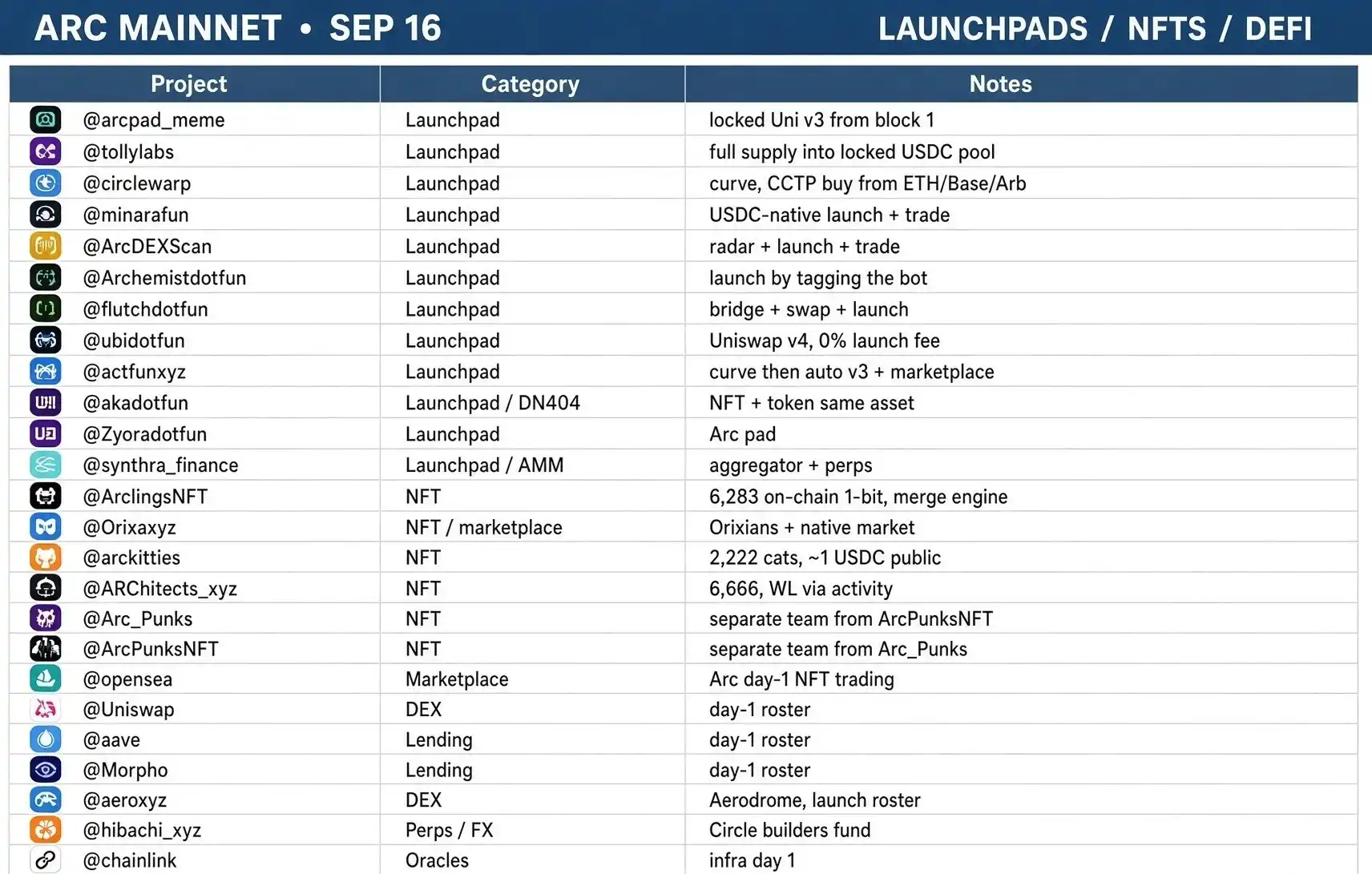
With 48 hours left before the public mainnet goes live, though, the market focus has shifted. What is stirring capital now is less the institutional narrative and more the contest over who controls token issuance on-chain. On Sept. 14, demand to position early in the Arc ecosystem kept rising, and the premium on related USDC swaps briefly reached 1.8x.
The appeal is straightforward. Robinhood Chain’s PONS has already shown what a launchpad-driven wealth effect can look like. On Arc, the same question is taking shape: who gets the token issuance gateway, and who captures the richest fee stream. Arc has already opened early deployment access to more than 100 institutions and ecosystem builders. Across social media and trading groups, the real fear of missing out is centered on new launchpads and whether one of them can produce a leading meme coin.
Where the pre-mainnet trading numbers come from
There is an important caveat before looking at the projects themselves. Arc’s public mainnet does not open until Sept. 16, yet social channels are already filled with screenshots showing launchpads posting tens of thousands or even millions of dollars in volume. Those figures are not coming from a live public market.
Arc previously opened a private mainnet, described as an early deployment environment, to more than 100 institutions and ecosystem teams. The trading data now being shared is a snapshot from that closed environment, which is not yet open to the public.
The related platform tokens were also issued on Arc’s private mainnet, on Chain ID 5042. The chain is live in a technical sense: contracts are deployed, pools exist, and trades have gone through. What remains closed is public access. The public mainnet launch on Sept. 16 is effectively the opening of that same chain. That means the platform tokens and liquidity pools already created there are expected to persist after the gate is opened, which helps explain why some traders are willing to position in advance.
Even so, the current data only shows that a launchpad’s rails are operational. It does not prove that the project can attract real speculative density once the public market arrives.
Model one: immediate liquidity, no bonding curve
This group is represented by Tolly and ArcPad. The structure is simple. Instead of using a Pump.fun-style process where tokens trade on an internal market until they hit a graduation threshold, creators launch a token and place the full supply directly into a permanently locked USDC liquidity pool. Trading can begin in the first block.
Tolly
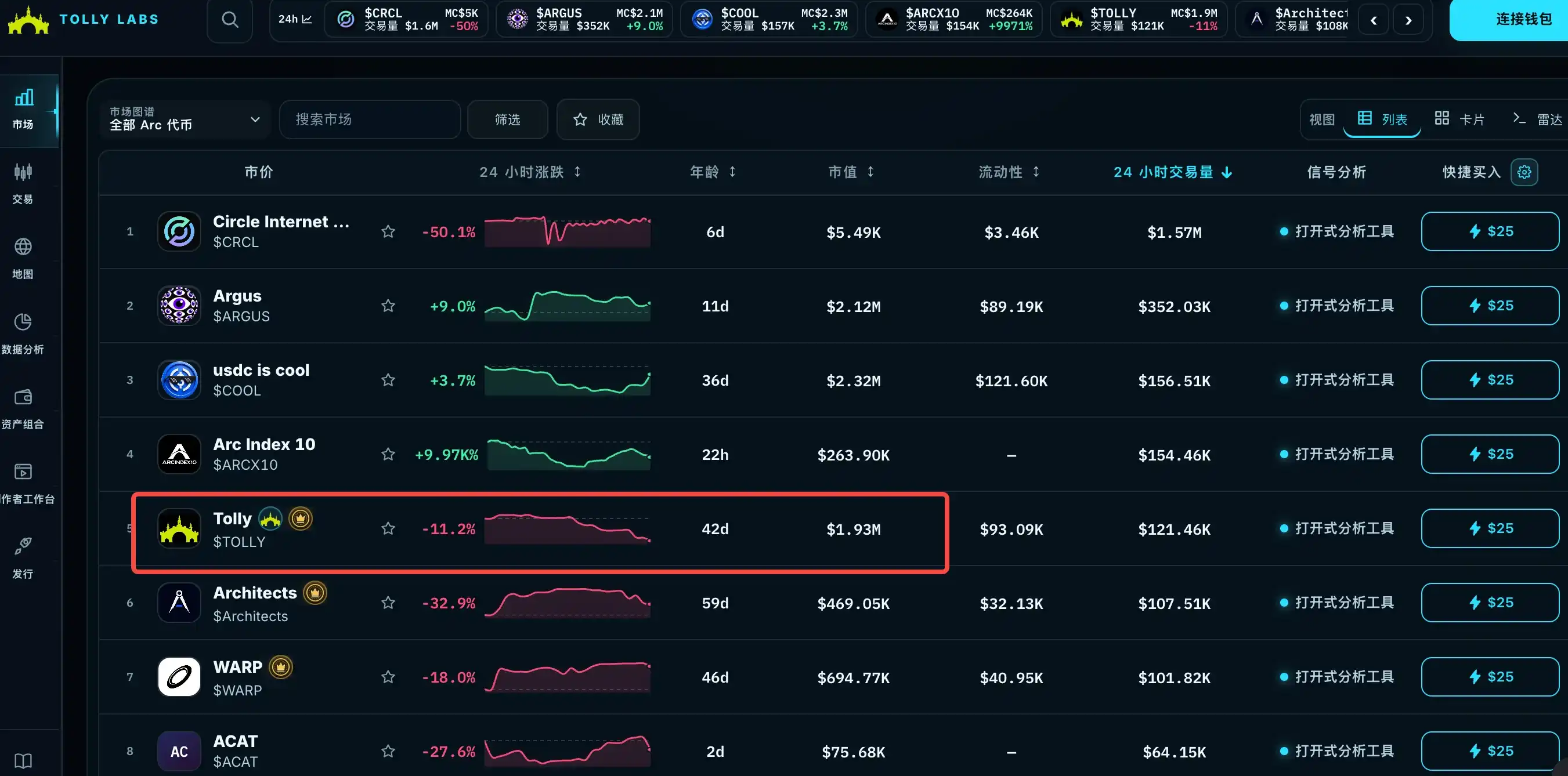
Tolly (@tollylabs) has posted some of the strongest trading data in the early deployment environment. Its buy-side fee is about 1%, and the fee is split with precision: roughly 64% goes to the creator, 12% goes to a holder reward pool, 10% goes to the protocol, and the remainder is used for buybacks and burns.
In the early environment, cumulative trading volume was about $1.8 million. Its platform token, TOLLY, reached a market cap high of around $2.47 million. The TOLLY contract address is 0xbc43ce8dec648ea298c4275559b81d6261c90b67.
ArcPad
ArcPad (@arcpad_meme) uses a cleaner architecture. There is no internal market. The full token supply is turned into a one-sided Uniswap V3 position and locked in a fee locker, while a per-address anti-sniping cap is set at 2%.
The trade-off is a much harder cold start. Early environment data shows only about 15 tokens and less than $30,000 in total volume. On its launch list, roughly 20 tokens are shown, mostly sitting around a $3,000 market cap, with individual trades often in the low tens of dollars. By current readings, the platform has drawn little attention.
Model two: bonding-curve graduation, following the Pump.fun playbook
Warp and Flipt fall into this category. The formula mirrors the classic Pump.fun path: tokens first trade on an internal bonding curve, then move to a DEX after reaching a set market cap threshold. The benefit is that the internal market can support early liquidity. The weakness is just as clear. Graduation rate becomes the central metric, and most tokens that fail to make it stay stranded on the curve.

Warp
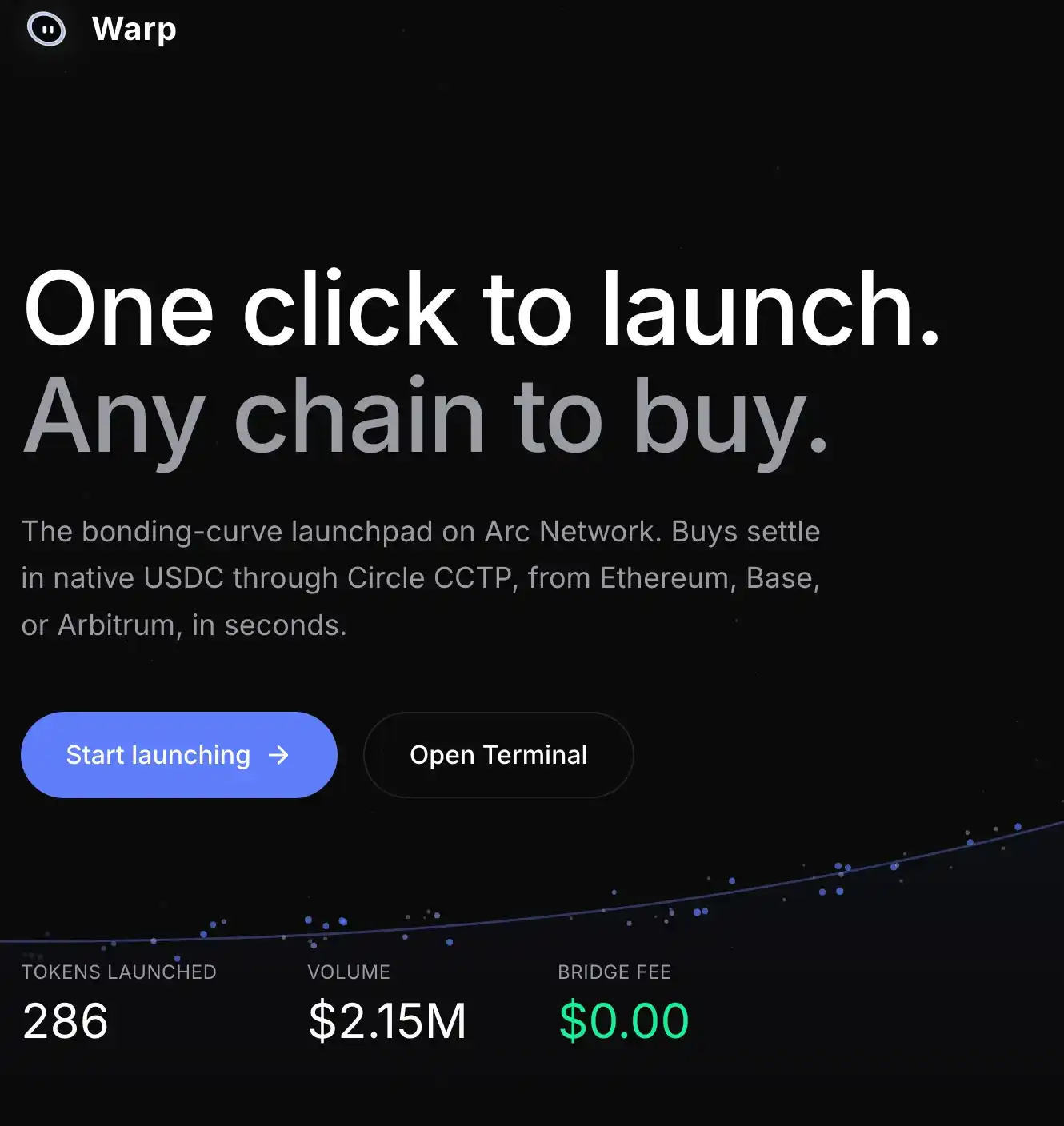
Warp (@circlewarp) is currently the only bonding-curve launchpad on Arc that has completed the full graduation process. It uses a USDC-denominated bonding curve. Once a token reaches around $69,000 in market cap, liquidity is migrated automatically to WarpDex, its in-house DEX, and the LP is burned.
Warp also leans on cross-chain access. Through Circle’s Cross-Chain Transfer Protocol, or CCTP, users can use USDC from Ethereum, Base, and Arbitrum to buy new Arc tokens with one click. The interface shows a zero bridge fee.
According to its website, Warp has launched 286 tokens and recorded $2.15 million in cumulative volume. A closer look changes the picture: about 84% of that volume came from WARP, the platform token itself, and only one token graduated over six weeks. For cold-start meme assets, the graduation threshold appears high. That remains its main issue.
WARP trades under the contract address 0x384c60f98ecd4c26345499345c03d677e40f115e and has a market cap of around $870,000.
Flipt
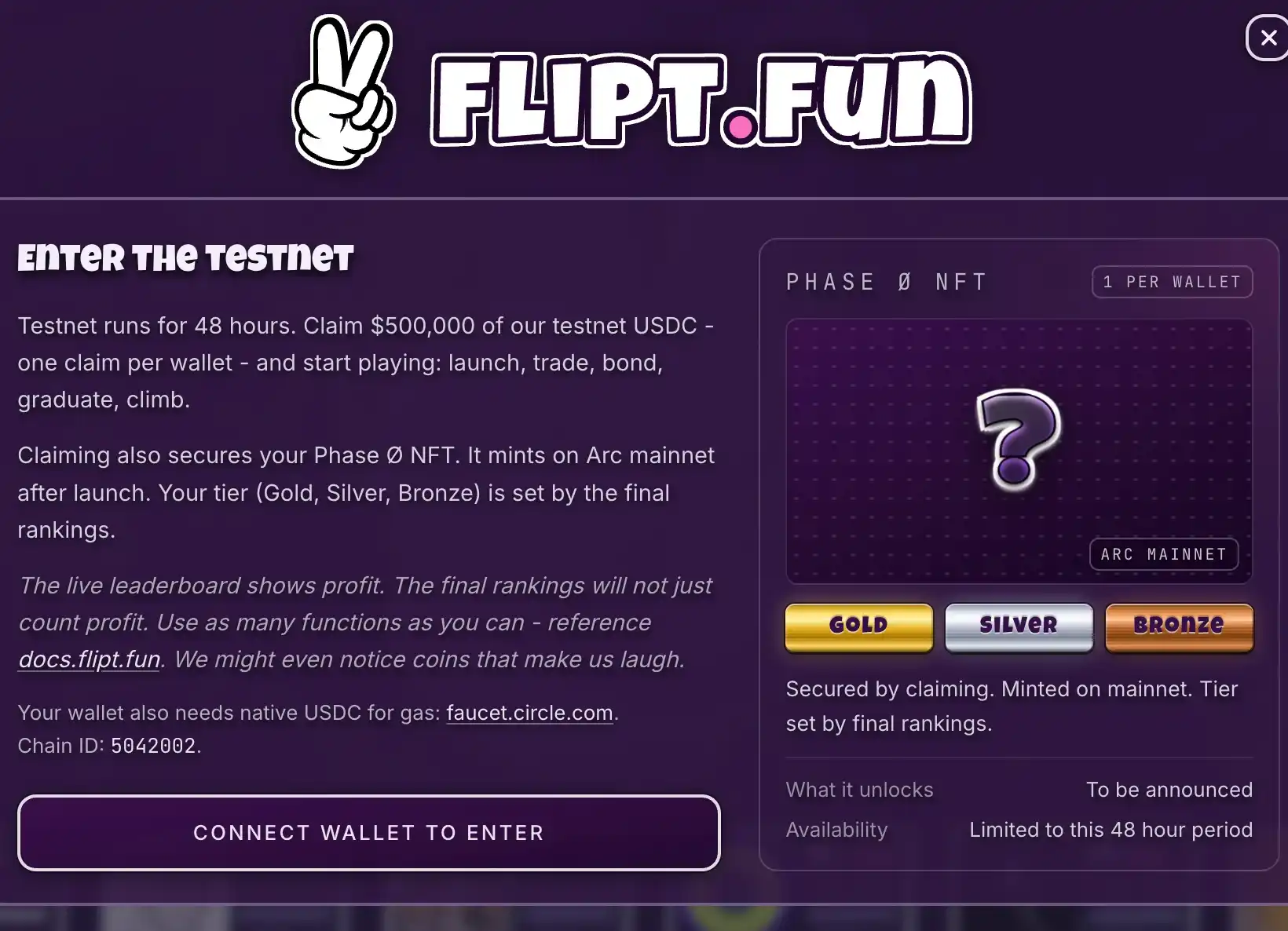
Flipt (@Fliptfun) has not yet launched on mainnet, but its testnet is live and has become one of the busiest interaction targets in the Arc ecosystem. It makes a notable adjustment to the bonding-curve model: buyers do not receive a freely sellable balance. They receive a bonded position instead. After graduation, that position earns a share of pool fees. Anyone who wants to exit early must join a public queue for 90 seconds, making large withdrawals visible to everyone rather than hidden.
Based on the disclosed setup, Flipt’s graduation raise line is about $6,375, with a graduation market cap around $30,000. Trading fees on the curve are 1.25%, and 0.75% goes to the bonder. The testnet event runs for 48 hours. Each wallet can claim 500,000 test USDC, and final rankings determine gold, silver, and bronze NFT rewards to be minted after the mainnet launch.
There is no platform token yet.
Model three: social bot issuance, launched from a post on X
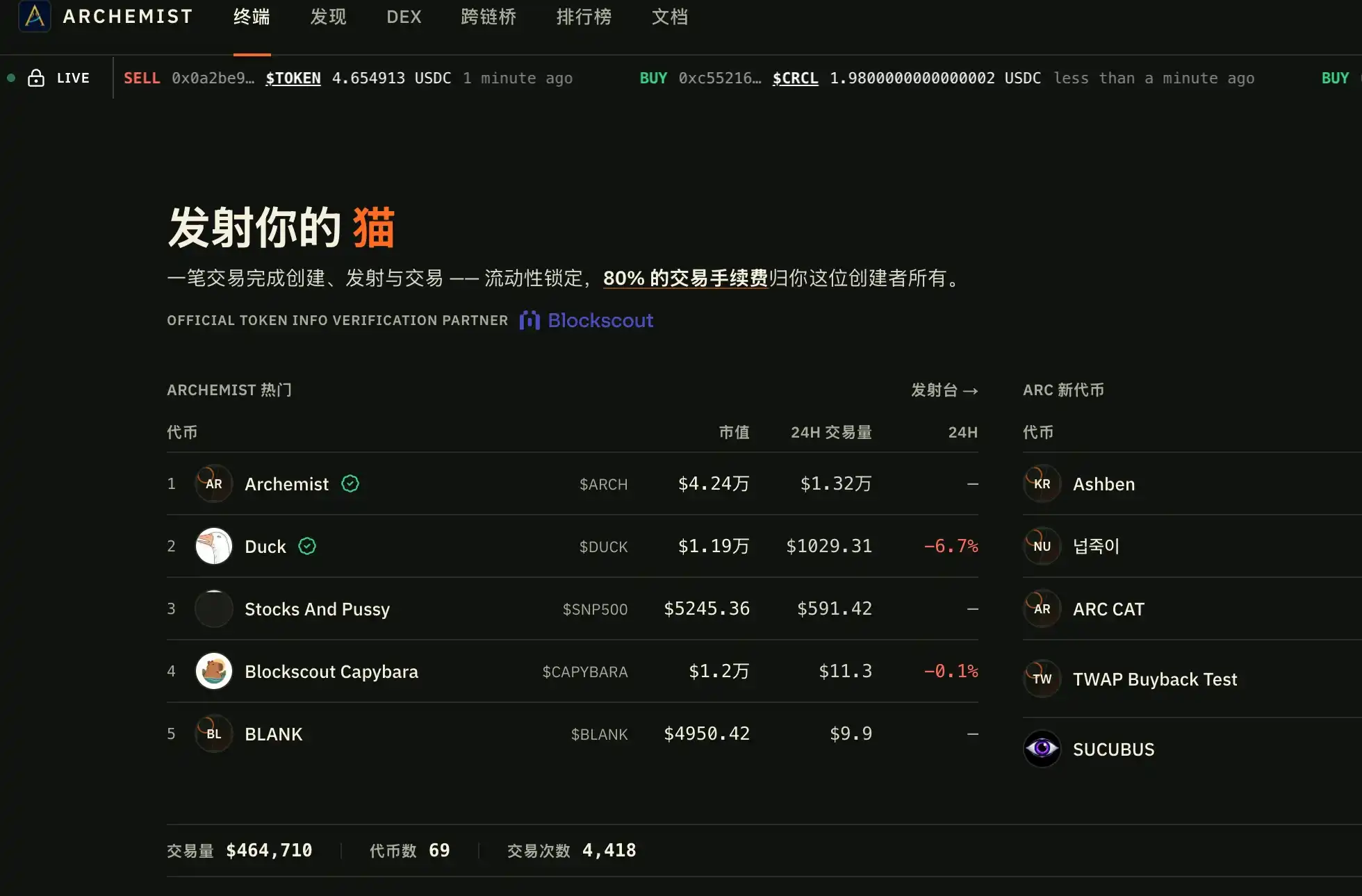
Archemist (@Archemistdotfun) represents a different route. The goal here is to push the issuance barrier as low as possible. Users do not need to open a separate website. They can create, launch, and trade a token through a single post by tagging a bot on X, while liquidity is locked automatically.
Its second hook is creator revenue sharing. The platform says creators can receive as much as 80% of trading fees, a design clearly aimed at attracting token issuers.
In the early environment, Archemist logged about $337,000 in cumulative volume and launched about 49 tokens. Roughly 77% of that volume relied on ARCH, its own platform token. The homepage also shows a partnership with Blockscout for token information verification, allowing contract details to be checked directly in the block explorer.
There is a complication. At the time of writing, the website counter showed zero volume and zero tokens. The original report said that likely reflected a reset ahead of the public mainnet transition, which reduces the reference value of the earlier trading figures.
ARCH’s contract address and market cap do not yet have a publicly verifiable standard reference, so both will need to be checked again after mainnet opens.
Model four: Uniswap V4 launchpads that write revenue sharing into the trading layer
This camp includes ubi.fun and Minara. Their common bet is Uniswap V4. With the hook mechanism in V4, launchpads can place dynamic fees, holder distributions, and automatic buybacks directly at the trading layer instead of relying on token taxes. Among Arc launchpad models, this is the newest technical pitch. It is also the coldest one in terms of current traction.
ubi.fun
ubi.fun (@ubidotfun) describes itself as the only Uniswap V4 launchpad on Arc. Token creation is free, and trading fees are distributed to creators and eligible holders. The product direction is broad holder revenue sharing. The website also states clearly that there is no platform token.
Its market activity has remained light. In the site’s live feed, most trades are small buys ranging from a few dozen dollars to about $200, and the most recent launch was six days ago. A third-party tally put the platform at only three tokens and around $4,800 in cumulative volume, with the holder reward pool once showing just $1.38.
For now, the mechanism is there, but capital has not meaningfully shown up to test it.
Minara
Minara (@minarafun) is also built around Uniswap V4 and emphasizes native USDC liquidity and low-friction issuance. There is community speculation about a possible Circle Ventures connection, but the team has not confirmed it, and the original report treated it strictly as rumor. Its website is live, though the token list is still largely empty.
There is no platform token and no reported trading data yet. A separate third-party review also noted that the rules allow creators to take as much as about 80% of supply at launch, a design that appears unfavorable to buyers. That is another point to watch once the public mainnet opens.
Model five: stock-token pairings and other outliers
Two names in the current survey sit outside the four main models, and their risk profile is different enough that they need to be separated from the rest.
Long.supply
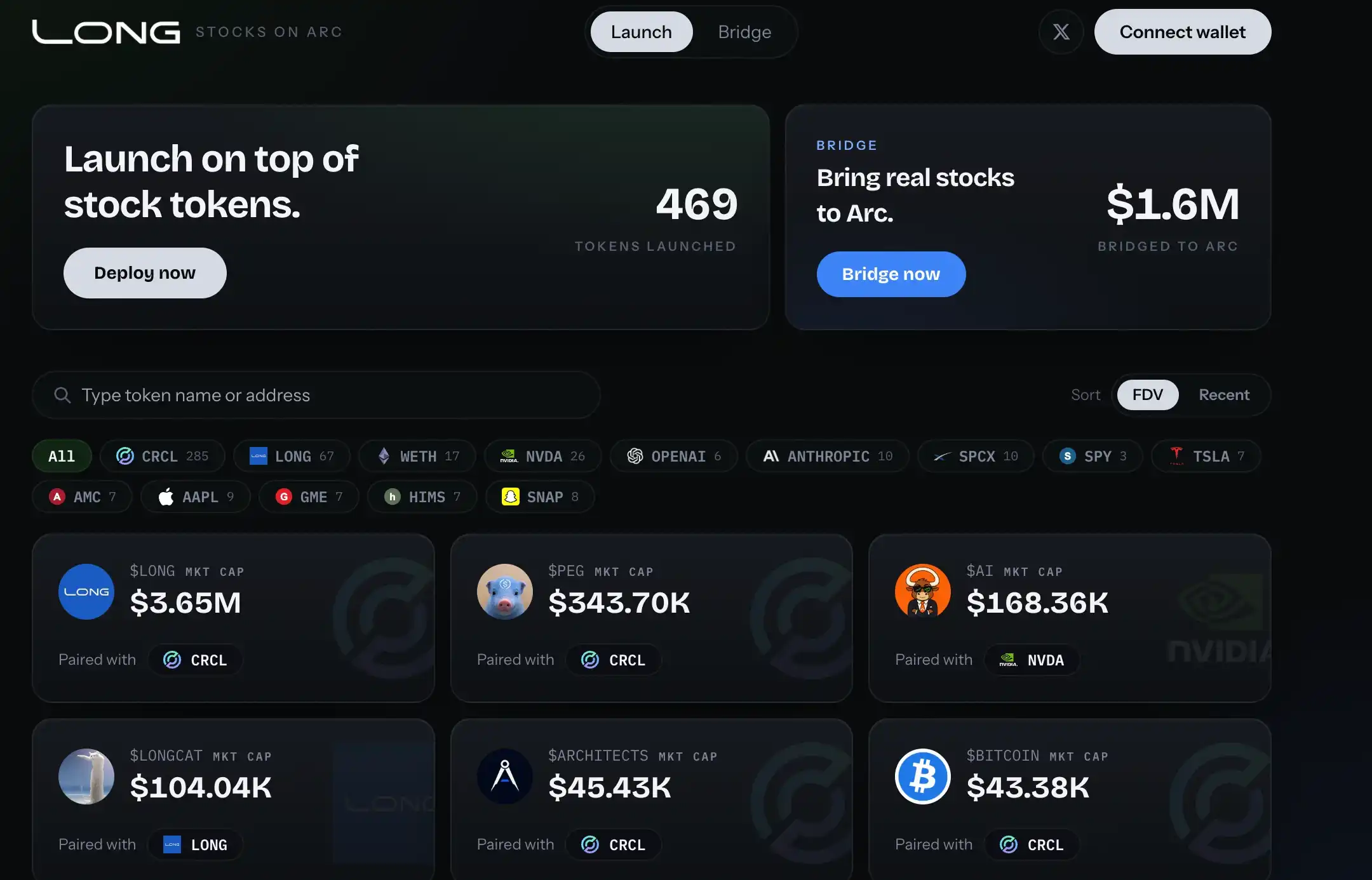
Long.supply (@Longdotsupply) is not building meme-USDC markets. It is building meme-stock-token pairs. The idea is to bridge stock tokens such as CRCL, NVDA, and even the still-private Anthropic onto Arc through its own bridge, then pair meme assets against those stock representations.
Its website shows LONG, the platform token, under contract address 0x2164bb17a2d38c1b5170e987b2c0416df1efc752. LONG’s market cap has climbed to around $3.61 million, the highest among Arc launchpad platform tokens covered in the report, while bridge funds are shown at roughly $1.6 million.
The central question is where those “stocks” come from. The report says they are not regulated stock tokens of the kind seen on Robinhood. They are certificates minted by the project team itself. Who holds the underlying assets, whether they can be redeemed for actual shares, and whether the bridge can be shut down unilaterally by the team are all unanswered in public disclosures. Those issues will need closer scrutiny after mainnet opens.
act.fun
act.fun (@actfunxyz) fits yet another category: a launchpad that had not formally opened business but moved early on timing. The platform itself is already functional. Its platform token ACT completed its presale on the project’s own venue. According to the report, the sale ended on Sept. 14 and filled both tranches of its $30,000 target. The Architect tranche was priced at a $50,000 FDV, while the Public tranche was priced at a $200,000 FDV.
The ACT contract has already been published at 0x177b47be2782575284211A000EDA4112807288a5. Formal launch is scheduled for Sept. 16, the same day Arc opens the mainnet to the public, when claiming and refunds are also set to go live. In effect, the project sold its own platform token before the public gate opened.
There is a clear risk flag. On-chain code checks show the contract owner still retains an emergency withdrawal privilege. Until that authority is relinquished, the promise that LP will be locked remains only a promise. The original article also noted that parts of the page carried what it described as an AI coding feel.
What the market will be watching after Sept. 16
Put together, the current picture is fairly clear. The volume and market cap figures now circulating were all generated in a closed environment by a few hundred addresses willing to pay a premium to get in early. Sept. 16 will be the first real exam.
The original report added that several other projects were left out for space reasons, and that some community analysts have already compiled their own launchpad ratings for research reference.
From here, three questions stand out.
- First, which launchpad can produce trading in a token that is not its own platform coin. Right now, Tolly, Warp, and Archemist all show volume heavily tied to their own platform assets. The first venue to produce a meme token with independent turnover and attention would offer a stronger proof of real distribution power.
- Second, whether public promises hold. Flipt’s mainnet rollout, act.fun’s LP lock and privilege renunciation, and aka.fun’s “see you on the 16th” line are all set to be verified or disproved within 48 hours.
- Third, whether Arc itself opens smoothly. It is still unknown whether the official RPC, block explorer, and Uniswap access will all be available to the public on time, and whether USDC can move in and out without friction. Arc has top-tier institutional names behind it, but the chain still has to prove itself in live operation.
Risk reminder
The original article closed with a standard warning: every project mentioned is still at a very early stage, most contracts have not been audited, and data from the pre-public environment should not be treated as a predictor of open-mainnet performance. Crypto projects carry substantial risk, and readers are expected to do their own research.