
Circle-backed Arc is scheduled to launch its mainnet on Sept. 16, and Circle will hold a livestream for the launch on the same day. Ahead of the opening, market attention has shifted to three practical questions: how to move funds into Arc, which official accounts may shape early narrative flow, and which token launch platforms are already gaining traction in the ecosystem.

The setup has drawn comparisons with Robinhood Chain. When that chain went live, the early market story centered on compliant equities and an onchain finance L2, yet Meme activity surfaced first and platforms such as Pons and Long.xyz gained momentum along the way. Arc also comes with backing from a major crypto company, and Circle has framed it around stablecoin finance. With the mainnet about to open and user traffic expected to arrive, traders are now asking whether Meme activity could again be one of the first areas to break out.
What Arc is
Arc is a new EVM-compatible Layer 1 blockchain launched by Circle, described as infrastructure for an internet economic operating system that combines programmable stablecoins with onchain financial innovation. The chain is designed for financial applications, with a stated focus on global payments, foreign exchange, lending and capital markets. Its target is to serve as a secure, low-cost, compliant and scalable base settlement layer for programmable money on the internet.
How users can get funds onto Arc
Before the public mainnet opens
The public mainnet has not opened yet, and bridges remain unavailable. For users who want to hold Arc-native assets as early as possible, the article says the most direct route is buying Arc USDC at a premium through the OTC market Unstable at https://unstabletrd.com, using USDC on Ethereum mainnet.
Community feedback cited in the article puts the exchange ratio at roughly 1.8:1. Unstable also charges a 3% fee, making early entry into Arc relatively expensive.
After receiving Arc USDC, users whose wallets do not automatically detect Arc can add the network manually with the following settings:
- Name: ARC Mainnet
- RPC URL: rpc.arc-scan.org
- Chain ID: 5042
- Symbol: USDC
- Backup RPC: http://niorfun.com/api/rpc
After mainnet launch
The article lists Across, Axelar, Stargate, Wheelx and Wormhole as official bridge partners. It adds that the market is still watching to see which of those protocols will support Arc first after launch.
Another route may come through Warp at https://circlewarp.fun/bridge, which the article describes as one of the most frequently recommended community options. Warp combines a Meme token launchpad, a trading terminal and a bridge in one product. It settles in USDC, supports token creation and trading on Arc, and lets users view positions. Its /bridge page is set up as the entry point for cross-chain deposits.
X accounts the market is watching
The article says comments from Arc team members and official accounts may have a direct effect on ecosystem discussion and Meme-related narratives in the chain’s early phase. The accounts highlighted are:
- @arc, the main Arc account
- @jerallaire, Circle co-founder Jeremy Allaire
- @0xrachelita, Arc product lead Rachel Mayer
- @bobbilee, Architects Lead and community lead
- @samconnerone, a core Circle and Arc community member who frequently reposts official mainnet announcements
- @blockjain, Arc product manager
- @AdiSeredinschi, Arc product manager
- @Soghoian, Arc engineer
- @gordonliao, Arc head of research
Early token launch platforms on Arc
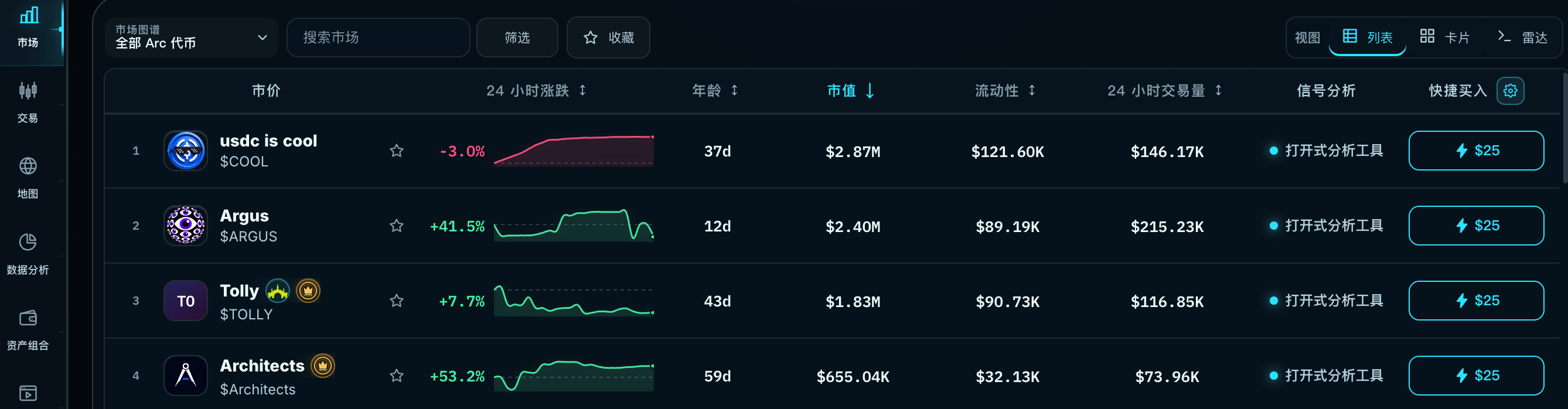
Tolly
Tolly’s official X account is https://x.com/TollyLabs. It is one of the more actively discussed token issuance platforms in the Arc ecosystem, and the article says three tokens on the platform already have market capitalizations above $1 million. TOLLY is the platform token.
Unlike the standard bonding-curve model common on Pump.fun, Tolly does not use a graduation step. Once a project is created, the full token supply is paired directly with USDC in a liquidity pool and locked. Trading starts immediately, so there is no migration process from an internal market to a DEX.
Trading fees are about 1%. On buys, which settle in USDC, around 64% goes to creators, 12% is allocated as holder rewards, 10% goes to the protocol, and the remainder is used to buy back and burn TOLLY and the project token. On sells, which settle in the project token, the amount is burned in full.
Warp
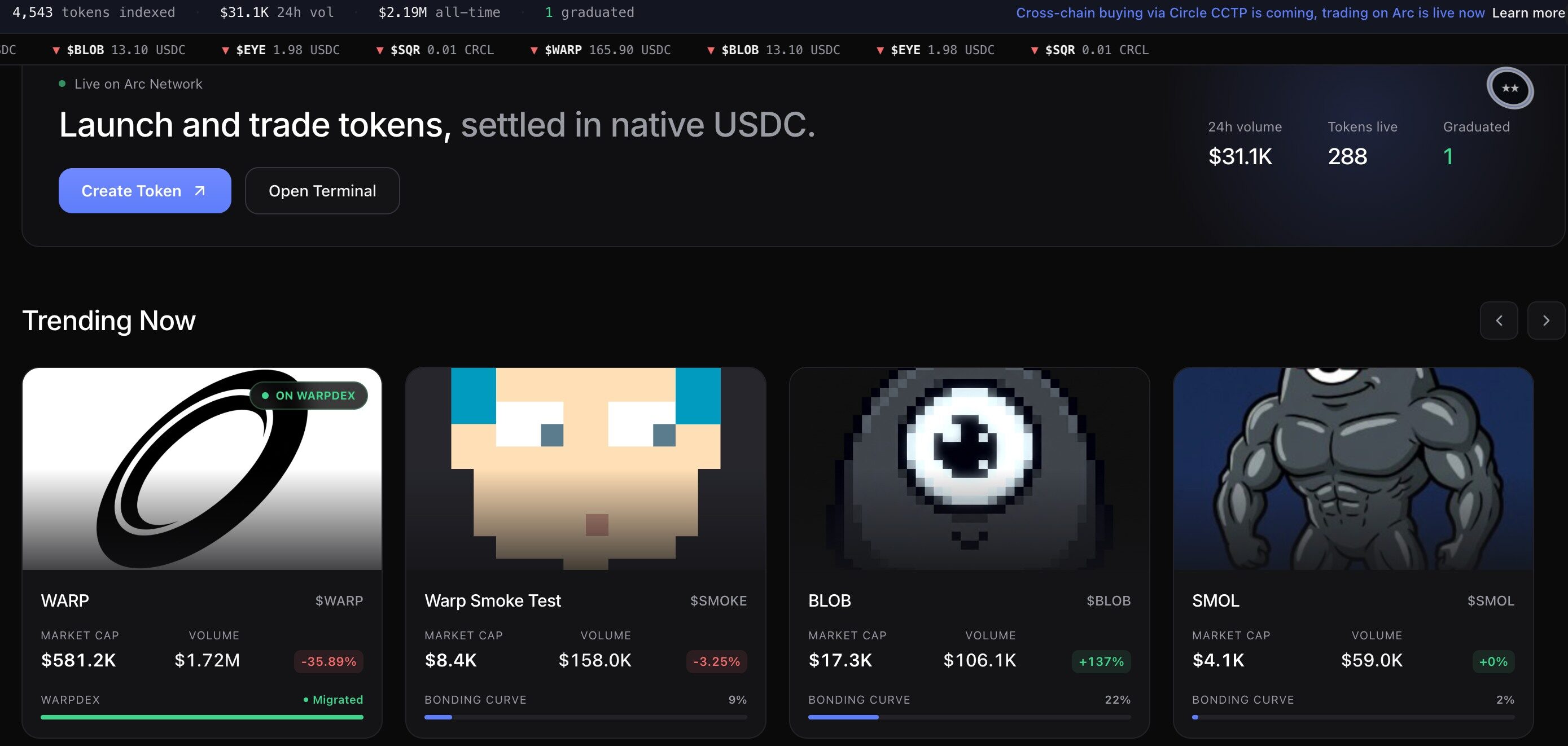
Warp’s official X account is https://x.com/circlewarp. It follows a more familiar Pump.fun-style structure. Projects first trade on a bonding curve denominated in USDC. When market cap reaches about $69,000, the token migrates to WarpDex and the LP is burned.
Warp also leans on Circle’s Cross-Chain Transfer Protocol, or CCTP. The platform says it supports one-click buying after bridging USDC from other chains, a feature meant to lower the operational hurdle for new users entering Arc. As of now, the platform has issued 288 tokens and generated roughly $2.1 million in cumulative trading volume.
The article notes, however, that Warp still shows a clear platform-token-driven trading pattern. Most of the volume comes from WARP itself, and over roughly the past six weeks only one project has met the graduation threshold. Compared with Tolly, Warp appears to be more complete as a product, but whether third-party Meme tokens can break out there will likely be tested only after mainnet traffic arrives.
Long.supply
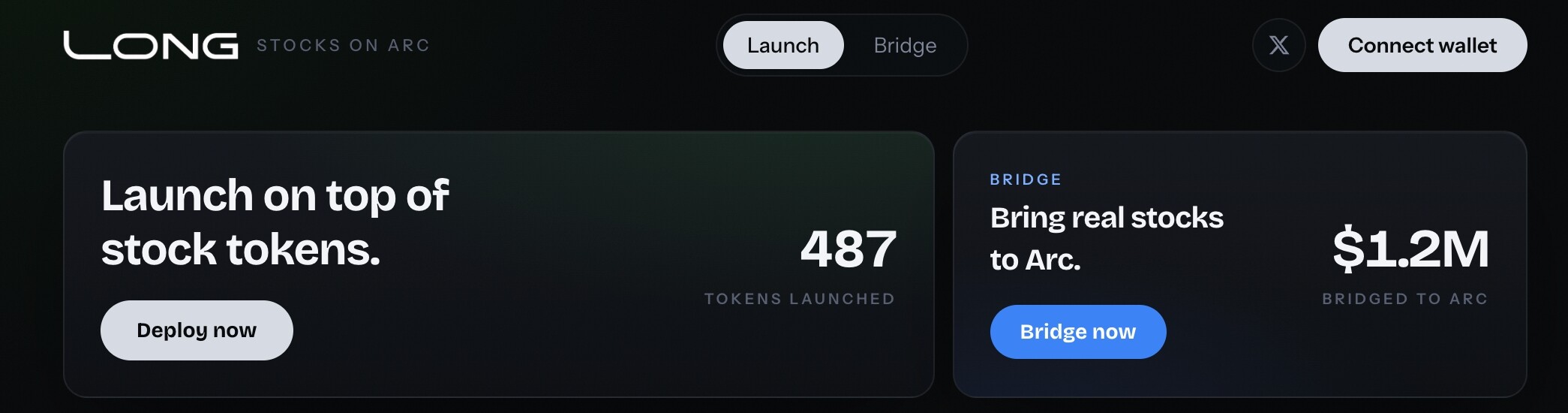
Long.supply’s official X account is https://x.com/Longdotsupply. The platform maps tokenized equities on Robinhood Chain, including NVDA and CRCL, onto Arc through its own custody bridge, then allows those mapped assets to be used as trading pairs for Meme launches.
The article stresses that Long.supply is not an official bridge. In practice, the platform custodies the underlying assets on Robinhood Chain and then issues corresponding mapped tokens on Arc. That means redemption back into the original chain’s assets ultimately depends on the project’s own custody and payout capacity.
So far, Long.supply has bridged $1.2 million worth of real stock tokens, issued 487 tokens in total, and seen its platform token LONG reach a reported market capitalization of $3 million.
Archemist
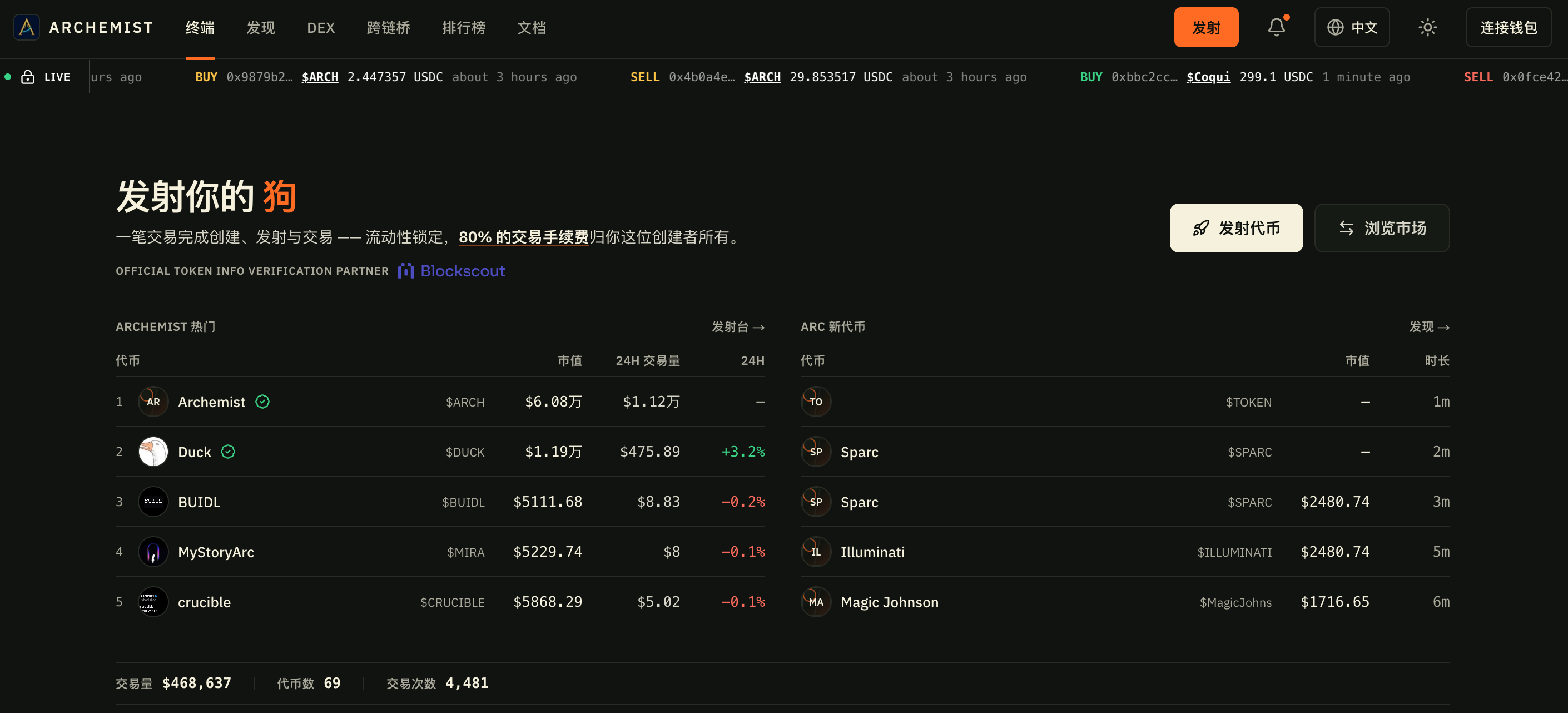
Archemist’s official X account is https://x.com/Archemistdotfun. Its pitch is social token creation. Users can launch tokens directly through an X bot, putting more weight on Meme distribution efficiency on social media than on a complex creation flow.
The platform allows creators to take a relatively large share of fees, with the article putting the maximum at 80%.
It currently operates through multiple product versions. Those include a direct issuance model based on Uniswap V3, and experiments built around Uniswap V4 hooks that add anti-sniping measures, creator co-buys, platform-token buybacks and holder reward mechanisms.
As of now, Archemist has recorded $468,000 in cumulative volume and issued about 69 tokens. More than 75% of that volume, however, still comes from the platform token ARCH.
ArcPad
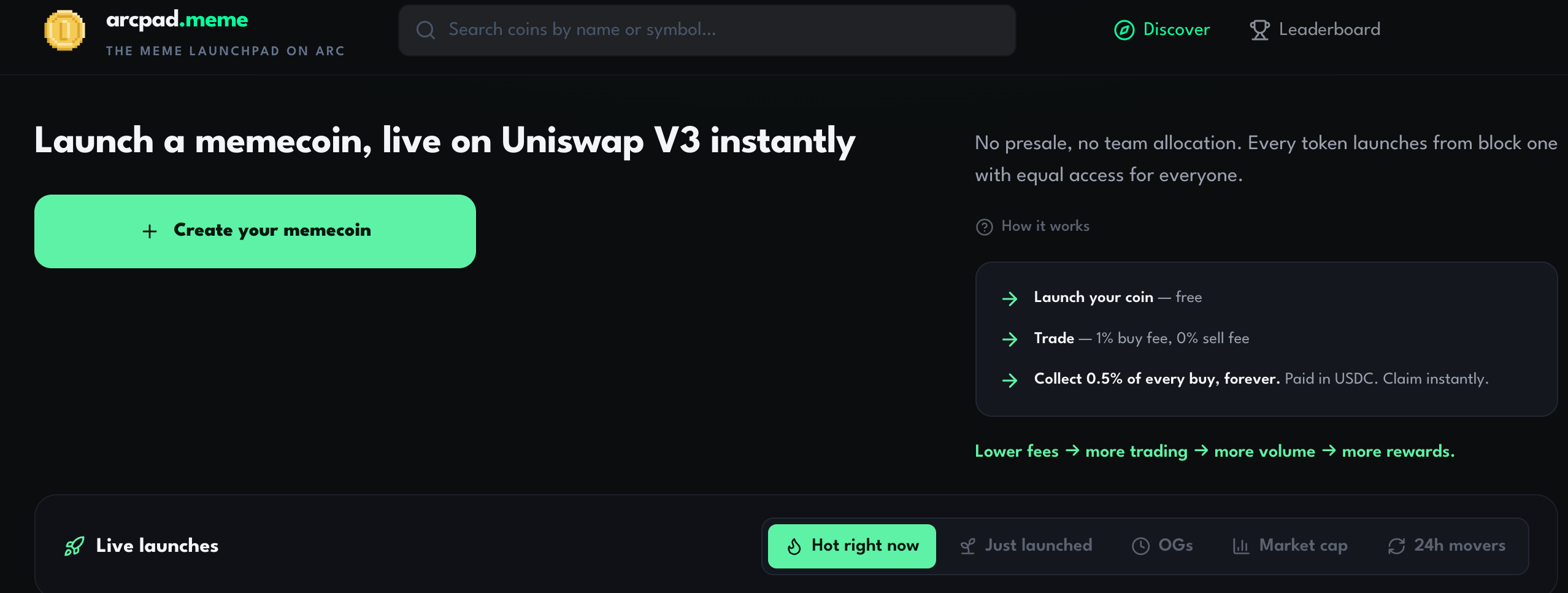
ArcPad’s official X account is https://x.com/arcpad_meme. The platform does not use a bonding curve and does not have a graduation mechanism. Instead, it deploys tokens directly to Uniswap V3.
After a project is created, the full supply is placed into a one-sided LP covering a very wide price range and locked permanently. The idea is to keep liquidity available from the token’s earliest stage through higher valuation ranges, reducing the friction associated with migration and re-pooling.
Its trading fee is 1%, split equally between the protocol and the creator at 0.5% each. Creators can also choose to give up their share in favor of token holders.
ArcPad has issued about 30 tokens so far, with roughly $30,000 in total trading volume. The article describes it as an early product that has already put infrastructure in place and is waiting for mainnet traffic to arrive.