

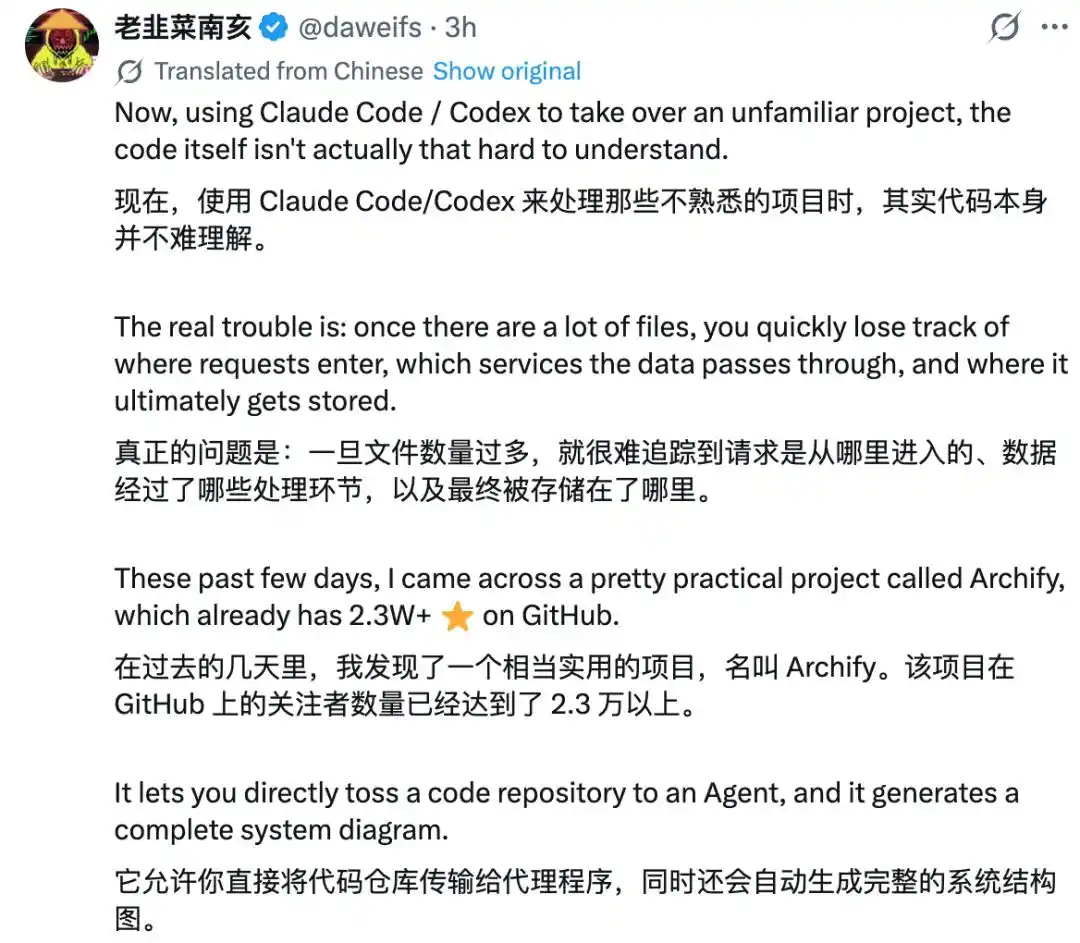
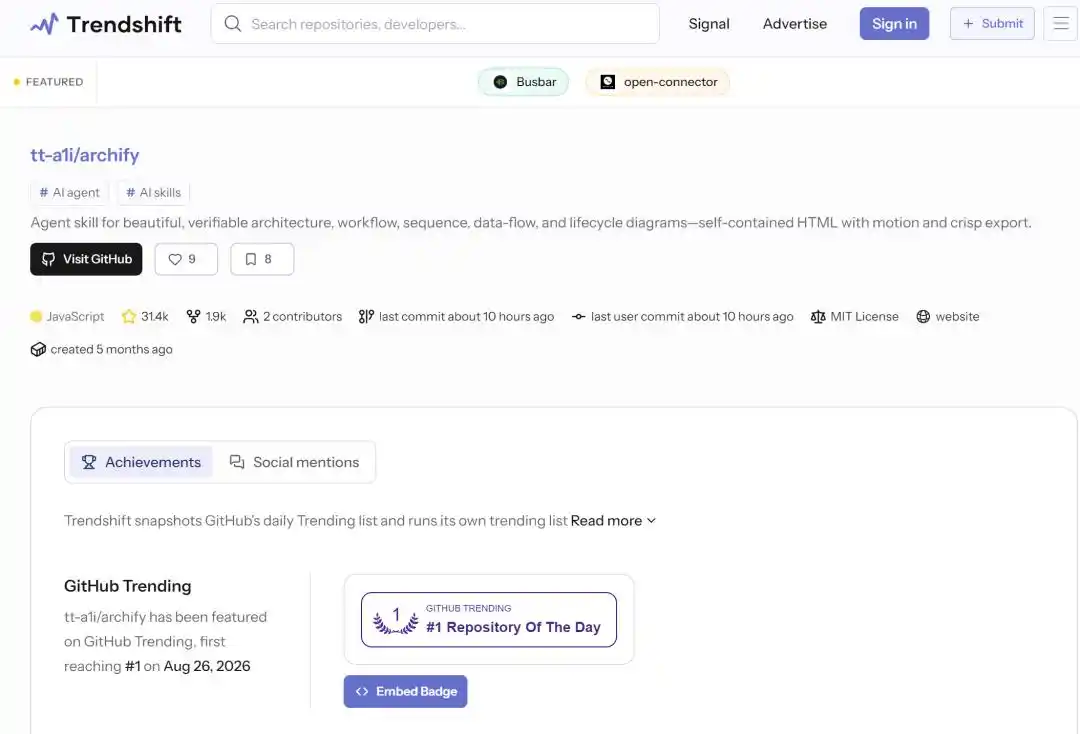
Archify, an open-source project that turns code repositories into architecture diagrams, has surged to No. 1 on GitHub Trending, according to a report MarsBit republished from the WeChat account Quantum Bit.

The idea is simple: take what used to be a messy, manual chore and shrink it into one short prompt: "Analyze this repository and generate a high-level runtime architecture diagram." But the result is not some dead static picture. Archify spits out an HTML diagram where users can search nodes, trace call paths, and flip themes.
The report said Archify runs across models and agents, including Claude Code, Codex, Cursor and others. At the time of publication, it had hit 31.4k stars and 1.9k forks, and it had also picked up multiple favorable reviews on X with 100,000 likes. One user quote in the report put it this way: "Thanks to Archify, I saved at least four or five follow-up meetings."
From repository analysis to interactive diagrams
Archify is described as an Agent Skill for AI agents like Claude Code, Codex, Cursor and OpenCode. Users can either hand it a written system description or tell it to inspect a code repository itself.
After parsing the code, Archify produces a structured JSON IR, runs schema, layout and rendering checks, and then exports a standalone HTML file.
The original article broke the workflow down like this:
- code or text description
- Archify understanding
- JSON IR generation
- rule validation
- HTML/SVG rendering
- interaction and export
Right now, the project supports five kinds of technical diagrams:
- architecture diagrams
- workflow diagrams
- sequence diagrams
- data-flow diagrams
- lifecycle diagrams
And those outputs do a lot more than just show a structure. Users can search nodes, inspect upstream and downstream relationships for a module, trace paths between two nodes, switch between light and dark themes, and export PNG, SVG, WebM and share cards.
If something looks off, users can keep revising it with prompts like "Add Redis," "Move the authentication module to the left," or "Highlight the fallback path after cache invalidation."
What sets it apart from Mermaid-style tools
The report stacked Archify up against text-to-diagram tools such as Mermaid and D2. Its case was blunt: Archify is doing more than rendering text into charts. It puts diagram generation inside an AI coding agent workflow, so the agent can understand code, make GIF-format charts, and keep updating them over time.
Mermaid and Graphify, by comparison, were described in the article as tools that mostly render already-written text descriptions into images. The piece also argued that Archify may produce better-looking visuals.

The split of responsibilities matters here. A user states the technical intent. The AI agent takes care of code understanding, component organization and structured data generation. Then Archify validates and renders the final result.
That setup is supposed to deal with a familiar problem in AI-made architecture diagrams: a model can draw fast. Correctly? Not always.
Before anything is delivered, Archify checks data structures, node layout, labels and line conflicts. If validation breaks, it points to the exact problem and the allowed repair method instead of handing back a polished-looking diagram that is wrong.
Snapshot comparison is supported, but it is not a real-time monitoring system
Archify can also compare two architecture snapshots and show the differences in a Before/Delta/After format, marking additions, deletions, modifications, moves and rerouted paths.
The report argued that this pushes diagrams into a bigger job. Instead of getting tacked on after development ends, they could become part of code review and change along with a project.
But the article was also clear about the limits. Archify is not a real-time monitoring system, it said, and it cannot automatically prove that a diagram fully matches a live production state. Accuracy still rests on the code base, the prompt and the AI agent's analysis quality.
Some users who tested the project pointed to practical headaches: small node detail panels, less fluid performance with models that lack native visual capability such as deepseek-v4-flash, and relatively high usage consumption.
The developer, who posts under the name "No wind, no rain, no clear sky, no foggy sky," said the product is being updated and that those issues are being worked on.
The developer's hiring story drew as much attention as the product
The creator's background became part of the story too. The original report said the developer did not come from an elite academic path. He studied at a junior college, then transferred into the software engineering program at Chongqing University of Posts and Telecommunications after placing first in the transfer exam.
After Archify went viral, he wrote on X: "I worked as a security guard, learned auto repair, worked in factories, and even made it through rounds of interviews at major companies such as ByteDance Feishu and Yuanfudao. I always thought an offer was within reach, but during background checks they found out I had attended a junior college, and I had to leave with regret. In the year I graduated, this kept happening. Interviews would go well, but once I said I was a transfer-up student, there was no follow-up from HR. (bitter smile)"

He also said that after offer after offer collapsed, he felt pain, doubt and confusion. At one point he even went straight downstairs and ran 5 kilometers. But he did not quit.
According to the report, encouragement from Manus COO Cz Chen pushed him to use Archify to prove himself. He summed up that push in one short line: "Coming from a poor background is not a disgrace!"
From junior college to open-source proof of ability
The report gave a longer version of his path. It said he has not publicly revealed his real name or current employer. The article then referred to him as "Teacher Sunny Day" and said the publication had already reached out to him and might publish a follow-up interview.
It boiled his story down to a few keywords: rural background, transfer-up education, self-taught front-end development, repeated setbacks during background checks, and using open source to prove ability.
After the 2018 college entrance exam, he entered a junior-college program in computer application technology. Later, he transferred into Chongqing University of Posts and Telecommunications with the top score in his cohort.

During internships, he felt steady work would lead to a better future. Then the autumn hiring season hit him hard. In one internship interview at Westlake University, when HR once again zeroed in on his transfer-up academic background, he answered: "Coming from a poor background is not a disgrace!" The report said he passed that internship interview.
Still, that did not turn into a full-time offer. The article said that from last year through this March, he kept moving from internship to internship to build experience because no company was willing to hire him as a regular employee.
Archify became a second résumé
A turning point came when he met what the report called the first major supporter of his career: Cz Chen, then chief operating officer of Manus.
She told him he could prove himself through work samples or open-source projects. The article said that advice matched something he had already accepted: his academic credentials could not be changed, and explanations would not change how other people saw a transfer-up degree.
So he went deeper into open source and turned his work into what the report described as a second résumé. In the end, the article said, he got an offer from a major company in Shanghai.

After Archify became widely known, he looked back on that road in another post: "Open source did not turn me from a transfer-up student into a 985 graduate, and it cannot guarantee that I will never again be blocked because of my education. I still cannot say clearly what these stars will finally bring me."
He added: "At least now, people are really using Archify. What I built can bring value to others and help many people. For me, that is the biggest meaning of doing open source."
The article ended by saying that beyond academic labels, he has built a new résumé written by real products, users and community feedback, and that the story of Archify is still still being written.
The original piece was published on the WeChat account "Quantum Bit" and credited to the author name "Following Cutting-Edge Technology."