
This article, based on data from Harmonic and analysis by Murph Capital, deconstructs the seed-stage investment patterns of 20 mega-funds (AUM over $10 billion) across three macroeconomic periods: the SaaS era (~2015-2019), the zero-interest era (2020-2021), and the AI era (2022-present). The dataset covers more than 30 million companies and 190 million individuals. Key metrics include annual early-stage deal count, lead rate, median round size, seed-to-Series B conversion rate, and sector distribution.
Research Framework: Three Eras of Mega-Fund Seed Behavior
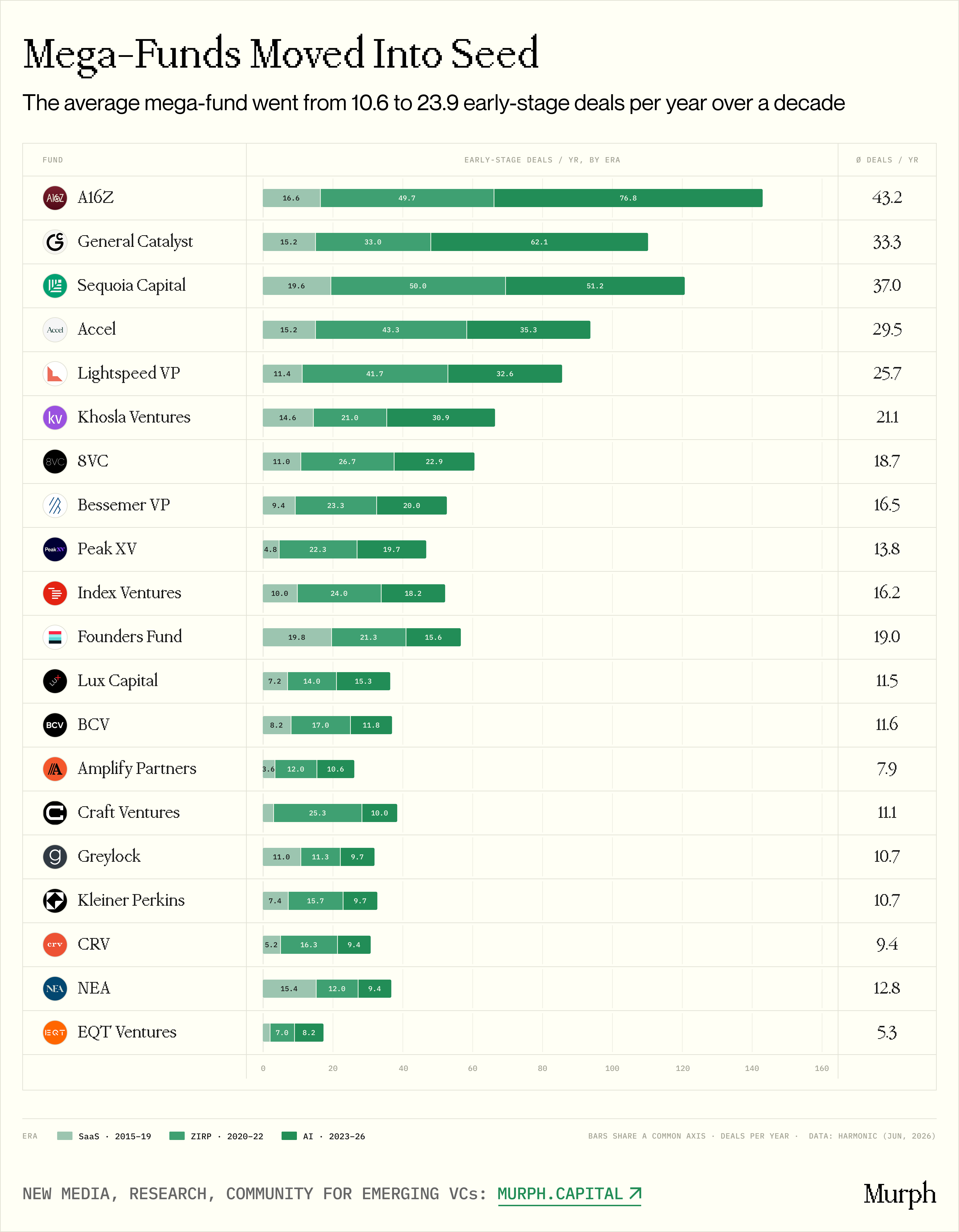
The analysis focuses on 20 top venture capital firms including a16z, Sequoia Capital, General Catalyst, Lightspeed Venture Partners, Accel, Bessemer Venture Partners, Khosla Ventures, and others. The SaaS era (pre-zero interest) saw typical mega-funds doing about 10.6 early-stage deals per year. The AI era has pushed this to 23.9 deals per year, a 2.37x increase. Notably, the AI era annual rate (23.9) is nearly identical to the zero-interest era (24.3), indicating the shift is structural rather than cyclical. Only three funds reduced early-stage activity after rate hikes. Three fundamental drivers: AI companies have inherently higher capital needs (GPU infrastructure, research scientists earning $300k-$500k); pricing power has shifted to top AI founders who can choose between a16z, Sequoia, etc.; and mega-fund AUM has ballooned—the top five funds' combined AUM grew from ~$34 billion to ~$249 billion, making seed check sizes trivial and eliminating price discipline.
Key Finding 1: Mega-Funds Are Structurally Flooding Seed Rounds
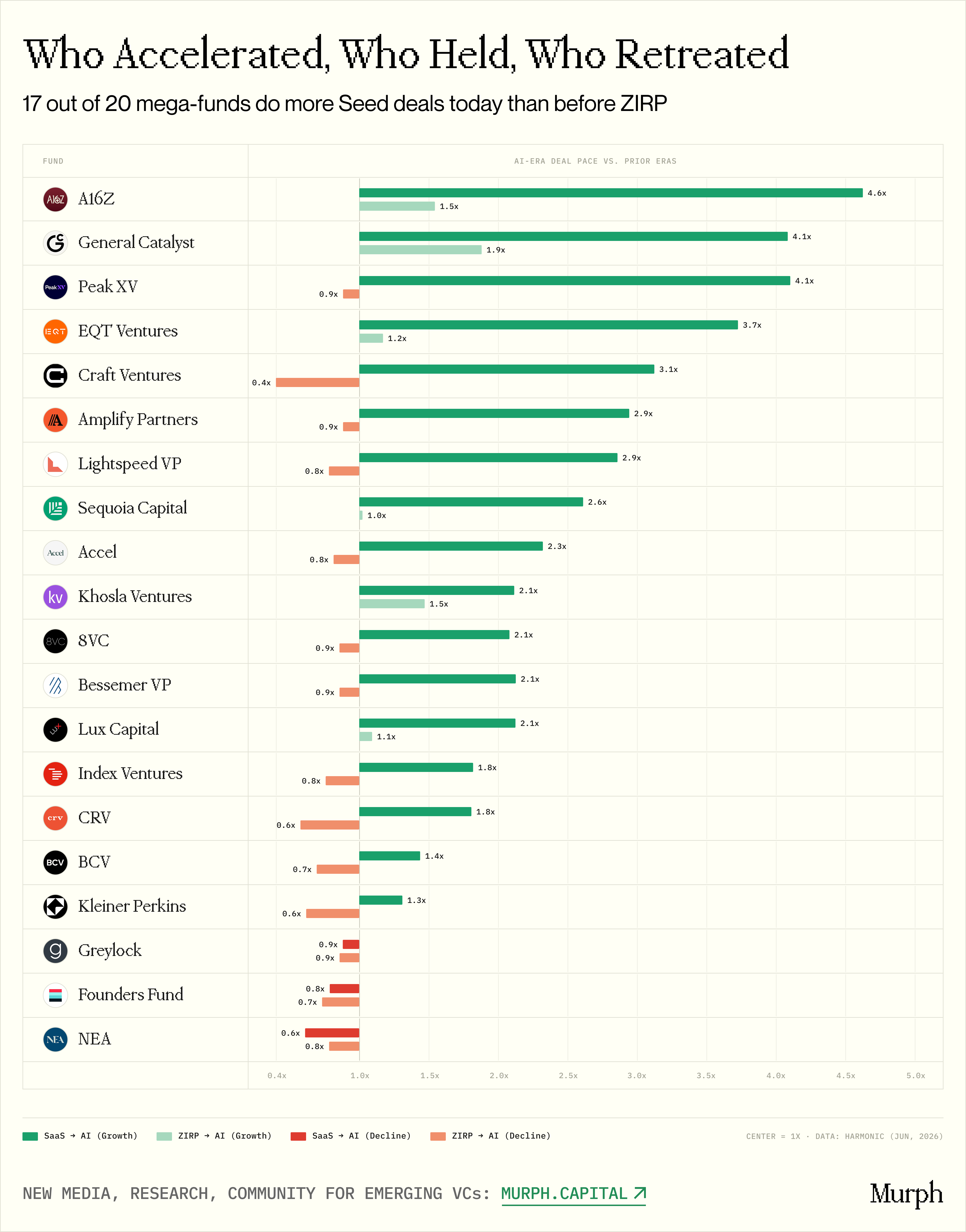
In the AI era, funds split into three behavioral clusters. Aggressive expanders (a16z 75.3 deals/year, General Catalyst 61.5, Khosla 31.5) exceeded even zero-interest peaks. Steady decliners (16 funds) settled at 2-3x their SaaS-era baseline but below zero-interest peaks. Consistent growers (Bessemer, Lux, Index) raised their permanent baseline. Exceptions: Founders Fund (Peter Thiel's contrarian approach, pivoting to late-stage bets like OpenAI), NEA, and Greylock (high-conviction, low-volume approach).
Key Finding 2: Seed Rounds Are No Longer a Side Hustle
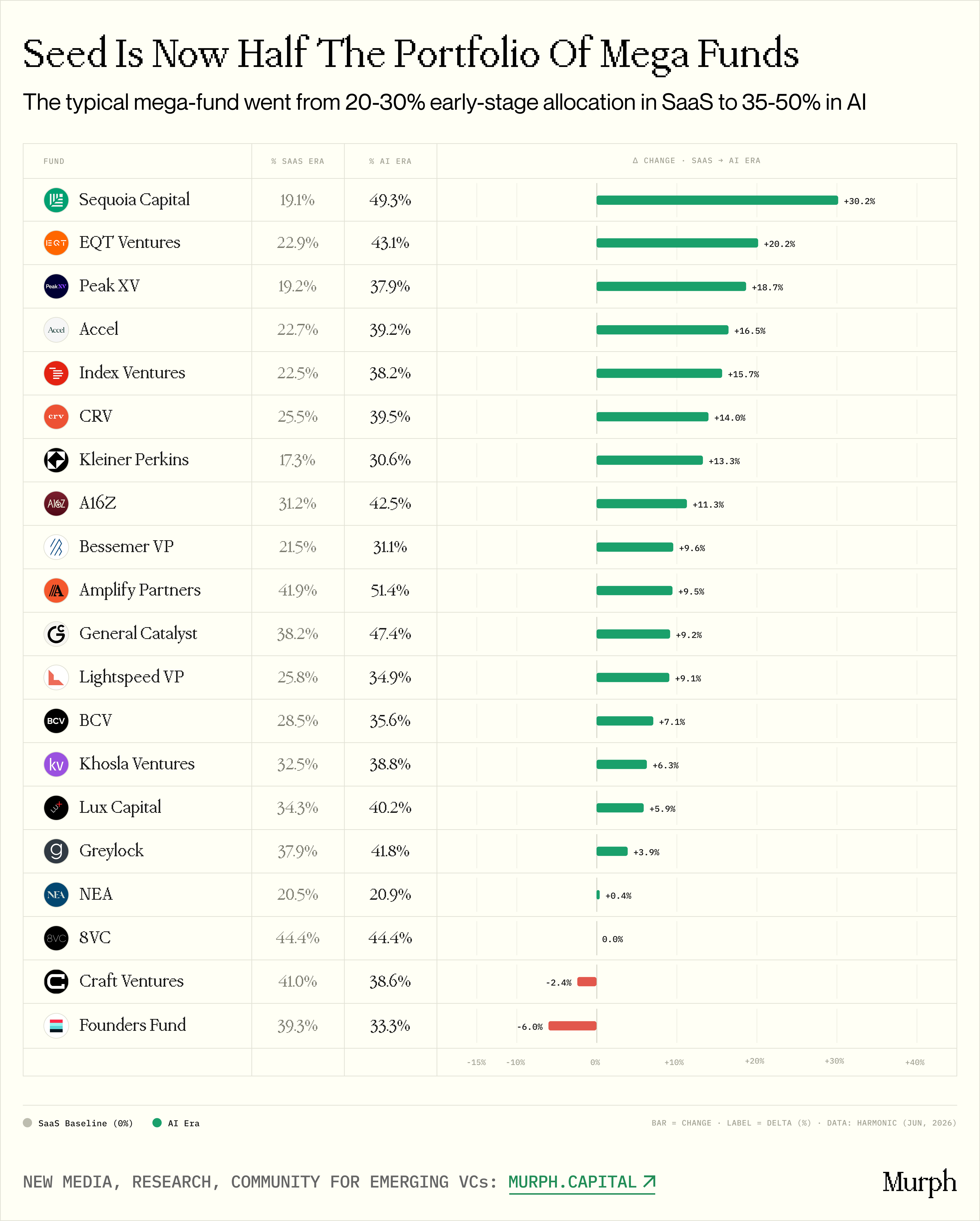
Sixteen of the 20 funds increased their allocation to early-stage to record highs in the AI era, from 20-30% of all deals in the SaaS era to 35-50%. Sequoia jumped from under 20% to 49%, General Catalyst from 38% to 47%, and a16z from 31.2% to 42.5%. The narrative that mega-funds 'occasionally write seed checks' is dead. These firms have dedicated teams, proprietary pipelines, and accelerator programs (a16z Speedrun, Sequoia Arc). For emerging managers, daily competition now comes from $10-90 billion AUM giants targeting 40-50% of their institutional deal flow at early-stage.
Key Finding 3: The Seed Market Has Split into 'Super Seed' and 'Classic Seed'
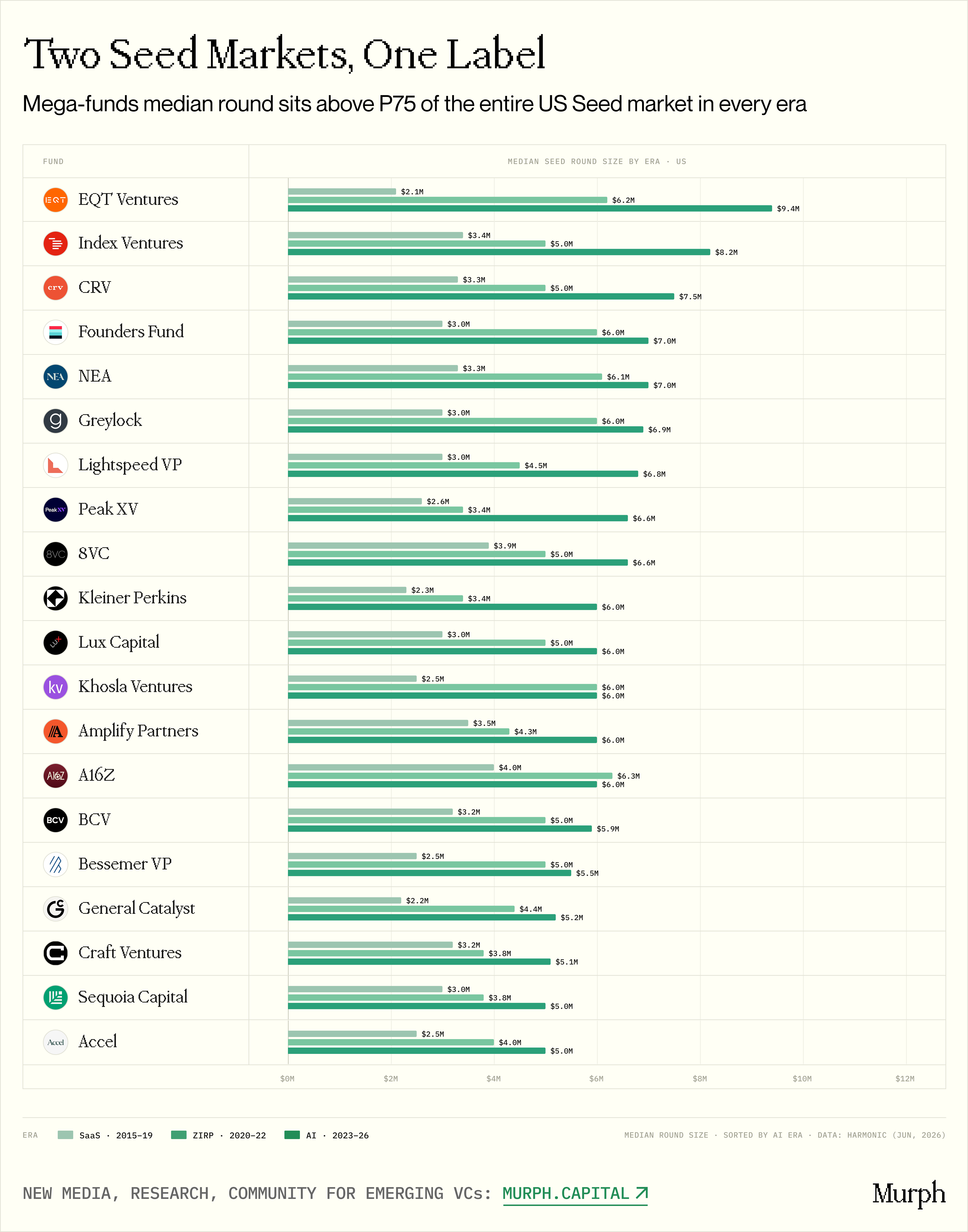
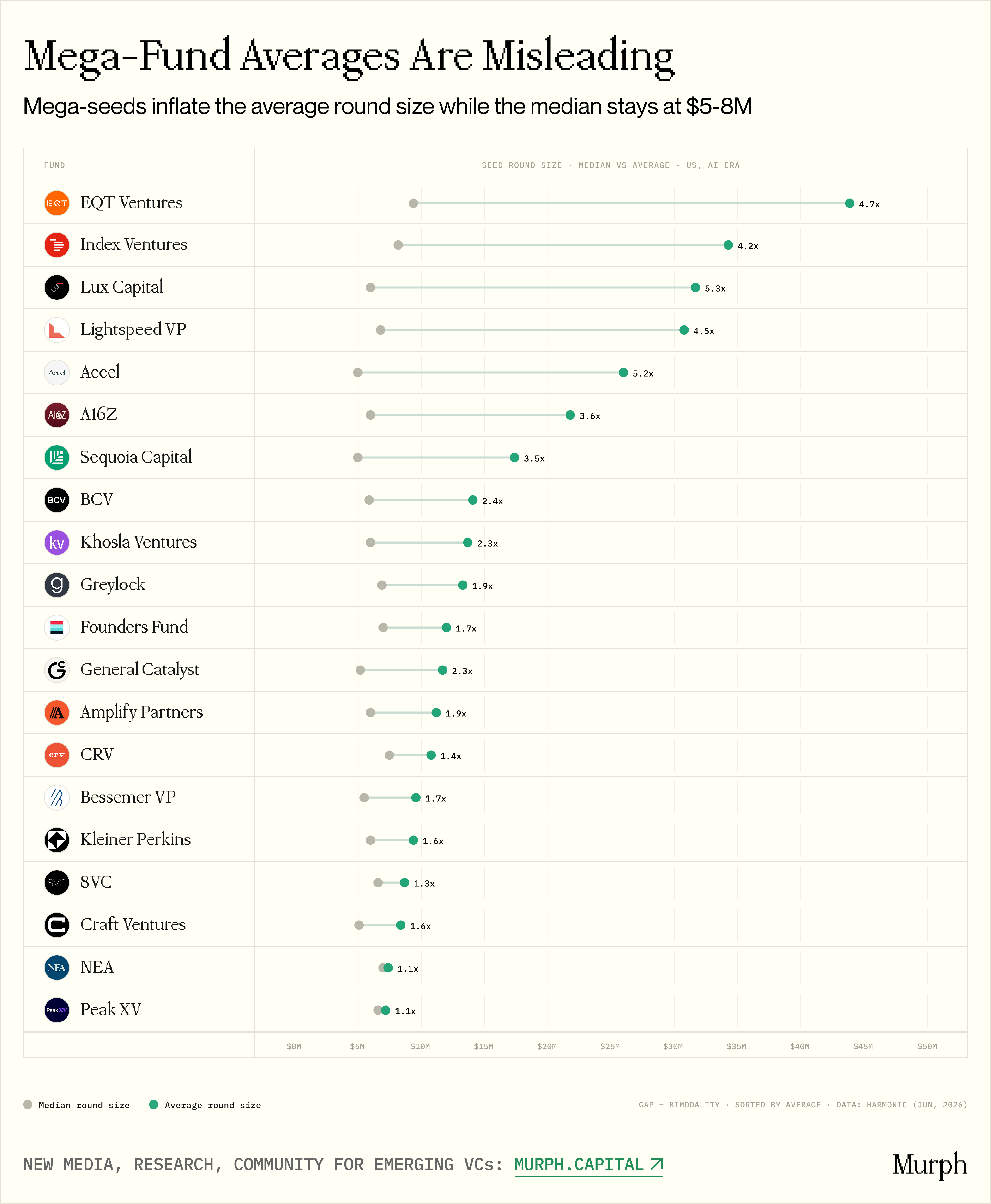
The median seed round involving a mega-fund is $6.2 million, 4.3-4.8x the overall US seed median (~$1.3M). Mega-funds systematically operate in the top quartile. Based on the gap between median and average round size, funds divide into 'dual-track' and 'homogeneous' types. Dual-track funds (Index, Lightspeed, Accel, a16z, Sequoia) play both classic seed ($5-8M) and super seed ($50M-$500M+). Their median is $5-8M, but averages are pulled up by huge outliers. Homogeneous funds (General Catalyst, Khosla, Bessemer, Greylock) have medians and averages close together, focusing exclusively on the $5-8M range. For emerging managers, homogeneous funds are the more persistent daily threat because they dominate the exact price range where most seed funds operate.
Key Finding 4: Lead Rates Are Rising, but Volume Dilutes Control
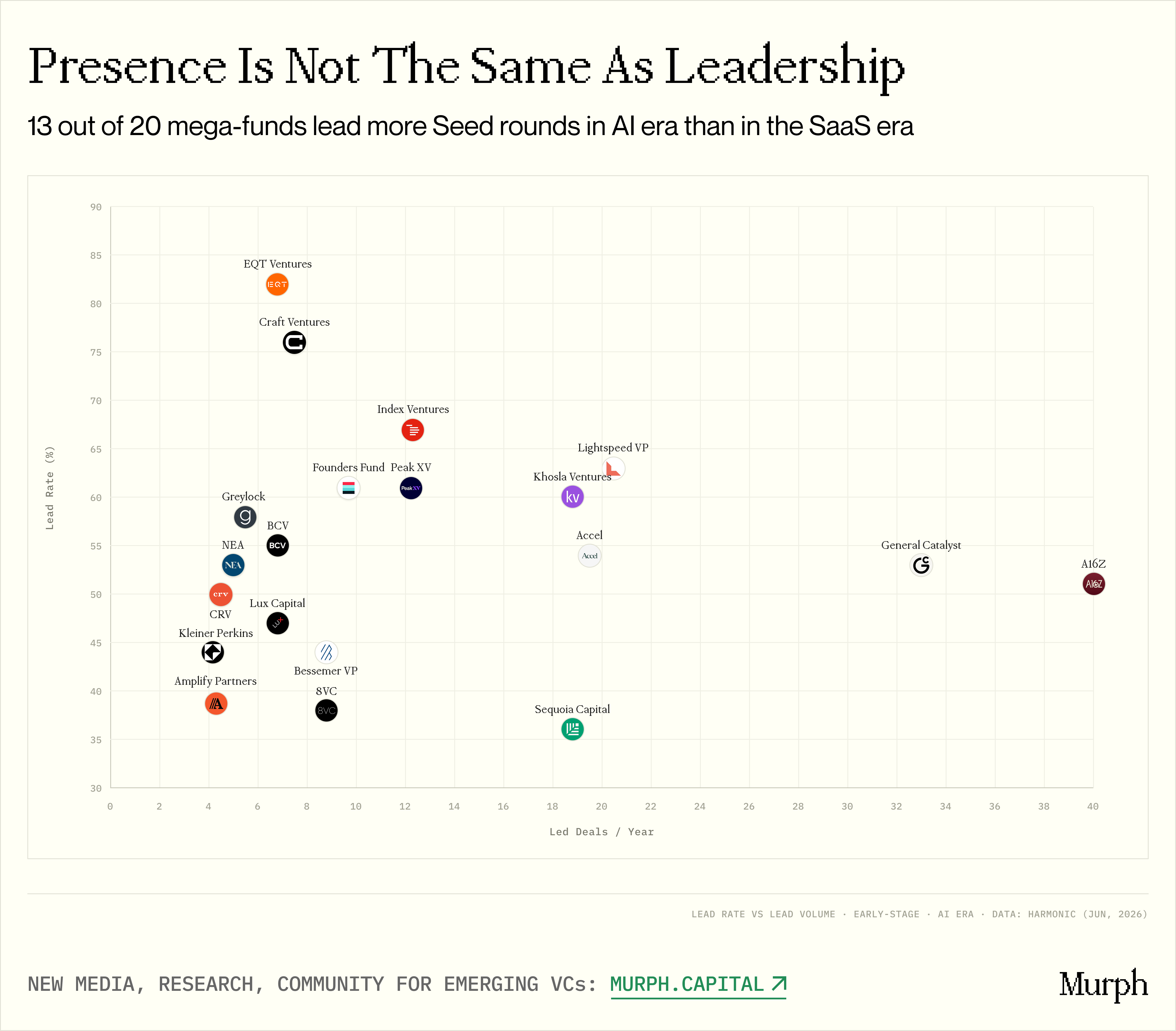
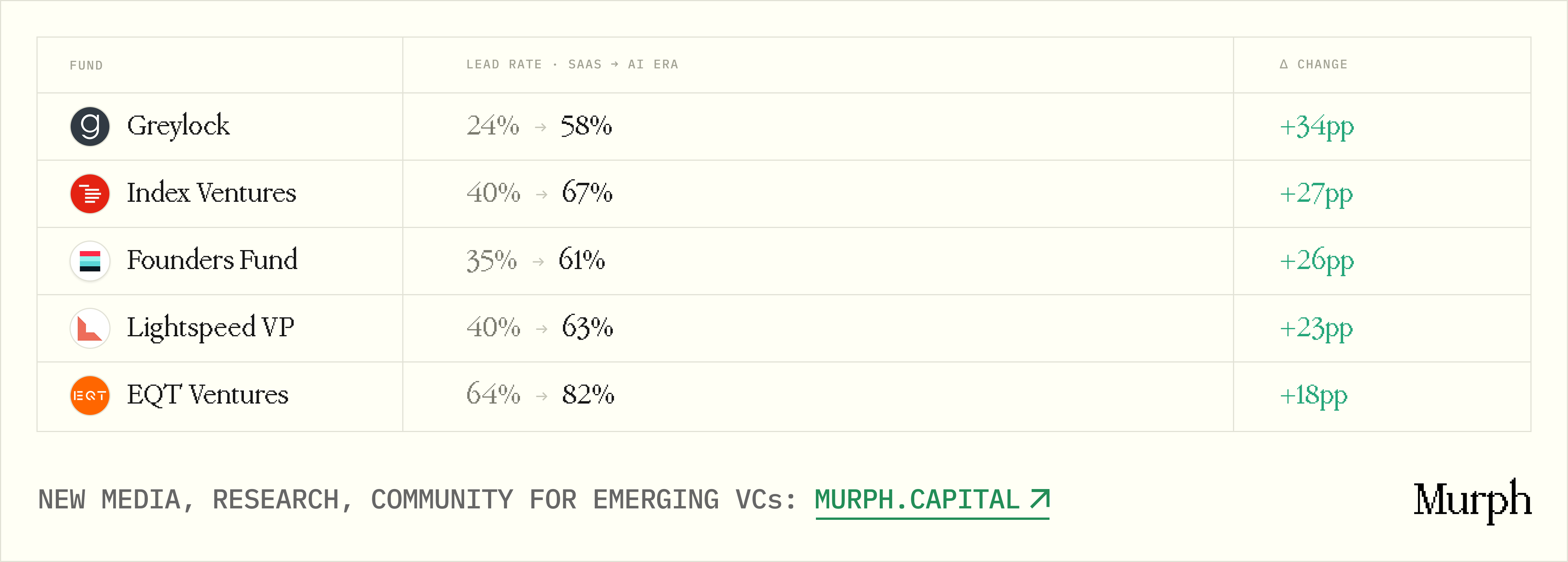
The lead rate—the percentage of seed deals where the fund sets terms—is rising across 13 of the 20 funds in the AI era vs. SaaS. 'Conviction lead' funds like Khosla (60%), Lightspeed (63%), and Accel (54%) lead 19-21 seed deals annually, making them the most dangerous competitors. However, the two largest by volume, a16z (51%) and Sequoia (36%), actually saw their lead rates decline from SaaS (a16z from 67%, Sequoia from 52%). The explanation: when you do 77 or 51 deals per year, it's physically impossible to lead every one. Yet in absolute numbers, a16z leads ~40 early deals per year and GC ~33—more than the total early-stage activity of half the funds on the list.
Key Finding 5: Sector Concentration Is Extreme, With Niche Exceptions
Enterprise AI & Automation and AI infrastructure & developer tools account for 42% of all mega-fund early-stage activity, with all 20 funds active. Drivers: enterprise AI spending soared from $1.7B in 2023 to $37B in 2025; top AI companies grow on a Q2T3 (4x,4x,3x,3x,3x) cadence vs. traditional SaaS T2D3; outliers like Lovable reached $1B ARR in 8 months. Cybersecurity (76 deals, 62% lead rate, $7M median round) and Defense & Aerospace (34 deals, 66% lead rate, only 12 active funds) are high-barrier niches where emergence managers can compete if they have deep domain expertise. Sectors like Climate & Energy, Logistics, PropTech, EdTech see much less mega-fund pressure.
Key Finding 6: Conversion Rate Is a Moat, but Volume Erodes Quality
The seed-to-Series B conversion rate for mega-fund-backed companies is 3.7-4.2x higher than the market average. Drivers include brand signaling, easier follow-on capital, talent and customer acquisition advantages. However, during the zero-interest era, the funds that expanded most aggressively saw dramatic conversion rate collapses: Sequoia tripled deal volume (20 to ~50/year) and saw conversion fall from 46% to 14%; Lightspeed quadrupled deal volume (12 to 42/year) and conversion fell from 31% to 11%. The only exception was Greylock, which kept volume constant (11.0 to 11.3/year) and saw conversion rise from 29% to 44%. This confirms the inescapable tension: mega-funds have not yet proven they can maintain high conversion rates while scaling.
Danger Index: Which Funds Threaten Emerging Managers Most?
The study constructs a 'Danger Index' based on three pillars: deal volume, strategic commitment (% of total activity in early-stage), and price overlap (median round size). Maximum score 30. Tier 1 (highest threat): General Catalyst (28), a16z (26), Sequoia (26), Accel (24). These funds compete directly in the $4-6M round market where emerging managers deploy capital. The danger index is not a death sentence but a minefield map—emerging managers must differentiate through niche selection, early access, and discipline, not by matching the volume of mega-funds.
Conclusion: Discipline Over Scale
The data confirms that mega-fund incursion into seed rounds is a permanent recalibration of venture capital. Their Achilles' heel is the tension between deployment volume and portfolio quality. The winning strategy for emerging managers is not to compete in crowded, high-priced sectors but to build deep domain expertise in less competitive verticals (climate, logistics, etc.), write the first check before mega-funds take notice, and maintain a concentrated, high-conviction portfolio. In an ecosystem increasingly obsessed with sheer scale, the ultimate counter-strategy for emerging managers is mastering the premium of absolute discipline.