

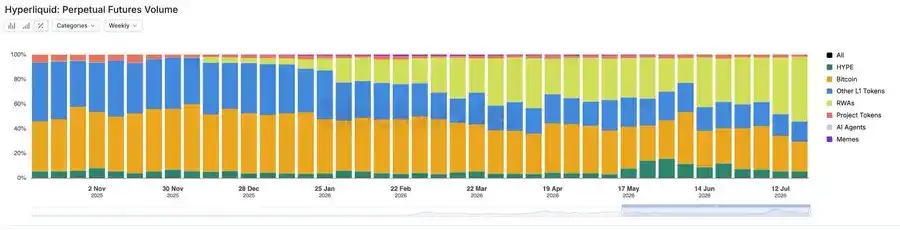
ARK Invest analyst Lorenzo said Hyperliquid has entered a new phase in DeFi, with real-world asset trading on the platform surpassing crypto-native volume for the first time on a single-week basis. In the post cited by MarsBit, RWA made up 54% of total volume on Hyperliquid.
Lorenzo also wrote that, since June, single-stock volume on HIP-3 has moved ahead of indices and commodities, and that 61% of all RWA trading volume now comes from single names. Based on that shift, he said RWA activity may not naturally consolidate on the same venues that dominate crypto trading today, and that separate category leaders could emerge inside the RWA market. He added that control of BTC, ETH and SOL order flow may matter less than many expect going forward.
Volume figures cited in the original thread
Using data attributed to Blockworks, the article says total DEX perpetual volume last week was $79 billion. Hyperliquid accounted for $50 billion of that total, and HIP-3 RWA volume reached $26 billion.
Lorenzo argued that Hyperliquid’s RWA market alone had grown larger than the combined crypto perpetual volume of every other DEX, and said investors still focused only on crypto token trading could be watching the wrong market.
What the chart is being used to show
The article’s longer analysis says the weekly mix on Hyperliquid was led mainly by Bitcoin and other layer-1 tokens through late 2025. That changed in 2026, with the RWA share rising steadily until it reached roughly 54% in the most recent week, making it the platform’s largest trading category.
That change is framed as a shift in product identity. In the article’s wording, Hyperliquid is moving from an on-chain crypto perpetual exchange toward a global, always-on, multi-asset derivatives platform. The reasoning is straightforward: the tradeable universe and market size in crypto are finite, while stocks, indices, commodities, FX and other traditional asset derivatives open a much larger pool of potential trading activity.
The piece also says the center of gravity inside RWA has moved beyond macro products such as gold, crude oil and the S&P 500. A third-party market snapshot cited in the article shows HIP-3 daily volume split roughly into 63% stocks, 20% indices and 16% commodities, close to the 61% single-stock share mentioned in the original post.
From that, the article argues that one of the clearest user demands on-chain may be leveraged price exposure to U.S. equities, traded around the clock with stablecoins as margin. The product users are buying, in this reading, is global access, 24-hour trading, leverage, lower-friction fund transfers and self-custody.
What “RWA trading” means on HIP-3
A key point in the piece is that the stocks, indices and commodities listed on HIP-3 are mostly perpetual contracts. Traders receive synthetic exposure to the price of the underlying asset. They do not take delivery of real shares, and they do not receive voting rights, claims on company assets or other shareholder rights. Pricing is kept close to external markets through oracle feeds and funding-rate mechanics.
That means the data supports one conclusion clearly: synthetic equity-style derivatives on-chain are attracting strong demand. It does not, by itself, prove that tokenized real shares, on-chain shareholder registries or atomic securities settlement have reached the same degree of adoption.
The article separates the two paths this way:
- Synthetic asset path: users post USDC and trade stock prices.
- Securities tokenization path: users actually hold on-chain securities with legal rights attached.
It says the first route can move faster and offer better capital efficiency, but comes with oracle, funding, market manipulation and regulatory risk. The second route requires coordination across custody, issuers, broker-dealers, transfer agents, clearing systems and securities rules, so progress is slower.
The platform-fragmentation argument
The article says Lorenzo is partly right in suggesting RWA may end up with separate leaders by segment, since different asset classes need different oracle setups, market makers, trading-hour handling, risk parameters and regulatory arrangements.
Still, it argues that HIP-3 allows that specialization to happen inside Hyperliquid rather than outside it. As described in the piece, HIP-3 lets third parties deploy their own perpetual markets. The deployer defines contract terms, oracle design, leverage limits and market operations while using HyperCore’s order book and margin infrastructure. The current threshold is staking 500,000 HYPE, and the deployer receives a fixed 50% share of the related trading fees.
On that basis, the article outlines a possible two-layer structure: Hyperliquid as the leading base-layer trading infrastructure, and HIP-3 deployers such as trade[XYZ] as leaders in specific asset verticals.
The snapshot cited in the story says trade[XYZ] accounted for about $5.577 billion in daily HIP-3 volume, while HIP-3 as a whole stood near $5.585 billion, or almost 99.9% concentration in a single deployer. The article’s conclusion is that category leaders inside RWA would not necessarily weaken Hyperliquid, as long as they continue to rely on HyperCore for matching, margin and settlement.
A math issue raised by the article
The write-up also points to a clear arithmetic problem in the original comparison.
Using the figures presented:
- Total DEX perpetual volume: $79 billion
- Hyperliquid volume: $50 billion
- Other DEX volume combined: $29 billion
- Hyperliquid HIP-3 RWA volume: $26 billion
On that basis, $26 billion is below $29 billion. The article says the statement that Hyperliquid’s RWA volume exceeded the crypto perpetual volume of all other DEXs cannot be directly derived from those numbers alone. It suggests the gap may come from different time windows, different data sources or a methodology for the $79 billion figure that may exclude part of HIP-3 activity, but notes that the original post does not explain the discrepancy. It also says simple rounding cannot account for a difference of about $3 billion.
What the shift could mean for HYPE
The article treats the development as a positive long-term signal for HYPE’s fundamentals, while adding several caveats.
First, it says Hyperliquid’s total addressable market expands as it moves into stock, index, commodity and FX derivatives. Second, revenue sources become less tied to the crypto cycle, because earnings reports, macro data, commodity moves and geopolitical events can drive trading demand independently of BTC bull and bear phases. Third, network effects get stronger as more markets bring in more traders, market makers, collateral and developers.
But the article is explicit that rising volume does not automatically equal revenue growth or token value capture. HIP-3 deployers receive 50% of trading fees, and trade[XYZ] has enabled Growth Mode on some contracts, allowing fee rates to be cut by more than 90%. In a period of fast volume growth, revenue per unit of volume could fall at the same time.
The metrics it says matter next are RWA fee revenue, open interest, retention among active traders, bid-ask spreads, the share of non-incentivized volume, and how much RWA fee income ultimately enters the HYPE value-capture mechanism.
USDC and Circle
According to the article, trade[XYZ]’s stock perpetuals currently use USDC as collateral, with the products themselves priced in dollars. That gives USDC three roles at once: trading margin, profit-and-loss settlement unit, and a unified funding account across stocks, crypto and other assets.
The article calls that a direct positive for USDC, but it also says $26 billion in weekly volume does not mean $26 billion in new USDC demand. Perpetual volume is notional turnover, and the same USDC collateral can support repeated trades within the week.
How much Circle ultimately benefits depends, in the article’s view, on the average margin balance, how much USDC stays on Hyperliquid over time, and whether USDC remains the main collateral asset for HIP-3.
The article’s main conclusion
Its bottom line is that the first breakout RWA application in on-chain finance may be round-the-clock synthetic stock trading margined in USDC, not the migration of actual stock ownership onto blockchains.
The piece says Hyperliquid has already shown that one on-chain order-book system paired with stablecoin margin can carry price exposure for both crypto assets and traditional assets. In that sense, it argues, the platform is moving closer to an open, global, on-chain combination of a CME-style and Nasdaq-style derivatives venue.
At the same time, it says Lorenzo’s broader point that focusing only on crypto trading may miss a larger market is worth taking seriously, while his suggestion that BTC, ETH and SOL order flow will stop mattering is still premature. The article says crypto flow gave Hyperliquid its initial users, market-making capital, collateral, brand and liquidity, all of which mattered for its move into RWA.
The current HIP-3 market map
In a second section, the article details what is trading on HIP-3. Citing OAK Research data around July 24, 2026, it says Hyperliquid had about 115 HIP-3 markets across four deployers. RWA volume was concentrated almost entirely in XYZ, with an approximate structure of 63% stocks, 19% commodities, 17% indices and about 0.4% in other categories.
Stocks and equity ETFs
This is described as the largest and fastest-growing category.
The semiconductor and AI supply-chain list includes NVDA, AMD, MU, INTC, SNDK, MRVL, TSM, ASML, AVGO, QCOM, WDC, SKHX, SMSN, KIOXIA, DRAM, SMH and LITE. The article says recent volume has been especially strong in SK Hynix (SKHX), Micron (MU), the DRAM index and SanDisk (SNDK), which it interprets as evidence that AI, memory and semiconductor trades are driving much of HIP-3’s growth in single names.
Large-cap tech and software products listed include AAPL, MSFT, GOOGL, AMZN, META, ORCL, NFLX, PLTR, NOW, IBM and ARM.
Crypto-adjacent finance and high-volatility names include CRCL, COIN, HOOD, MSTR and STRC. The article says these products fit naturally with a user base that overlaps heavily with crypto traders and is already comfortable using USDC as trading collateral.
Other names tied to new energy, space, AI infrastructure and popular high-beta themes include TSLA, RIVN, RKLB, SPCX, CRWV, NBIS, CBRS, BOT, HIMS, LLY, GME, DKNG, DELL, BX, BABA and SOFTBANK.
For Asian equities and country ETFs, the list includes SKHX, SMSN, HYUNDAI, TSM, BABA, EWY, EWJ and EWT. The article also says trade[XYZ] converts Korean stock prices from KRW into dollars using the USD/KRW exchange rate, with margin and P&L settled in USDC.
Equity indices
The main products listed are XYZ100, SP500, KR200 and JP225, with some third-party deployers also offering similar products such as USA500. The article says XYZ100 and SP500 are among the largest markets on HIP-3 by volume.
Commodities
HIP-3 is described as having built a relatively complete macro commodity line.
Energy products include CL, BRENTOIL and NATGAS. Precious metals include GOLD, SILVER, PLATINUM and PALLADIUM. Industrial metals include COPPER.
The article says WTI crude is one of the highest-volume HIP-3 markets, while Brent, silver and gold also post sizable activity. It adds that these products can keep trading within HIP-3 when traditional futures markets are closed, allowing the market to function as a weekend venue for price discovery around geopolitical and macro events.
FX
The current lineup includes EUR, JPY and GBP, corresponding to EUR/USD, USD/JPY and GBP/USD. Maximum leverage can reach roughly 50x, and external price coverage is close to the traditional FX market’s 24-hour, five-day schedule, according to the article.
Sector and theme ETFs
Beyond country ETFs, the article says HIP-3 also lists sector and thematic ETFs such as URNM, SMH, XLE, EWY, EWJ and EWT. It notes that some of these products are counted under “Stocks” in category statistics, which means the chart’s 61% single-stock share may also include part of the ETF and equity-product complex.
Pre-IPO and special assets
HIP-3 can also list valuation contracts tied to private companies. The example cited from trade[XYZ] documentation is QNT, a pre-IPO contract linked to Quantinuum.
The article says contracts tied to OpenAI, Anthropic, SpaceX and Cursor appeared historically, but Ventuals has ceased operations. Its HIP-3 markets were scheduled to settle and stop trading by June 19, 2026, so OpenAI and Anthropic should no longer be treated as active markets. It adds that names such as SpaceX could later be converted or reclassified as standard stock-price perpetuals if they complete an IPO.
The RWA names currently driving turnover
Based on the recent 24-hour ranking cited in the article, the larger HIP-3 RWA markets include:
- WTI crude (CL)
- SK Hynix (SKHX)
- Nasdaq-100-like index (XYZ100)
- Brent crude (BRENTOIL)
- Micron (MU)
- S&P 500 (SP500)
- DRAM index
- SpaceX (SPCX)
- Silver (SILVER)
- SanDisk (SNDK)
The article sums up the current growth engine in HIP-3 RWA as AI and semiconductor single stocks, U.S. equity indices, energy commodities and precious metals.
It closes with the same caveat repeated throughout the piece: all of these products are synthetic perpetual contracts. Traders get price exposure, not actual ownership of stocks, ETFs or commodities, and they do not receive dividends, voting rights or legal title. In most cases, the trades are margined in USDC and track external prices through oracle feeds, funding rates and market-making mechanisms.