

ARK Invest bought about $77 million of crypto-related equities in June, increasing exposure to a sector that had just gone through one of Bitcoin’s weakest monthly performances in the past four years. Based on ARK’s daily trade disclosures, the firm added roughly $44 million of Coinbase, $25.25 million of Circle, and $8.2 million of Bullish. The trades are consistent with Cathie Wood’s long-standing view that listed equities can offer regulated access to crypto upside without requiring investors to hold Bitcoin directly.
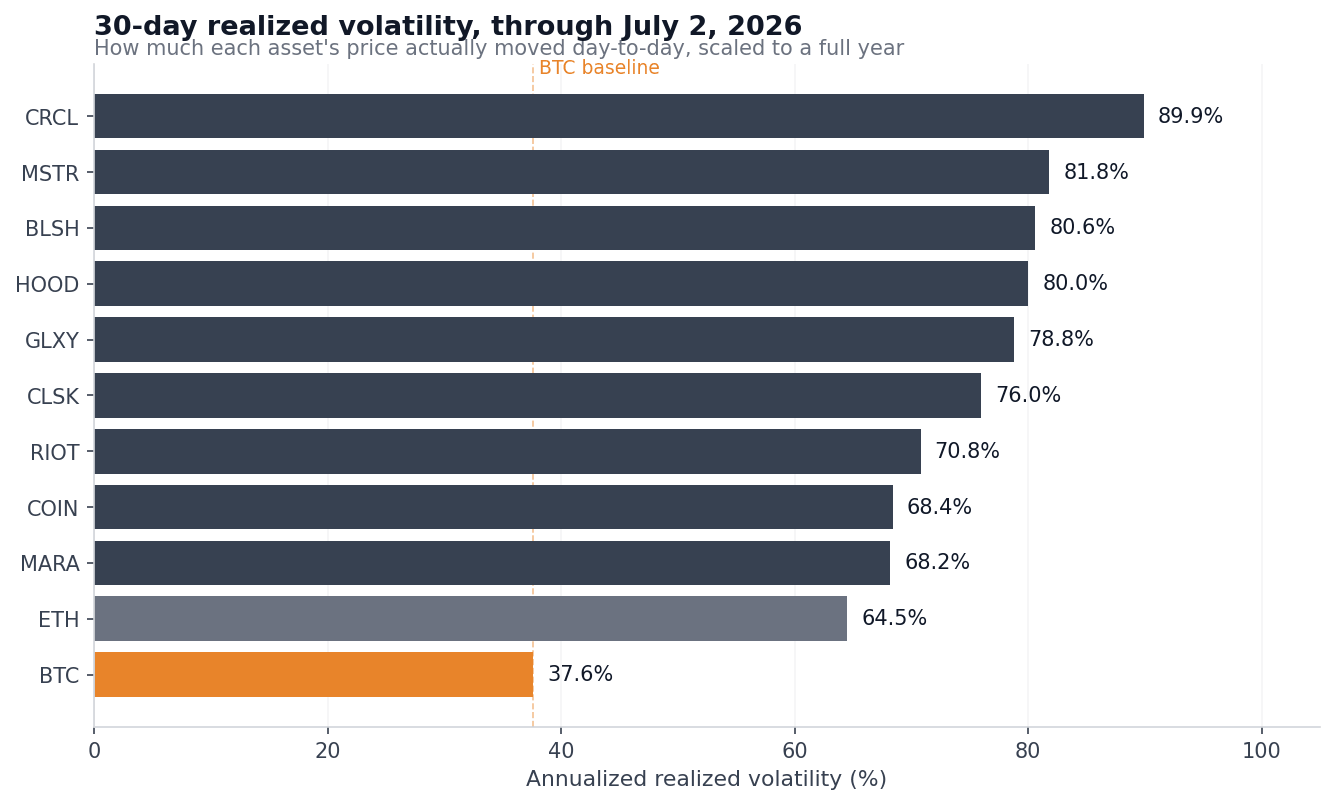
Yet the numbers show that this approach does not necessarily reduce risk. Data analyzed through July 2 indicates that nine U.S.-listed crypto companies posted 30-day annualized realized volatility in a range of 68% to 90%, nearly twice Bitcoin’s 37.6%. On a 90-day basis, Circle reached 103.6% volatility, versus just 37.8% for Bitcoin. Drawdowns also widened materially: Circle fell 51.4% from its high, MSTR dropped 48.6%, and Bullish declined 43.6%, all steeper than Bitcoin’s 36.4% retreat from its January peak near $97,000.
Higher volatility does not mean these stocks simply track Bitcoin with leverage
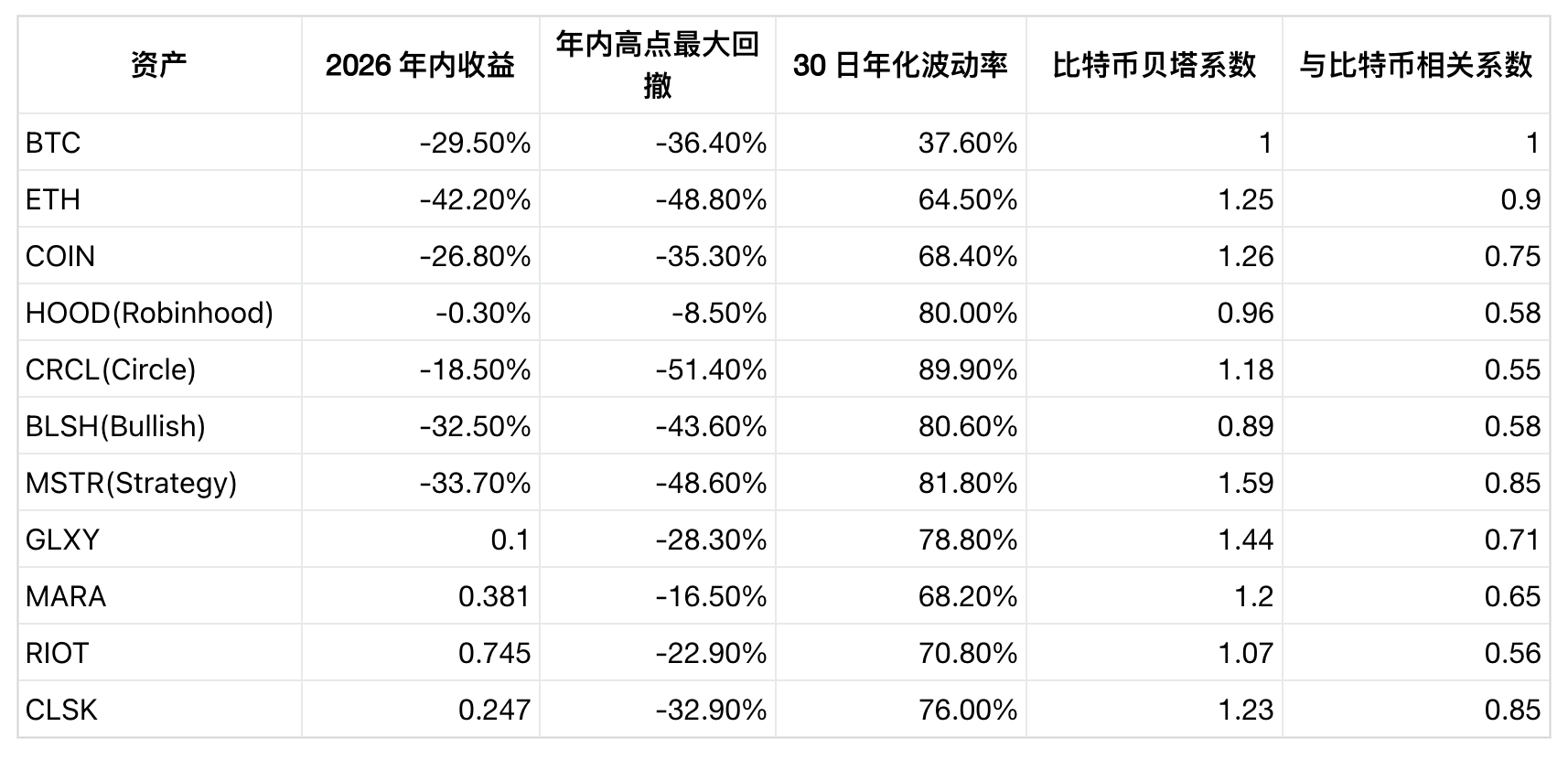
At first glance, crypto equities may appear to be little more than leveraged Bitcoin trades. But correlation data suggests a more complicated reality. Over the last 90 trading days, Circle, Robinhood, and Bullish showed correlations with Bitcoin of only 0.55 to 0.58. In practical terms, that means Bitcoin explains only about one-third of the price behavior in those stocks, while the rest comes from company-specific drivers such as earnings reports, competition, financing activity, dilution, and execution risk.
That distinction matters because investors buying crypto equities to express a view on the digital asset cycle may end up with only partial Bitcoin exposure while also taking on a full set of equity-market risks. Instead of a clean directional bet on BTC, they are often buying a hybrid instrument whose returns depend on both crypto sentiment and management, business model, and capital structure.
MSTR remains the closest thing to a Bitcoin proxy
Within the sector, MSTR stands out as the only stock that behaves much like a direct Bitcoin substitute. Its beta to Bitcoin is 1.59 and its correlation is 0.85, making it effectively a leveraged equity wrapper around Bitcoin holdings. That characteristic can be attractive in a rising market, but it also amplifies downside when sentiment turns. In the latest drawdown, both its year-to-date losses and pullback from peak levels exceeded those of Bitcoin itself.
Coinbase offers a more balanced profile. The stock was down 26.8% year to date, slightly better than BTC, with a beta of 1.26 and a correlation of 0.75, the second-strongest linkage to Bitcoin in the group. Even so, its volatility still approached twice that of Bitcoin, and shares remained 60.6% below the all-time high of $419.78 reached in July 2025. For investors who bought that top, losses have been materially worse than for those who entered Bitcoin at its own late-2025 peak.
Circle and Robinhood show how business mix reshapes crypto equity exposure
Circle illustrates the limits of the “crypto stock equals crypto exposure” thesis. It had the lowest correlation to Bitcoin in the group and the highest 90-day volatility. The clearest example came on June 30, when Open USD, a stablecoin backed by more than 140 companies including Coinbase, Stripe, Visa, Mastercard, and BlackRock, officially launched. Circle shares fell 17.5% in a single day. The move had little to do with Bitcoin and instead reflected direct competitive pressure in the stablecoin and payments market.
Robinhood represents the opposite case. Its shares were down just 0.3% year to date, with a maximum drawdown of only 8.5%. That resilience stems from the company’s broader brokerage model, where crypto is only one component alongside equities, options, and derivatives. Diversification helped cushion downside during weaker crypto conditions. The tradeoff, however, is that investors should not expect Robinhood to fully capture upside during a crypto bull run either.
Miners have increasingly traded on AI and compute narratives, not just Bitcoin
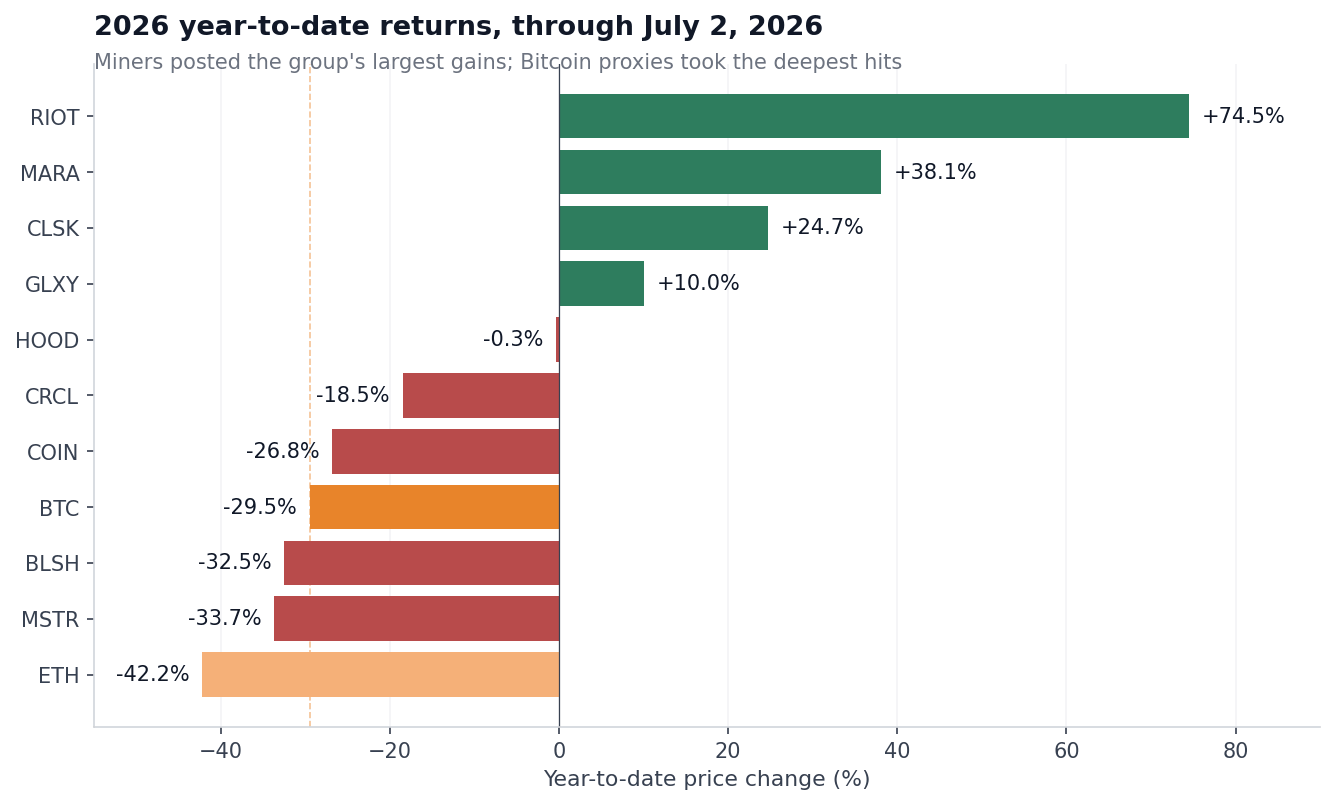
The mining segment has diverged even more sharply from spot Bitcoin performance. While Bitcoin was down 29.5% on the year, RIOT rose 74.5%, MARA gained 38.1%, and CleanSpark advanced 24.7%. The key explanation is that miners have been repositioning themselves as AI and high-performance compute providers, signing large compute leasing agreements and continuing to reduce their Bitcoin inventories.
These companies still react to Bitcoin on a day-to-day basis, and their betas remain above 1. But their full-year return profile has been driven increasingly by AI hosting, data center utilization, and infrastructure narratives rather than by BTC alone. That makes them even less suitable as pure Bitcoin substitutes, despite their continued classification as crypto equities.
Strategy highlights the capital structure risk that spot Bitcoin holders do not face
Buying Bitcoin exposes investors primarily to the asset’s price fluctuations. Buying a listed crypto company adds layers of business, financing, and balance-sheet risk on top. Strategy has become the clearest illustration of that difference. At the end of June, its mNAV multiple fell below 1 for the first time. That metric compares the company’s market valuation with the value of its net assets. When it falls below 1, the market is effectively valuing the firm at less than the worth of the cash and Bitcoin it holds.
As of the company’s June 22 disclosure, Strategy held 847,363 BTC. On the day mNAV fell below 1, those holdings were worth about $50 billion. The problem is structural: Strategy’s growth model relied on trading at a premium, issuing common and preferred shares, and using that capital to buy more Bitcoin. Once mNAV drops below 1, further equity issuance can become value-destructive because it resembles selling Bitcoin exposure at a discount through stock issuance.
By late June, Strategy’s market capitalization had dropped to $29.54 billion, less than half of its peak above $71 billion in 2024, while all four classes of preferred stock had fallen to historical lows. In response, the company announced on June 29 a share repurchase authorization of up to $1.25 billion and said it could sell Bitcoin to support liquidity, including preferred dividends and debt interest. Weeks earlier, on June 1, it had already sold 32 BTC, its first Bitcoin sale since 2022. After the June 29 announcement, the stock jumped 12.6% in a single session, ending an eight-day losing streak.
ARK’s buying spree is effectively a basket bet on very different business models
This is the backdrop against which ARK continued to add exposure. On June 25, as crypto equities broadly sold off, Wood’s funds bought $3.27 million of Robinhood in one day while also adding to Coinbase, Circle, and Bullish. Wood has maintained a long-term Bitcoin target in the million-dollar range and appears to view the current weakness as an opportunity to accumulate listed crypto companies trading well below their 2025 highs.
But the underlying data makes clear that these are not interchangeable vehicles. Strategy is best understood as leveraged Bitcoin exposure plus dilution risk. Circle is a stablecoin and payments company facing fierce competition. Robinhood is a diversified brokerage where crypto is secondary. The miners are increasingly tied to AI compute narratives. In that sense, ARK is not simply buying “crypto stocks”; it is assembling a portfolio of companies with very different revenue engines, risk profiles, and degrees of sensitivity to Bitcoin.
Some of those bets have worked better than holding BTC this year. Coinbase has outperformed Bitcoin on a year-to-date basis, Robinhood has mostly preserved its starting level, and miners have led returns thanks to AI-related demand. Still, the broader conclusion remains difficult to ignore: crypto equities are not inherently lower-risk alternatives to owning Bitcoin. Across the available sample, they either magnify Bitcoin’s volatility or introduce substantial company-specific risks unrelated to the asset itself. In 2026, the strongest-performing crypto stocks have often rallied on AI compute, brokerage traffic, and payment products, with Bitcoin playing only a secondary role.