


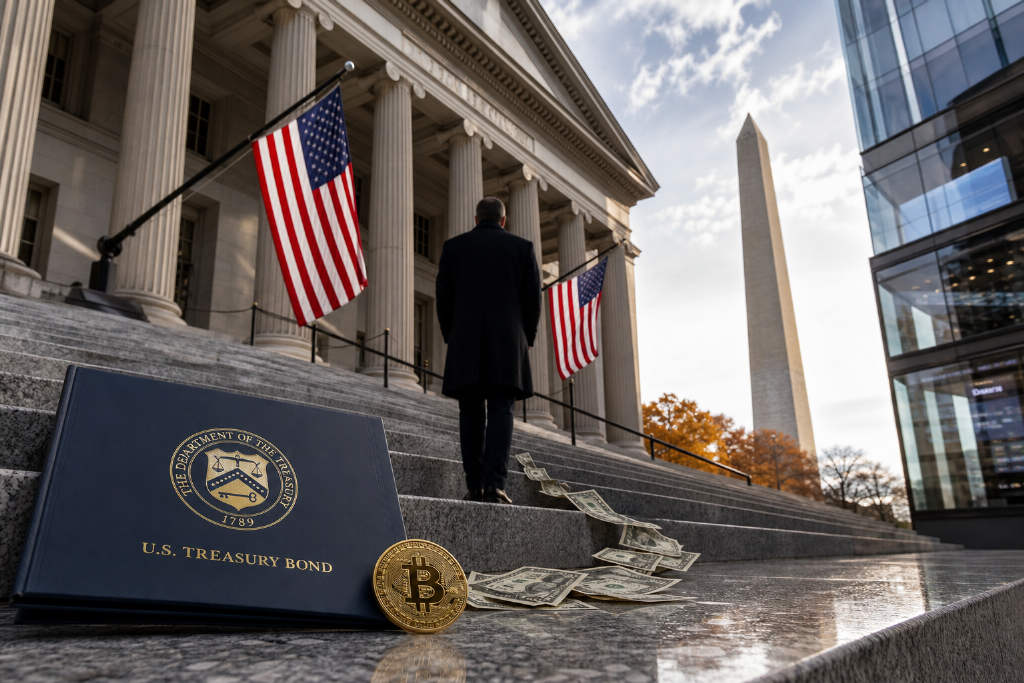
Arthur Hayes said the real bullish trigger for Bitcoin appears when the US 10-year Treasury yield gets close to 5%, arguing that both Janet Yellen and Scott Bessent turn to liquidity-creating measures once that level comes under pressure.
The article, written by Hayes and translated by TechFlow, says the names and rhetoric may change, but the policy response does not. In his view, once Treasury market stress starts to threaten growth through higher long-term borrowing costs, the US Treasury shifts toward actions that suppress yields and release dollar liquidity. Hayes argues that this liquidity then flows into Bitcoin and other crypto assets.
A fictional scene used to make a policy argument
Hayes opens with an extended fictional nightclub scene in New York, placing Bessent and Yellen in the same setting and using the confrontation to frame the article’s main point. The style is deliberately exaggerated, but the argument underneath is simple: both Treasury secretaries, despite different pre-office narratives, respond in similar fashion when the bond market tightens.
He writes that both are constrained by politicians who want to keep spending, and both ultimately treat intervention in the Treasury market as the answer when yields rise too far. In Hayes’s telling, those interventions amount to a form of money printing because they create dollar liquidity that can move into financial markets, including crypto.
He focuses on two episodes. The first is late 2023, when Yellen issued more short-term Treasury bills than longer-dated debt. The second is the current period, where Hayes says Bessent has intervened in the dollar-yen market and then increased the nominal size of Treasury buybacks. Hayes says Bitcoin reacted positively after Yellen’s liquidity measures, and he expects a similar pattern if Bessent accelerates liquidity creation in the same way.
Why the 5% level matters
Hayes describes the 10-year Treasury yield as the most important price in the American financial system. He says 30-year fixed mortgage rates, corporate borrowing costs and a range of consumer debt products are priced off the 10-year yield, with mortgage rates also affected by prepayment optionality.
His conclusion is that once the 10-year yield moves above 5%, financing costs for households and businesses become too expensive, and economic activity starts to slow. That, he says, is why officials fight so hard to defend that level.
Treasury bills, longer debt and the reverse repo channel
Hayes then turns to the difference between Treasury bills and longer-dated government debt. He says bills mature in less than one year, while longer-dated securities extend beyond that. In a footnote, he adds a stricter breakdown: bills mature in less than one year, notes in one to 20 years, and bonds in 20 to 30 years.
Because very short duration is closer to cash, Hayes says these instruments are more liquid and more attractive to many investors, especially money market funds. Those funds want the highest available yield while taking as little interest-rate risk and counterparty risk as possible.
He says the safest place to hold cash is at the Federal Reserve because the Fed can always create money and does not need congressional approval to settle its own liabilities. The Fed’s reverse repo facility, or RRP, gives eligible counterparties a place to park money and earn a return close to the effective federal funds rate.
At the same time, Hayes says lending to the US government in dollars may be treated as risk-free in theory because the government can print money, but actual debt settlement still depends on congressional approval. That is why debt-ceiling confrontations matter for markets. If politicians fail to approve spending, bondholders may not be paid in full when expected. In that setup, he says Treasury bills need to yield slightly more than the RRP to compensate money market funds for that risk.
Hayes’s reading of Yellen’s late-2023 move
Hayes presents late 2023 as the first major case study. He says voters were focused on the cost of living, and with the 2024 election approaching, the administration needed market-supportive liquidity without making it look like direct money printing that would fuel inflation.
According to Hayes, about $2.5 trillion was sitting in the RRP at the time. He says those funds had a money multiplier of zero while they remained on the Fed’s balance sheet and could not be rehypothecated. But if money market funds shifted those balances into higher-yielding Treasury bills, the banking system could rehypothecate them, sending liquidity into bonds, lowering yields and lifting equities.
He links that process to crypto as well, saying Bitcoin had also bottomed after the FTX collapse. In his account, larger bill issuance pushed bill prices down and yields up to levels well above the RRP yield, which gave money market funds a reason to move capital between the two instruments.
Hayes gives a specific before-and-after figure. By the time Bessent took office on Jan. 20, 2025, RRP balances had fallen from $2.5 trillion to $100 billion. He treats that $2.4 trillion change as a liquidity injection, saying the funds originated from deposits created during the COVID stimulus period and then moved into financial markets. He says the Nasdaq 100 and Bitcoin rose, while the 10-year yield moved down quickly from the critical 5% area, even as the federal funds rate stayed around 5.3%.
That, in his view, explains why Bitcoin and other risk assets rose even as the Fed held rates at the highest level since 2008 and continued quantitative tightening. He notes that academics coined the term activist Treasury issuance, or ATI, to describe the type of policy Yellen used.
Bessent’s version of the same problem
Hayes argues that Bessent is dealing with the same structural issue. No matter where a US president wants to spend, the Treasury secretary still has to fund that spending at low cost.
He says Treasury bills are the highest-yielding and safest dollar-denominated cash-like instrument, which is why demand for them remains strong. He adds that even crypto participants effectively hold bill-linked exposure through products such as USDT and USDC.
Still, he says the Treasury bill solution has a cost. Bills mature within a year, so the larger the bill share in Treasury funding, the faster the debt snowball rolls. The Treasury then has to issue more and more debt each week to finance new spending and repay maturing obligations, which accelerates growth in total US debt outstanding.
Hayes says this structure also pulls the Federal Reserve back into the center of the system. He writes that the Fed currently prints money, more precisely creates bank reserves, to buy Treasury bills under its reserve management program, or RMP. The monthly nominal purchase size is decided by New York Fed President Williams. If Williams believes markets cannot function properly without additional Fed-created dollar liquidity, Hayes says he can instruct traders to create reserves and buy Treasury bills in the open market.
In Hayes’s framing, that means the Fed prints money to make sure politicians’ checks clear.
Using buybacks to lean on the long end
Hayes then describes how Bessent could issue large amounts of debt and use the proceeds to buy back longer-dated notes and bonds, shaping the yield curve in the process.
He says Bessent first hinted at this capacity shortly after last year’s so-called Liberation Day. At that time, Hayes writes, Trump had tried to use aggressive tariffs to redirect global trade flows, but backed off after markets reacted sharply. Bessent’s message, according to Hayes, was that the market should not test him because the Treasury had a powerful tool: buybacks.
More than a year later, Hayes says Bessent formally moved toward heavier use of that tool to suppress long-end yields.
What happened on Aug. 19
Hayes spends particular time on Bessent’s Aug. 19 announcement. He says Bessent unexpectedly said the Treasury would begin buybacks above the previously planned size at the start of next month and lifted total long-end buybacks for the next fiscal quarter by $20 billion.
According to Hayes, the 10-year yield fell quickly after the announcement, but only modestly. Bitcoin woke up and rallied strongly over the following two days. Yet by the close of the next trading session, the 10-year yield was above its pre-announcement level.
Hayes offers three reasons.
- First, he says the scale was too small. Against a total debt stock of $40 trillion, an extra $20 billion was negligible.
- Second, he says the market sensed panic. Just weeks earlier, Bessent had supported removing the usage cap on the FIMA facility, allowing Japan and other large holders of US Treasuries to borrow newly created dollars from the Fed against their bonds instead of selling those bonds in the open market.
- Third, and most important in Hayes’s view, the market understood that pushing the 10-year yield higher could force Bessent to go much further and inject trillions of dollars in liquidity, just as Yellen had done through different channels.
Hayes calls Bitcoin a global liquidity smoke alarm and says it clearly picked up the signal. If Bessent proves willing to behave like a more aggressive version of Yellen, Hayes believes Bitcoin could launch a sharp move from its lows.
What Bessent might do next
Hayes lays out several possible paths from here, always returning to the same premise: assets like Bitcoin are highly sensitive to dollar liquidity.
The worst case: spending cuts
For Bitcoin, Hayes says the worst outcome would be for US politicians under President Trump to decide to cut spending. He does not think that is likely, saying elections are only months away.
He also mentions the growing momentum of democratic socialist politicians associated with AOC. In a footnote, he identifies AOC as Alexandria Ocasio-Cortez and says she is the leading candidate for the Democratic presidential nomination in 2028.
The best case: an explicit 5% cap through unlimited buybacks
Hayes says the most bullish version would be a Bank of Japan-style intervention regime. Under that approach, Bessent would tell the market that if yields move above 5%, the Treasury will buy back unlimited amounts of 10-year and longer bonds.
Hayes expects bonds to rally first and yields to drop sharply if such a policy is announced, because the market would initially give Bessent the benefit of the doubt. But he also says every uneconomic intervention is eventually tested, and traders would try to find out whether Bessent is truly prepared to defend that line with enough dollars.
The middle path: step-by-step escalation
Hayes says the most likely path is incremental escalation until market stress becomes severe. He points to a MOVE Index reading above 130 as the marker of that kind of stress.
In that scenario, Bessent would keep increasing buybacks and look for other, less visible ways to create Treasury-linked liquidity.
Another obvious option: run down the TGA
Hayes also points to the Treasury General Account, or TGA, as another source of funding for buybacks. He says Bessent recently discussed the idea on CNBC and that the TGA holds about $1 trillion.
By contrast, Hayes says direct Fed rate cuts or unlimited quantitative easing are politically difficult right now, at least until the AI credit bubble truly breaks in coming years. He says US voters remain focused on the cost of living, and the public now understands that rate cuts and QE mean money printing.
His market stance and disclosed positions
Hayes closes with a direct market call. Whether Bessent releases liquidity quickly or slowly, he says Bitcoin will keep rising. But he also warns that volatility will increase, so even a chart that trends upward can still include sharp pullbacks. Unless someone is a full-time trader, Hayes says, they should avoid leverage.
His practical advice is to buy Bitcoin or whatever altcoin one prefers and sit tight while Bessent does the work.
He also discloses that Maelstrom is fully risk-on. The assets he names are Bitcoin, Ether, Ethena and Ether.fi.
Flop Network mention at the end
The article ends with a plug for the Flop Network airdrop. Hayes says this is the best time to take part, that there is no presale, and that users cannot buy $FLOP. Only those who participate in the testnet airdrop campaign in a useful way are eligible, he writes, adding that more details are available via the X account @flop_labs.