
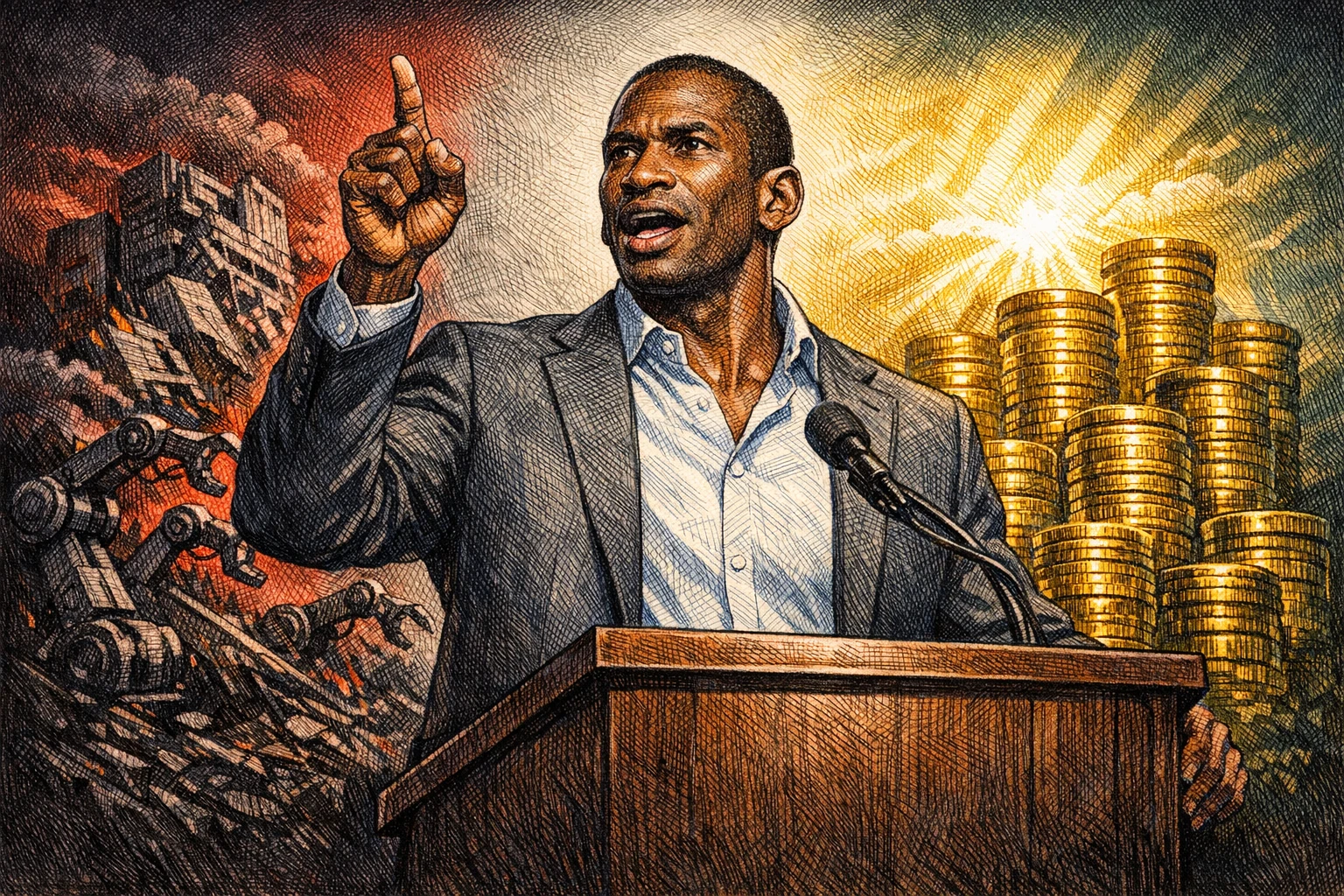
BitMEX co-founder and Maelstrom CIO Arthur Hayes took the stage at Bitcoin 2026 in Las Vegas with a blunt declaration: “AI is the new subprime.” He argued that bitcoin’s dominant narrative has shifted from “AI deflation and bank credit contraction” to “wartime inflation and forced government money printing,” and reiterated his year-end target of $125,000, adding his trademark caveat: “Long term, I’m still bullish.”
Narrative Flip: AI Deflation Gives Way to Wartime Inflation
Hayes dissected the past six months of decline: bitcoin hit an all-time high of $126,000 in October last year, then dropped roughly 50% by the time of the conference, while the Nasdaq remained nearly flat. The drawdown wasn’t in big tech but in SaaS. “A SaaS company used to charge $10,000 per seat; now AI can do the same job for $10 a month,” he said. The sell-off reflected an anticipated bank-level credit contraction: high-earning knowledge workers face unemployment, SaaS companies default on loans, and AI replaces an entire high-income cohort. Hayes branded this phenomenon “AI is the new subprime.”
But after the U.S.-Iran war broke out in late February, the trajectory reversed. “Since the war started, bitcoin has outperformed both the Nasdaq and SaaS stocks,” Hayes noted. “Bitcoin is now focused on ‘wartime inflation.’”
Hayes’s Unfiltered Opening: “Hopefully We Don’t Die in a Nuclear War”
Hayes set the stage with an unfiltered list of assumptions: “First, hopefully we don’t die in a nuclear war — if that happens, there’s no investment anyway. Second, assume markets treat this war as a short-term event. Then we can talk about money printing and what it means for bitcoin.” On AI’s impact on the banking system, he dropped the conference’s sharpest line: “I personally want to fire all human accountants and lawyers — I spend too much on them. I can’t wait for Claude to take over. That’s the ‘AI is the new subprime’ thesis: once high-paid knowledge workers fall, hundreds of billions or even trillions of dollars in bank loans go bad.” Summing up the narrative shift: “After the U.S. explicitly acknowledged a wartime footing, insufficient defense spending, and the need to print more money for bombs, markets began repricing bitcoin. My year-end target is roughly $125,000 — long term, I’m still bullish.”
Kevin Warsh Is Not a Hawk: The Fed-Bank Swap “Trick”
Markets have been panicking since January over potential Fed chair Kevin Warsh, fearing he would slash the Fed’s balance sheet and drain dollar liquidity. Hayes dismissed this interpretation. He laid out Warsh’s actual path: the Fed wouldn’t sell bonds directly — that would crush markets — but would instead execute swaps with commercial banks. The Fed would take roughly $3 trillion in bank reserves and replace them with Treasuries and repos. The companion move is easing bank leverage rules — precisely the Enhanced Supplementary Leverage Ratio (ESLR) that took effect on April 1. Hayes’s conclusion was blunt: “The net effect on liquidity is neutral — nothing is bought or sold, it’s just a regulatory story. Warsh can go on stage and say he shrank the Fed’s balance sheet, but the only thing that matters for investors is the net effect, which is zero.” He added there’s an invisible red line between Warsh and Treasury Secretary Scott Bessent: Bessent still needs to issue trillions in debt, so the Fed cannot afford to disrupt market liquidity.
The Real Bull Engines: War Department Demand + ESLR + $4 Trillion Credit Creation
Hayes anchored his 2026 bull case on three axes. First, ESLR frees up bank balance sheet space. S&P Global estimates the regulation will unlock roughly $1.3 trillion in new lending capacity. Big banks (JPMorgan, Citibank) will absorb the Treasuries and repos the Fed offloads; smaller banks will return to their core business — expanding commercial and industrial (C&I) loans. Second, the U.S. “Department of War” as the ultimate demand source. The military-industrial complex is special: the government not only injects equity but also issues offtake guarantees for products. When banks see a customer backed by “a government that can print money,” lending appetite increases sharply. The same logic applies to critical mineral miners and AI capital expenditure. “AI CapEx is now defined as a national security issue,” Hayes stressed. If hyperscalers’ free cash flow isn’t enough to service debt, banks will step in. Third, the credit multiplier effect. The money multiplier for bank lending is roughly 3x, far higher than for central bank lending. Multiplying the $1.3 trillion from ESLR by 3 yields about $4 trillion in credit creation — enough to offset the “hundreds of billions to trillions” in credit contraction caused by AI displacing knowledge workers.
On the most critical metric, Hayes highlighted his own dollar liquidity index (based on the Bloomberg dollar liquidity index), which bottomed in November last year, almost perfectly coinciding with bitcoin’s drop to around $80,000. He closed succinctly: “We’ve had volatility. We’ve had war. Now it’s time for a breakout. That’s why I believe bitcoin will continue to rise.”