
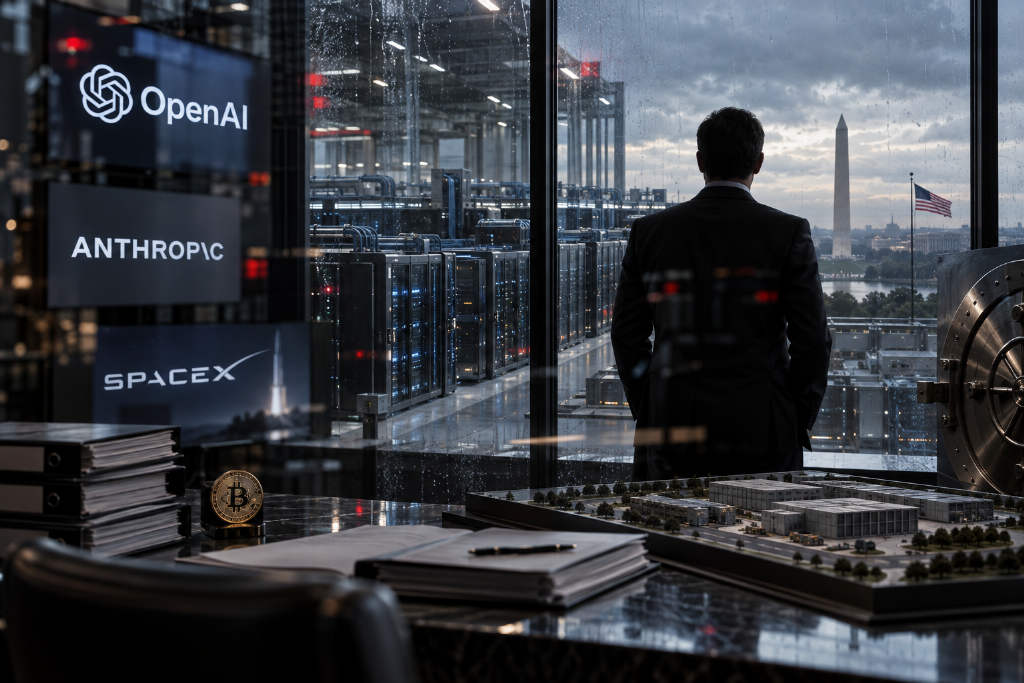
Arthur Hayes said in a new essay published on Sept. 22 that the "safety first" stance presented by Anthropic, OpenAI, and SpaceX as a reason to slow AGI development is not really about concern for human welfare, but about economics.
In "Safety First," Hayes argued that the market does want AI, but it wants AI at "China prices" — intelligence that is 100 times cheaper than what is available today. In his view, "safety first" is effectively compute demand destruction. If spending on training new models falls and labs shift toward efficiency gains, customers will spend less on compute.
AI labs support a large debt structure through compute demand
Hayes wrote that the three major AI labs do not generate profits, yet their demand for compute supports more than $1 trillion in investment-grade debt and hundreds of billions of dollars in lower-quality debt.
He said that debt depends on off-balance-sheet support from profitable technology companies including NVIDIA, Broadcom, Google, and Microsoft, while the ultimate bagholders are U.S. insurance policyholders.
Hayes cites Nick Nameth on what he describes as a captive reinsurance scheme
Referencing analysis by Nick Nameth, Hayes said private equity groups such as Apollo, KKR, and Brookfield buy insurance companies, then load insurance asset books with AI data center debt and private credit tied to SaaS companies exposed to AI disruption.
He said affiliated captive reinsurance companies then provide backing with very little capital, creating what he described as a "captive insurance scam." Nameth estimated the total amount of this kind of sham reinsurance asset exposure at $1.54 trillion.
According to Hayes, if AI data center debt is downgraded by ratings agencies because compute demand comes in below expectations, insurers would be forced to raise capital. The affiliated reinsurers, he argued, would not be able to pay, leaving insurers insolvent.
State protection caps are limited
Hayes added that insurance protection limits in most U.S. states are only $250,000 to $300,000. He also said surviving insurers pay into guarantee funds only after failures occur, a structure he argued encourages every participant to maximize risk-taking.
He compared the setup to the 2008 rescue of AIG. Hayes wrote that TARP money ultimately flowed to Goldman Sachs and produced record bonuses, while ordinary people received foreclosure notices, and said he expects that pattern to repeat.
Two policy paths, one result in his view
For crypto investors, Hayes said the conclusion is a "win-win." If the U.S. government becomes the buyer of last resort for compute, it would print money in the name of national security to fund what he called unproductive economic goods, pushing up financial speculation and the price of Bitcoin.
If the government instead rescues insolvent insurers, Hayes said it would still need to print money to cover bad AI debt. That would expand the money supply and also lift Bitcoin.
Hayes says the current net effect remains stimulative
Hayes also pointed to the Federal Reserve's unanimous vote last week to raise rates by 25 basis points. He said RMP bond purchases stopped on Aug. 14, but commercial banks have already taken over and created more than $100 billion in money.
He added that higher rates give banks an extra $7.5 billion a year in interest on excess reserves, and said that money will be used to expand lending and market speculation. On that basis, he argued that the net effect is still stimulative.
His market view for crypto
Hayes said the choppy price action after crypto's modest rise at the end of August is about to end. He expects U.S. dollar supply to keep growing, with Bitcoin and a selection of altcoins moving higher.
He also called the setup "absolutely beautiful," saying the government will not allow the free market to stop the buildout of AI data centers. In his telling, spot compute will move into oversupply, AI agent usage will rise, and faster money printing will push investors toward crypto assets.