
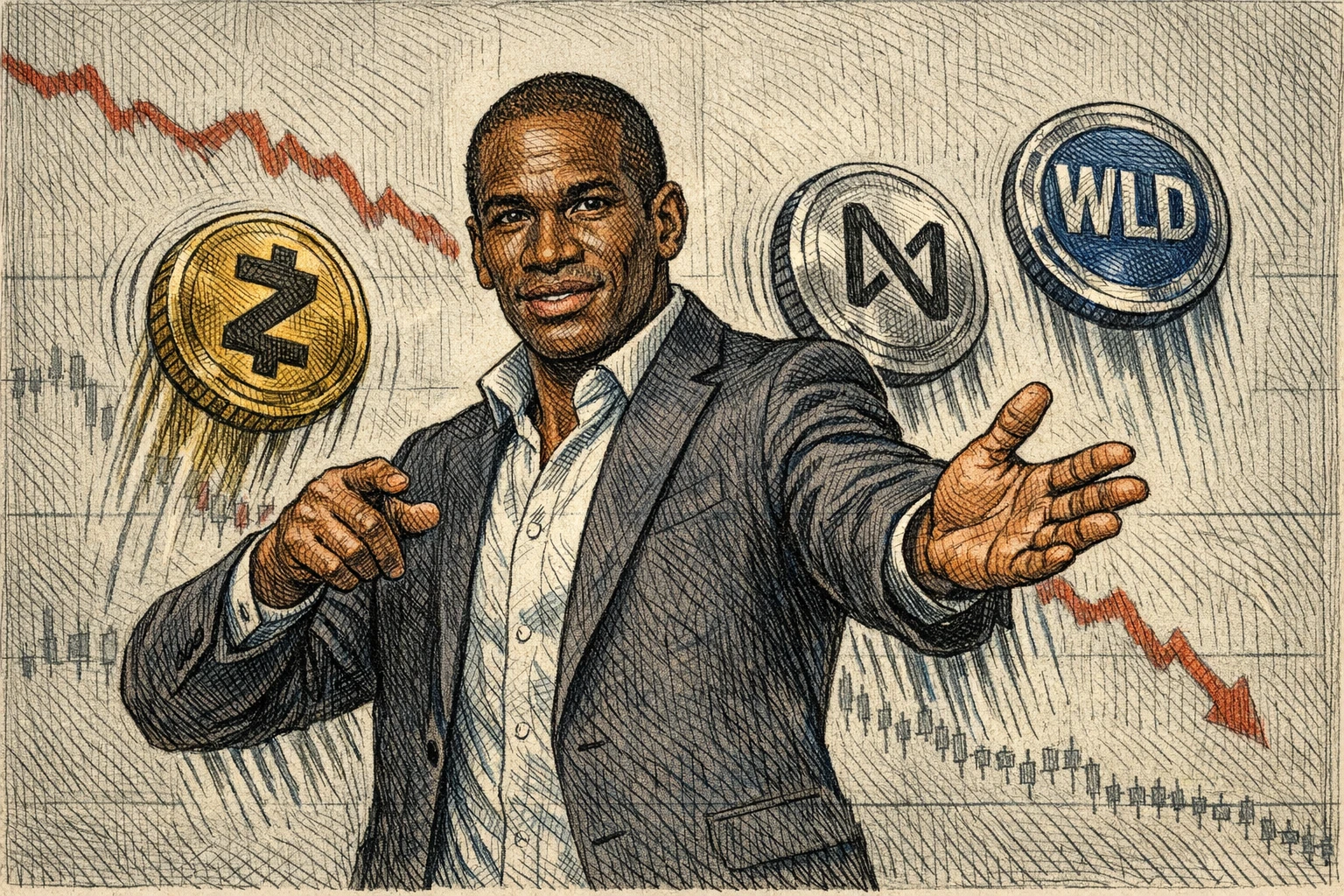
BitMEX co-founder Arthur Hayes publicly turned bullish on ZEC, NEAR, and WLD, then exited those positions near local highs. According to the report and on-chain tracking, he later disclosed that he had closed the trades and shifted to a bearish stance, while all three tokens have now slipped back to roughly where they were before his public calls.
Three trades, each ending with a well-timed exit
ZEC was the earliest and most aggressive example in the timeline described by the source. Hayes reportedly accumulated the privacy coin during a period of rising market interest, posted “ZEC > XRP” on X, and framed a target equal to 10% of Bitcoin’s price. ZEC then moved from the $38 range to a record high of $676. On May 22, he grouped ZEC with HYPE and NEAR as his “Holy Trinity,” but after the Orchard infinite mint issue became public, he said on June 5 that he had fully exited and declared that the “Holy Trinity” was dead.
NEAR moved faster. When Hayes named the “Holy Trinity” on May 22, NEAR was trading around $1.70. The token then jumped 30% in a single day to a six-month high of $2.55. Just 13 days later, on June 4, Hayes sold about $134 million worth of NEAR, a move the report says was followed by a 24% drop.
WLD came next, after he had already rotated out of other positions. On the same day he cleared out HYPE and NEAR, June 4, Hayes publicly pitched WLD and gave it a $10 target. His investment vehicle, Maelstrom, set a $5 medium-term target before August. The report says WLD surged from the $0.30–$0.35 range to $0.55, a gain of 62%, before giving the move back along with the wider market.
June liquidations brought criticism back into focus
The source says Hayes cleared HYPE and NEAR on June 4, cashing out more than $150 million, then exited ZEC the next day. Lookonchain’s tracking was cited as laying out a consistent pattern: a public bullish call first, then an exit once attention and price momentum had already built. That sequence has revived criticism from parts of the crypto community over whether his trade timing benefits from the visibility of his own statements.
The article also points to HYPE as another example. Near the end of May, Hayes reportedly said HYPE could reach $150 and tied that view to a public $100,000 charity wager. Four days later, he had already sold out, taking in about $18.02 million. After closing these positions, he turned bearish and listed four reasons: higher energy costs linked to the Iran conflict, liquidity being drawn away by potential IPOs involving SpaceX, OpenAI and Anthropic, a policy shift by Trump on AI, and the possibility that markets could peak before September. He also said he would publish a longer explanation titled Reality Test on June 9.
All three tokens have fallen back to pre-call levels
The common thread across the three trades is hard to miss in the source material. ZEC, NEAR, and WLD each drew heavy attention and sharp price action after Hayes spoke publicly, and all three later retraced to about the levels seen before those calls. In the end, the market record is not the slogan. It is the wallet movement and the exit timing.