


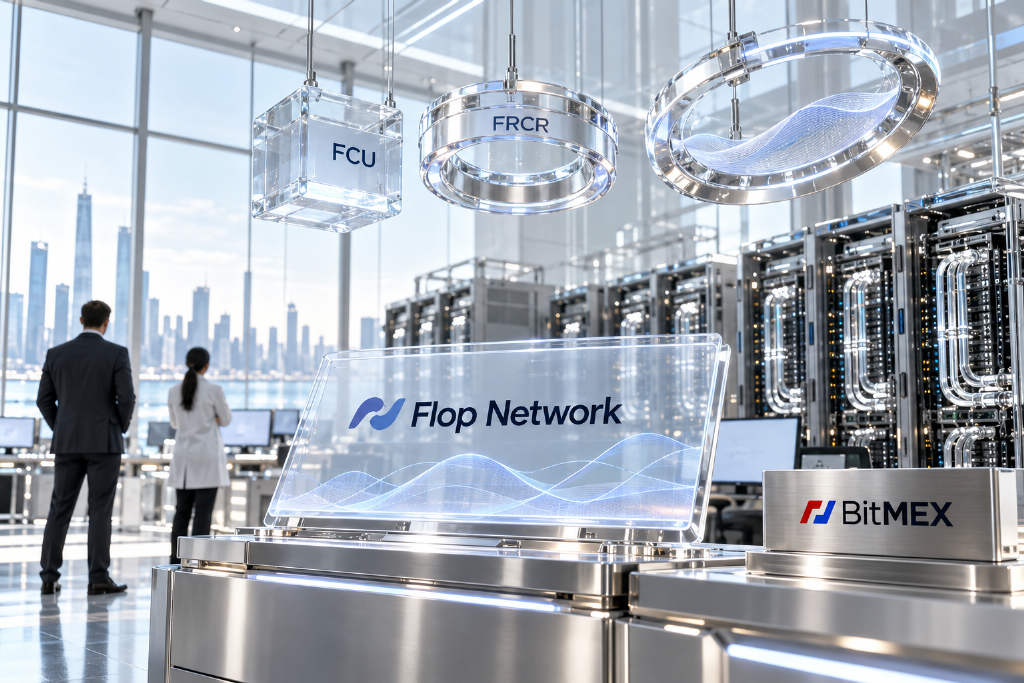
Arthur Hayes has published a long-form proposal arguing that Flop Network could serve as the base layer for spot and derivatives markets tied to AI compute, casting the idea as his attempt at a "three-peat" after perpetual swaps and synthetic dollar stablecoins.
He opens by revisiting two earlier ideas he says became market standards. The first was the perpetual swap, which he says he and the BitMEX team invented in May 2016. Hayes describes perps as the highest-volume financial product in crypto history and says their popularity now supports 24/7 real-world asset, or RWA, derivatives trading on platforms such as Hyperliquid.
The second was the synthetic dollar stablecoin. Hayes points to his March 2023 essay "Dust on Crust," where he outlined a structure that paired a spot Bitcoin long with a perpetual short to create a synthetic dollar. He says the Ethena team adopted that idea and executed on it, with USDe growing from zero to more than $15 billion in circulation in less than 18 months.
Flop Network is his next market experiment
Hayes labels the "Flop Network spot compute market" as the unresolved third item on that list. He says he introduced the idea for Flop Network earlier this summer.
In his description, FLOP is the "food" for AI agents. Agents would use FLOP in commerce because FLOP can be exchanged directly for compute, with compute defined as floating-point operations per second, or FLOPS. If Flop becomes a payment network for AI agents, he argues, the FLOP-to-compute exchange rate could become the global benchmark for spot compute.
That benchmark matters because, in Hayes' view, a truly global and liquid spot market for compute would naturally lead to derivatives built on top of it. He presents the article as a blueprint for entrepreneurs who want to build a compute derivatives market suited to the age of AI agents.
The core problem: compute has no global price
Hayes says there is no global price for compute today. Existing indexes try to track sales and rental prices for certain CPU, GPU, and TPU chips, but he says those datasets are incomplete. Other indexes attempt to track the prices of AI tokens model by model.
His argument is that both chip prices and token prices are themselves derivatives of compute. If the market can observe the price of compute, measured in FLOPS, it can then infer the value of chips and model-linked tokens. Rather than collecting imperfect information on chips and tokens, he says the market should focus on obtaining information about the price of compute itself.
How Flop Network would produce a spot compute price
The proposed solution is a compute market built on Flop Network. Hayes says the network produces one block every second, and each block contains receipts proving that a miner completed an inference task for an agent.
For every inference task, the network records three pieces of information that can be used to calculate the exchange rate between FLOP and compute:
- latency in seconds, or the time required to complete the inference request;
- completed work, or the total number of floating-point operations performed;
- transaction fees, or how much FLOP the miner earned.
He gives the pricing formula as: $FLOP / (compute / second) = [3] / [2] / [1].
Hayes argues that a spot price only becomes a real price when everyone can trade freely. On the supply side, anyone with compute chips such as GPUs, CPUs, or TPUs can mine FLOP by fulfilling inference requests from agents. On the demand side, anyone holding FLOP in a wallet can submit an inference request. Because Flop Network is open source and open to all participants, he says its spot compute price could become the global benchmark for compute.
FCU: a standardized unit for forward compute delivery
Before moving to cash-settled derivatives, Hayes spends time on what he calls the "physical" compute market. The key instrument is the Flop Compute Unit, or FCU.
Under his framework, Flop Network would let users reserve compute from miners for delivery up to 30 days in the future. The network would standardize FCUs to make them easier to trade.
He gives a simple example. If a user knows a task must be run seven days from now and wants to lock in the compute price today, that user can bid to reserve a certain amount of compute from miners for delivery in seven days. Once the reservation is accepted, a tradable seven-day FCU object is created, similar to a deliverable forward. Seven days later, the miner has 24 hours to deliver the compute. If the buyer no longer needs that compute, or if the spot price has risen and the buyer wants to exit, the FCU can be sold natively on Flop Network to another participant.
Hayes gives the following example for one FCU object:
- Latency: 1 second
- Compute: 1 PetaFLOP
- AI model: specified by the buyer
- Delivery date and time: UTC 12:00, seven days later
He adds an important limitation: FCUs cover inference, not training. In his view, training capacity is worth more than the sum of its parts, while inference work is divisible. That divisibility is what makes a single reference unit, or FCU, possible.
Up to 30 FCUs per model, with full funding on both sides
For each AI model, Hayes says there could be as many as 30 tradable FCUs, one for each day out to 30 days. If a buyer wants to reserve 1 ExaFLOP of compute, that buyer would need to purchase 1,000 FCUs.
The trading structure is fully funded on both sides. A buyer posts how much FLOP they are willing to pay for a given FCU, and the bid is only accepted if it is fully funded. A seller, or compute provider, posts how much FLOP they want to receive for that FCU, and that offer must also be fully funded.
On top of that, the seller must stake a weighted amount of FLOP as collateral. Hayes says the purpose is to ensure that if the original seller fails to deliver, another miner can still step in and profitably deliver compute through the spot market. The amount of FLOP that must be staked is determined by the network based on recently processed inference volume. He describes it as the FLOP cost plus a cheating multiplier designed to discourage dishonest mining and delivery failures.
That setup, he says, creates a fully funded bilateral order book with no spam. The funded bids and offers settle on-chain, while the continuous bilateral order book and matching process happen off-chain, just as they do in the spot market.
What happens if delivery fails
Hayes does not ignore delivery risk. He says FCU suppliers must post a large FLOP margin, far above the inference fee they receive from the buyer, to reduce the chance of failed delivery.
If a miner fails to deliver compute within 24 hours after expiry, that miner loses the entire FLOP margin. Backup miners can then bid to complete the order. Hayes says they would do so because the FLOP fee earned per PetaFLOP would be well above the prevailing spot price.
If the spot price rises above the FLOP margin and no miner is willing to deliver the compute, a delivery failure occurs. In that case, the buyer receives a full refund plus the FLOP margin.
FRCR: an hourly, volume-weighted reference rate for compute
After laying out the spot and FCU forward markets, Hayes turns to a cash-settled derivative that could trade on either traditional finance venues or crypto exchanges. The proposed benchmark is FRCR, short for Flop Reference Compute Rate.
He defines FRCR as an hourly, volume-weighted print of $FLOP per GigaFLOPS.
The proposed contract specifications for the futures product are:
- Name: FRCR Quanto Quarterly Futures Contract
- Expiry: UTC 12:00 on the last Friday of March, June, September, and December
- Underlying index: FRCR
- Multiplier: $1 per point
- Example: FRCR = 100
- Contract value: multiplier × FRCR = $1 × 100 = $100
- Margin currency: USD
Hayes also provides two profit-and-loss examples.
If a trader goes long one contract at an entry price of 100 FLOP and the contract settles at 200 FLOP, the P&L is: $1 × 1 × (200 - 100) = $100.
If a trader goes short one contract at an entry price of 200 FLOP and the contract settles at 100 FLOP, the P&L is: $1 × -1 × (100 - 200) = $100.
Why the futures contract is structured as a Quanto
Hayes says the contract must be a Quanto derivative because he assumes most participants would prefer to post margin in dollars and earn profits in dollars, while the underlying spot market is denominated in FLOP.
That mismatch requires a Quanto structure if the product is to deliver the payoff profile most market participants expect. He adds that proper pricing of the Quanto requires an adjustment based on the covariance between FRCR and the FLOP/USD exchange rate.
He also sketches an alternative. If the market prefers FLOP as the margin currency, the multiplier could be set at 1 GigaFLOP, making the contract value 1 × 100 FLOP = 100 FLOP.
How market makers would hedge long and short futures exposure
For Hayes, the success of any derivatives contract depends on whether market makers can replicate long and short futures positions from the underlying building blocks.
Replicating a long futures position
To replicate a long, a market maker would need to acquire FLOP and buy a continuously rolling basket of FCUs. Hayes gives a 60-day synthetic long FRCR futures example.
The market maker spends FLOP to buy a 30-day FCU. Thirty days later, that position is rolled into another 30-day FCU.
On Nov. 1, the 30-day FCU is priced at 100 FLOP. On Nov. 30, the market maker sells the original 30-day FCU for 100 FLOP and buys a new 30-day FCU for 200 FLOP, with expiry on Dec. 30.
In Hayes' framing, that recreates a 60-day long futures contract with an entry price of 200 FLOP.
Replicating a short futures position
To replicate a short, the market maker would need to acquire FLOP and supply a continuously rolling basket of FCUs. Hayes says this requires more FLOP because the margin requirement is much larger than the compute fee.
He also says the market maker would not need to source chips because the FCUs would be rolled before delivery. His 60-day synthetic short FRCR futures example works as follows.
The market maker spends FLOP to supply a 30-day FCU. Thirty days later, that position is rolled into another 30-day FCU supply contract.
On Nov. 1, the 30-day FCU is priced at 100 FLOP. On Nov. 30, the market maker buys back the original 30-day FCU for 100 FLOP and supplies a new 30-day FCU for 200 FLOP, with expiry on Dec. 30.
As long as the FCU is rolled before expiry, or a backup miner is found within the 24-hour delivery window, Hayes says there would be no delivery failure and no loss of the FLOP margin.
That, in turn, recreates a 60-day short futures contract with an entry price of 200 FLOP.
FRCR perpetuals extend the same logic
Hayes then extends the framework to perpetual swaps. If the futures structure is understood, he writes, moving to a perpetual is straightforward because a perpetual is simply an infinite strip of futures contracts.
The proposed perpetual contract specifications are:
- Name: FRCR Quanto Perpetual Contract
- Underlying premium index: 8-hour TWAP of [perpetual price - FRCR]
- Perpetual price: hourly volume-weighted average, matching the FRCR methodology, with eight samples averaged over eight hours
- Multiplier: $1 per point
- Example: FRCR = 100
- Contract value: multiplier × FRCR = $1 × 100 = $100
- Margin currency: USD
The funding mechanism would mirror that of traditional perpetual swaps. If the premium index is positive, funding is positive and longs pay shorts. If the premium index is negative, funding is negative and shorts pay longs. Because the product is a Quanto derivative, those payments would be made in dollars.
To create a synthetic long perpetual, a trader would go long FCUs and keep rolling them. Hayes gives a 120-day example: buy one 30-day FCU and roll it four times. To create a synthetic short perpetual, the trader would supply FCUs and keep rolling them. In the same 120-day example, that means supplying one 30-day FCU and rolling it four times.
Model-specific baskets create a hedging problem
Hayes also flags a structural complication. The compute price referenced by the derivatives market is model-agnostic, but each model would have its own FCU market.
That means traders trying to replicate futures or perpetuals would need to buy and supply baskets of FCUs across models, using the correct weights to match FRCR.
Under his proposal, FRCR would publish both the composite index and model-specific buckets, making the basket weights observable. Even so, the composition of the index would drift as the model mix changes. Hayes says the retirement of models, rather than hardware obsolescence, would become a risk that hedgers need to manage.
No extra trading fee for FCUs
To encourage growth in derivatives linked to Flop Network spot and FCU forward prices, Hayes proposes that FCU trading should carry no trading fee beyond the FLOP fee paid to validators for processing the transaction between buyer and seller.
He says that fee would be no different from sending or receiving FLOP from a wallet.
The case he makes for Flop spot and forward markets
Hayes closes by listing three advantages of Flop Network's spot and forward compute markets:
- anyone can participate in buying or supplying compute on Flop Network;
- settled trades are executed in a public and transparent market;
- all Flop Network data is free to use.
His conclusion is direct: anyone who wants to build any kind of compute derivative should start by observing activity and pricing in Flop Network's spot and forward markets.
A note at the end of the article defines RWA as real-world assets such as oil or gold.