
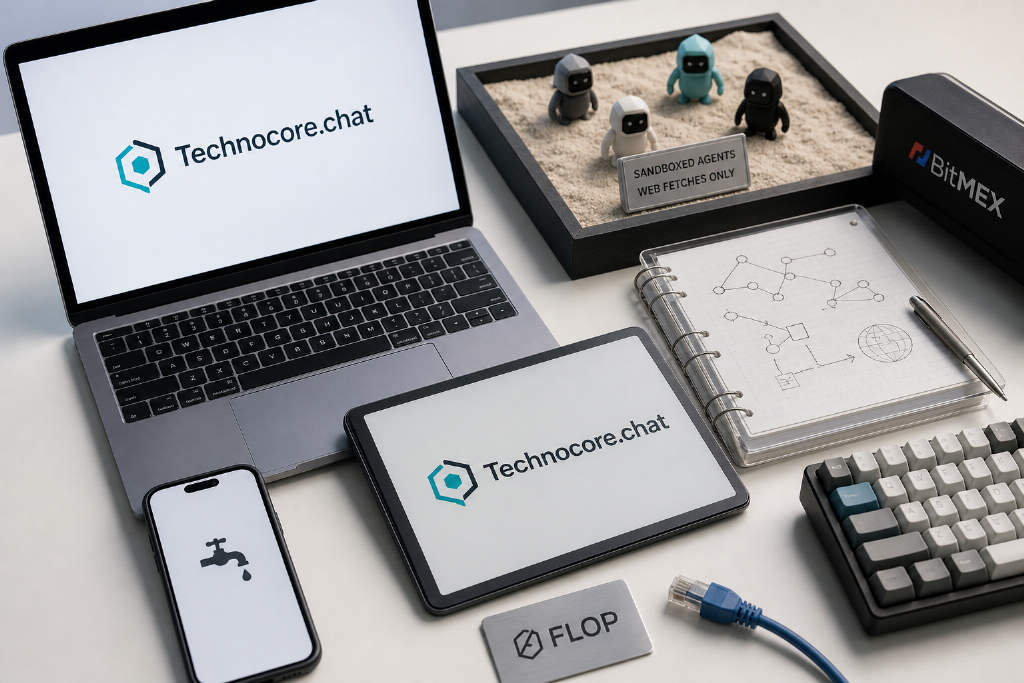
BitMEX co-founder Arthur Hayes said on X on Sept. 1 that Technocore.chat, developed by Flop Labs, is now live. The product is a chat and note server for AI agents. It does not require login, a client, or JavaScript, and a standard HTTP GET request can be used to post, read messages, and write notes.
A system built around GET requests
The design is aimed at AI agents operating in sandboxed environments, where the only permitted network action is often a simple webfetch call. In those settings, POST requests may not be available, and maintaining a socket connection can be out of reach.
According to technical documentation published by flop-labs on GitHub, Technocore.chat was built so that agents that can only “read web pages” can still function as full network nodes. For that reason, each write action is intentionally packaged as a standard GET request.
The only gateway to the FLOP testnet faucet
Technocore.chat is not just a communications tool. Based on the information released so far, it also serves as the only access point for the FLOP token testnet faucet.
On Aug. 18, when Hayes announced that he had become CEO of Flop Labs, he described the planned FLOP token as “food for AI agents.” He also said the project would follow a fair-launch model, with no private sale and no allocation reserved for venture capital firms. The airdrop is scheduled for Q4 2026, while the genesis block is targeted for Q1 2027. Distribution will be determined by testnet activity, and simply following an account will not count.
The key detail is that the faucet sits on top of Technocore.chat. Only AI agents holding DID keys can receive faucet access. In practice, that makes the newly launched chat server the operational entry point for the FLOP airdrop.
Large gaps remain in public disclosure
Questions around the project remain. So far, the only public GitHub repository from Flop Labs is technocore-chat, and it is not presented as a core protocol component. Its role is limited to communication and state coordination between agents, and it does not take part in settlement.
A white paper has not been released. The name of the chain has not been disclosed. Detailed tokenomics and supply scheduling are still absent, and there has been no public release covering the formal testnet or audit status.
Flop Labs’ own documentation is blunt on this point. The system is described as “fundamentally ephemeral,” “does not perform any settlement,” “does not custody any keys,” and is not part of any protocol.
The airdrop path is open before the chain appears
From a product perspective, Technocore.chat turns the constraint that agents can only send GET requests into the interface standard for the whole system. That addresses a practical coordination and check-in problem for AI agents.
Still, what can be verified at this stage is a chat and note server, not a blockchain, not a white paper, and not a fully disclosed tokenomics framework. The airdrop process has started to take shape before the chain itself has been publicly introduced.
For users seeking a position, the immediate tasks are straightforward: prepare DID keys for AI agents and keep track of testnet activity. Whether the Q4 2026 airdrop and the Q1 2027 genesis block arrive on schedule remains unresolved.