
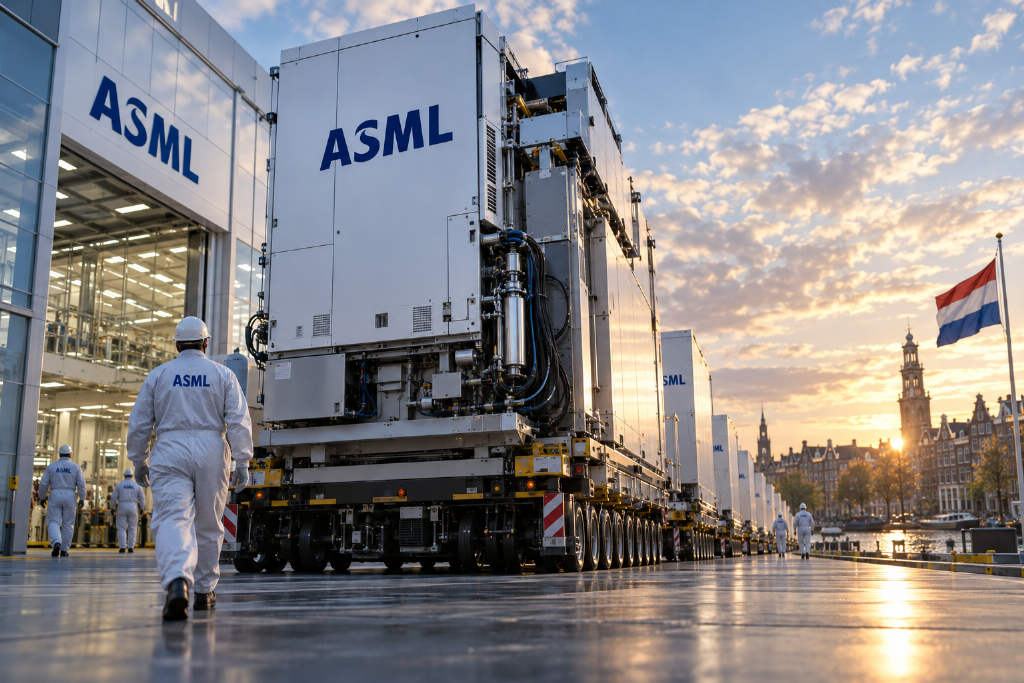
ASML reported record results for the third quarter of 2026, but the bigger signal from the release was not just the headline growth. Management said customer demand for advanced logic and memory capacity continues to strengthen, and the company’s planned tool supply for 2027 and 2028 is no longer enough to fully meet that demand. Some customers have increased their 2028 orders and are already asking to reserve equipment for 2029 and even 2030.
Net sales for the quarter came in at 11.662 billion euros, up about 55% year over year and near the high end of the company’s prior guidance range of 11 billion to 12 billion euros. Net profit reached 4.960 billion euros, up about 133%, while basic earnings per share rose to 12.95 euros, above market expectations of roughly 10.7 euros.
AI spending keeps moving upstream
ASML’s comments point to AI semiconductor spending continuing to move up the supply chain. Demand is no longer centered only on NVIDIA GPUs and data center servers. Capacity additions at TSMC, Samsung, Intel, SK Hynix and Micron in advanced logic, DRAM and HBM ultimately translate into purchases of EUV, DUV and inspection tools.
For ASML, the immediate question is no longer whether orders exist. It is whether the company can produce, install and service systems fast enough. In the third quarter, ASML sold 113 new lithography systems, up 31.4% from the second quarter. Net system sales were 8.4 billion euros, including 4.1 billion euros from EUV systems, which included one High-NA EUV tool, and 4.3 billion euros from non-EUV systems.
Installed base management and service revenue reached 3.289 billion euros, up 19.1% from the second quarter and nearly 400 million euros above the company’s earlier expectation. A large number of customers chose to upgrade productivity on existing EUV and DUV systems, which was a main reason gross margin improved to 57.5% in the quarter. Gross profit was 6.7 billion euros, with gross margin up 3.5 percentage points from the prior quarter.
Part of profit came from Mistral AI valuation gains
ASML also disclosed a factor that needs to be separated from operating performance. About 500 million euros of quarterly net profit came from an increase in the valuation of its initial investment in Mistral AI. That was an investment revaluation gain rather than profit generated directly from lithography system sales.
The quarter’s operating performance was still strong, but the 12.95 euros in basic EPS should not be viewed entirely as recurring operating earnings.
After the earnings release, ASML’s American depositary receipts fell about 3.9%. The Nasdaq also dropped 1.9% that day as higher-than-expected U.S. inflation lifted Treasury yields and put pressure on AI and semiconductor shares. The move in ASML reflected both a reassessment of valuation and earnings quality and a broader decline in risk appetite across tech.
Key quarterly figures
- Third-quarter 2026 net sales were 11.662 billion euros, up about 55% year over year and a record high.
- Net profit was 4.960 billion euros, up about 133%.
- Basic EPS was 12.95 euros, above market expectations of about 10.7 euros.
- About 500 million euros of profit came from the higher valuation of ASML’s investment in Mistral AI.
- Gross profit was 6.7 billion euros, and gross margin was 57.5%, up 3.5 percentage points from the second quarter.
- Net system sales were 8.4 billion euros, including 4.1 billion euros from EUV systems and 4.3 billion euros from non-EUV systems.
- ASML recognized sales of 113 new lithography systems in the quarter, versus 86 in the second quarter.
- Installed base management and service revenue was 3.289 billion euros, up 19.1% from the second quarter and nearly 400 million euros above the company’s prior forecast.
- In system sales mix, logic customers accounted for 54% and memory customers for 46%.
- The company expects 2026 memory system revenue to grow about 75%, versus about 10% for logic.
- ASML expects full-year EUV revenue to grow more than 45%, non-EUV system revenue about 20%, and installed base management about 50%.
- Fourth-quarter revenue guidance was 14.2 billion to 15.2 billion euros, with a midpoint of 14.7 billion euros.
- Fourth-quarter gross margin is expected at about 57%, and installed base management and service revenue is expected at about 3.7 billion euros.
- Full-year 2026 revenue guidance was narrowed and raised from 43 billion-45 billion euros to 44 billion-45 billion euros.
- Full-year gross margin is expected at about 56%, and full-year revenue is expected to grow about 36%.
- China is expected to account for about 20% of 2026 total revenue.
- Third-quarter free cash flow reached 11.4 billion euros, including customer prepayments for future orders.
- ASML repurchased about 4.1 billion euros of shares in the third quarter and will pay an interim dividend of 1.88 euros per share.
ASML’s position in the AI supply chain
MSX Research said ASML holds a distinctive place in the AI infrastructure chain. NVIDIA, AMD and custom AI chip companies design processors. TSMC, Samsung and Intel manufacture advanced chips. Micron, SK Hynix and Samsung produce HBM and advanced DRAM. No matter which chipmaker gains share, continued expansion in advanced logic and memory capacity eventually feeds through to lithography demand at ASML.
That gives ASML upstream exposure to AI capital expenditure across multiple chip suppliers. In the third quarter, 54% of system revenue came from logic and 46% from memory. Management expects memory system revenue to grow about 75% in 2026, much faster than the roughly 10% growth expected for logic. The reason is not only stronger HBM demand, but also the wider use of EUV in advanced DRAM.
As DRAM geometries continue to shrink, chipmakers need more critical lithography layers. ASML benefits not only from capacity expansion at memory manufacturers, but also from an increase in the number of lithography steps required for each advanced DRAM wafer.
The constraint is shifting from orders to capacity
The demand signal reaching into 2029 and 2030 matters because it shows planned 2027 and 2028 capacity is already insufficient. At least over the next two years, advanced lithography equipment still appears to be in tight supply.
ASML had previously planned to raise Low-NA EUV capacity in 2027 by about 30% from a 2026 base of around 65 systems. DUV immersion capacity was also set to rise about 30%. The company is now studying how to push 2028 capacity growth beyond the previously discussed 30%.
That has two direct implications. First, supply tightness strengthens ASML’s pricing power. Management has already completed price negotiations with customers for some key products. The effect is expected to start showing up in 2027 and become more visible from 2028. If demand stays above supply, higher pricing and higher unit output could support both revenue and gross profit.
Second, rapid capacity expansion carries extra cost. ASML needs more production space, more trained technical staff, and coordinated expansion from core suppliers such as Zeiss. The company expects fourth-quarter revenue to rise clearly from the third quarter, but gross margin to edge down from 57.5% to around 57%, mainly because expansion costs are increasing.
That leaves delivery capacity as the next issue to watch more closely than order visibility.
High-NA EUV and China remain key variables
High-NA EUV represents a longer-duration growth driver. ASML recognized revenue from one High-NA system in the third quarter, showing the technology is moving from R&D and customer validation toward commercialization.
Management said Intel has already used High-NA EUV systems to expose more than 1 million wafers. Samsung plans to introduce High-NA into mass production in 2028, while TSMC plans adoption in 2030. Fleet availability for High-NA systems is now close to 90%. Those timelines suggest High-NA revenue will not scale all at once in the near term, but once major customers enter volume production, the platform could lift ASML’s average selling price, service revenue and long-term customer stickiness at the same time.
China is another important variable. ASML expects China to account for about 20% of total 2026 revenue, with demand mainly tied to mature-node logic and memory capacity. Management said domestic demand in China remains strong, but actual revenue still depends on Dutch and U.S. export control policy and on whether ASML can continue to provide parts, software updates and maintenance services for existing tools.
Three points highlighted by the quarter
MSX Research summarized the quarter around three themes. First, AI demand is still spreading into advanced logic, DRAM and wafer fabrication equipment, and there is no visible sign that major customers are making clear cuts to capital spending. Second, ASML’s core constraint for 2027 and 2028 has shifted from orders to capacity, and the pace of expansion will shape how much revenue the company can convert. Third, the 57.5% gross margin and 12.95 euros in EPS were strong, though the earnings figure included an investment revaluation gain.
The next items to watch are whether Low-NA EUV and DUV capacity ramp as planned, whether upgrade-related installed base revenue stays elevated, whether High-NA enters volume production on customer timelines, and whether China business faces new export restrictions.



