
ASR Microelectronics has officially applied for a Hong Kong listing, aiming to put an A+H structure in place just over four years after its debut on Shanghai’s STAR Market in 2022. The company designs full-standard cellular baseband chips, and it is looking for new funding as research spending and business expansion continue to eat up capital.
After years in the red, ASR posted attributable net profit again in the first half of 2026. But only partly. Profit after deducting non-recurring items still showed a loss of RMB 58.67 million, which leaves the company facing a harder question now that scale has grown: can the core business actually generate lasting earnings?
R&D spending remains a heavy drag on earnings
ASR was founded in April 2015. The source article describes it as one of the few domestic platform companies spanning 2G through 5G full-standard cellular baseband chips. It also says ASR stands with Qualcomm, MediaTek, HiSilicon and UNISOC as one of just five commercial suppliers of multimode cellular baseband chips in the world.
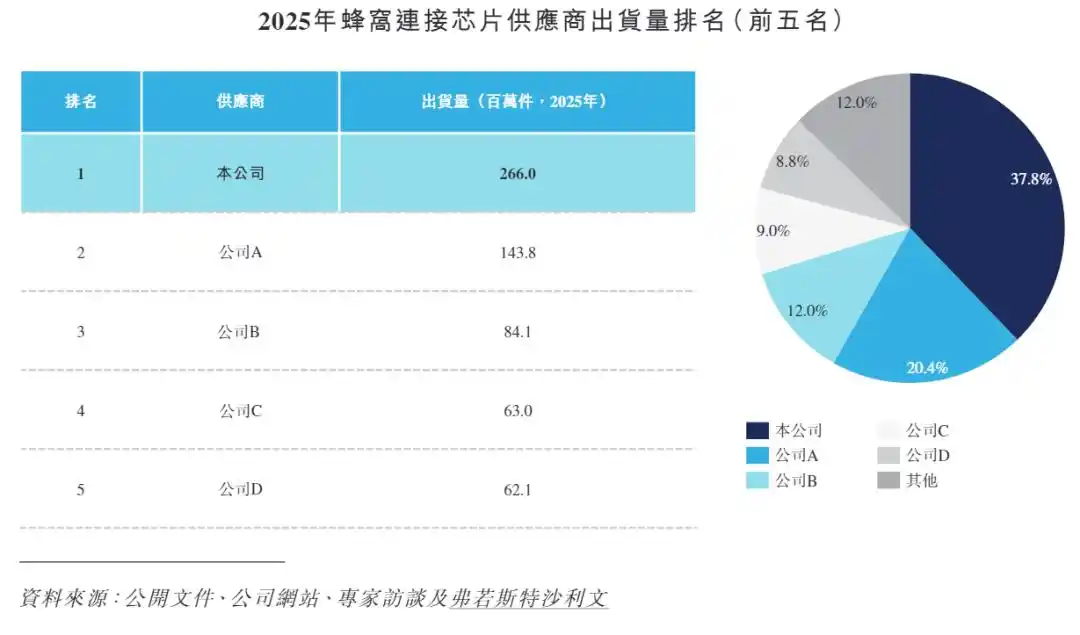
Frost & Sullivan data cited in the filing show ASR shipped 266 million cellular connectivity chips in 2025, good for a 37.8% global market share and the top spot worldwide. Its shares in Cat.1 and Cat.4 were 51.6% and 52.5%.
That standing has not changed one basic reality: the business still leans heavily on one main source of revenue. In 2025, chip products made up 93.78% of revenue, and cellular baseband chips accounted for 93.81% of chip product revenue.
Cellular baseband chips are hard to build. Development cycles are long. End customers also tend to stick with established brands. New products often need time to win acceptance, and there is always the risk of weak uptake or failed mass production. As a later entrant, ASR has had little choice but to keep spending in order to narrow the technology gap with bigger overseas rivals such as Qualcomm and MediaTek.
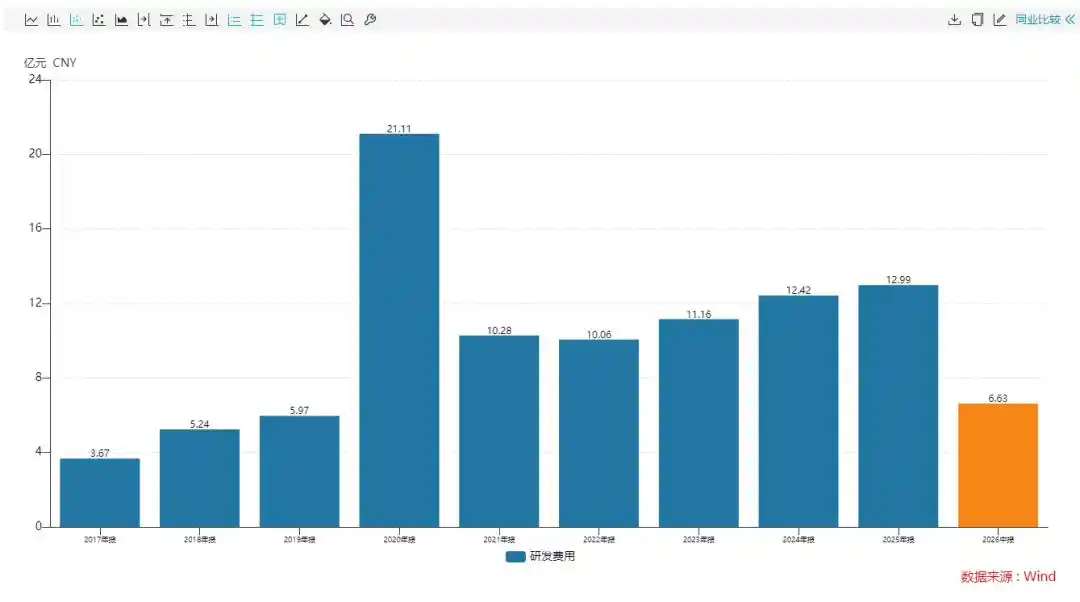
Wind data cited in the article show R&D expenses climbed from RMB 1.028 billion in 2021 to RMB 1.299 billion in 2025. That was still below the historical peak of RMB 2.111 billion in 2020, but the amount remained large. Very large.
The prospectus lays out that pressure pretty bluntly. Revenue was RMB 2.6 billion in 2023, RMB 3.386 billion in 2024 and RMB 3.817 billion in 2025. Net profit in those years was negative RMB 506 million, negative RMB 693 million and negative RMB 390 million. ASR said the ongoing losses were mainly caused by heavy R&D investment in multimode cellular baseband technology and AI computing technology.
Then came a visible turn in the first half of 2026. Revenue reached RMB 2.451 billion, up 29.15% year over year, while attributable net profit was RMB 84.2438 million.
Still, that profit is being picked apart. Fairly so. Profit excluding non-recurring items remained negative RMB 58.67 million. The article says gains from fair value changes in external investments and investment income rose year over year during the reporting period, lifting net profit by about RMB 130 million. So the swing back to reported profit was driven to a considerable extent by non-recurring gains, not by a full rebound in the core business.
By business line, cellular baseband chips were still doing the heavy lifting, bringing in RMB 2.022 billion in first-half revenue, up 23% from a year earlier. The custom chip business emerged as a fresh growth point as projects moved into delivery and acceptance, with first-half revenue of about RMB 324 million, up about 157%.
Cash flow has not followed the revenue recovery
The income statement got better. Cash flow did not.
In the first half of 2026, net cash flow from operating activities was negative RMB 377 million. Cash paid for goods purchased and services received was higher than cash received from selling goods and providing services, and the net operating cash outflow widened by RMB 111 million from the same period a year earlier.
This is not new. Net cash flow from operating activities was negative RMB 678 million in 2023, negative RMB 412 million in 2024 and negative RMB 456 million in 2025.
The source article says Zidancj Finance sent ASR questions about changes in R&D expenses and related matters, but had received no reply as of publication.
Market share came with lower pricing pressure
To take share in a chip market controlled by entrenched players, ASR did not rely only on aggressive R&D spending. It also leaned on price.
The prospectus shows the average selling price of the company’s wireless connectivity chip products dropped from RMB 12.6 in 2023 to RMB 10 in 2025. ASR said it continued rolling out lower-priced new products to fit shifting market demand.
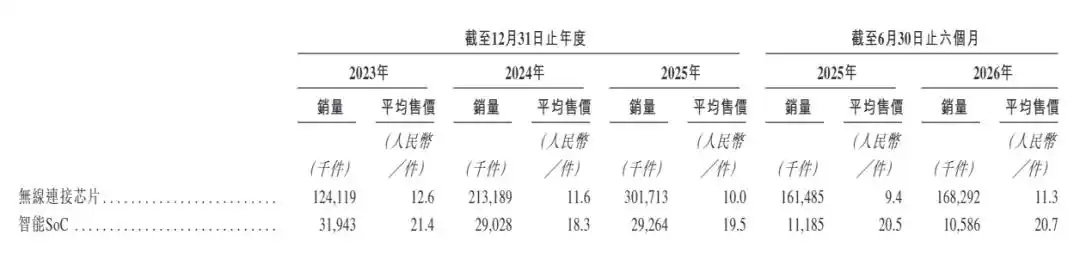
In the first half of 2026, the average selling price bounced back to RMB 11.3 as market demand improved, customer procurement rates rose and higher-priced products such as 5G chips contributed a larger share of sales.
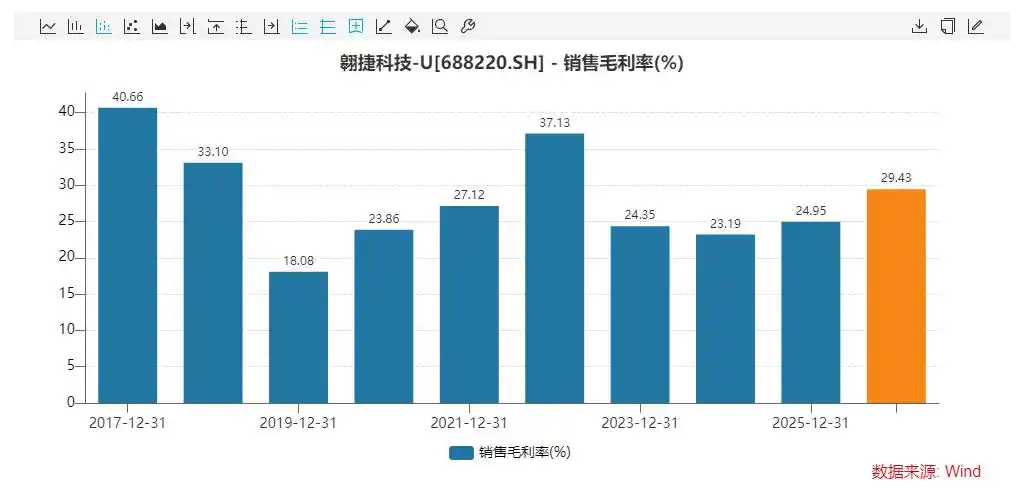
The approach helped ASR win position. But it also pressed on margins. Gross margin was 24.35% in 2023, 23.19% in 2024 and 24.95% in 2025. In the first half of 2026, overall gross margin was about 29.43%, up about 4.72 percentage points from a year earlier.
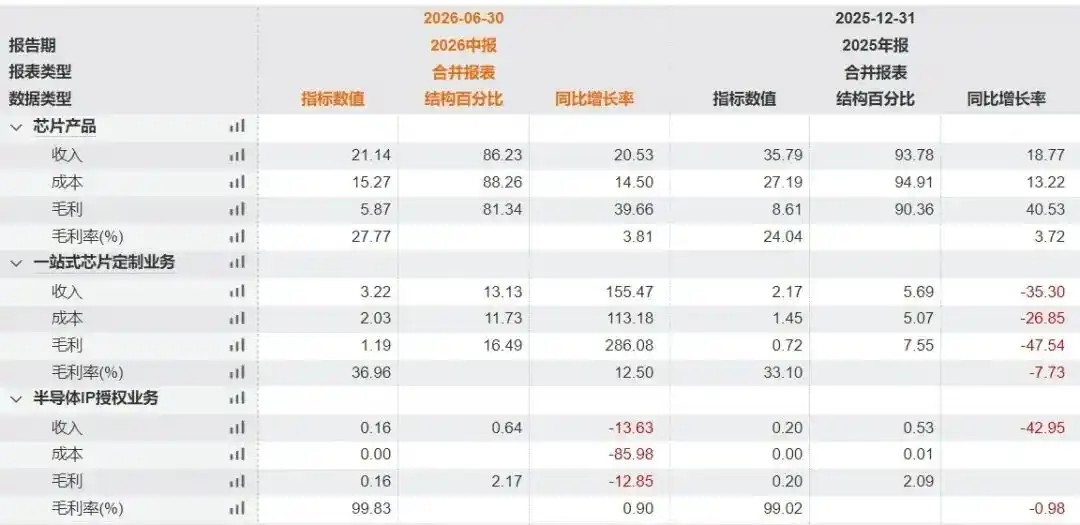
Even with that recovery, gross margin was still below 30%. Competition is one reason. Product mix is another. According to the 2025 annual report, chip products contributed more than 93% of revenue, yet that business posted a gross margin of only 24.04%.
The custom chip business recorded a gross margin of 33.1%, while IP licensing reached 99.02%. But those businesses made up a much smaller portion of revenue, so they were not in a position to materially change the company’s overall earnings structure anytime soon.
And IP licensing has been shrinking too. Revenue from that segment fell from RMB 123 million in 2023 to RMB 20 million in 2025, and in the first half of 2026 it accounted for only 0.64% of revenue. The company has kept its operational focus on self-developed chip products.
Customer and supplier concentration limits pricing flexibility
ASR’s bargaining power is also shaped by concentration on both ends of the supply chain.
The prospectus shows that sales to the top five customers accounted for 80.1%, 82.1%, 82.6% and 79.9% of total revenue in the respective reporting periods. Sales to the biggest customer alone accounted for 42.7%, 37.1%, 37.6% and 36.9%.
That setup is common in chip design. Certification barriers are high, and order cycles run long, so once a supplier gets into a customer system, the relationship can become sticky. But the same setup also means losing one major customer can hit revenue hard.
Procurement is concentrated too. As a Fabless semiconductor company, ASR relies on external foundries for manufacturing. And the number of wafer foundries and packaging and testing suppliers that can meet its standards on technology, quality and service is limited.
Purchases from the top five suppliers accounted for 75%, 77.6%, 71.4% and 74.8% of total procurement during the reporting periods. The largest supplier accounted for 52.4%, 51.5%, 45.5% and 51.1%.
According to the prospectus, the company’s largest supplier was founded in 1987, is headquartered in Taiwan, China, focuses on application-specific integrated circuit manufacturing and is listed on both the Taiwan Stock Exchange and the New York Stock Exchange. The source article says the market has widely speculated that this supplier is Taiwan Semiconductor Manufacturing Co. (TSMC), based on its industry background and the available cooperation information.
On the manufacturing side, advanced process capacity is extremely concentrated. Below 7nm, the article says there are basically only two options: TSMC and Samsung. For mature nodes, there are several foundries available, including SMIC, UMC and Huahong, but process adaptation and capacity lock-in costs make switching hard for Fabless companies.
In the first half of 2026, ASR’s second-largest customer also became its third-largest supplier. The company bought RMB 128 million of memory chips from that party. That overlap makes supply-chain management more complicated and has drawn market attention to coordination and transaction fairness.
If upstream wafer capacity tightens, or if geopolitical and trade frictions worsen, ASR could come under cost pressure. And with downstream revenue concentrated in a small group of large customers, it is still unclear how much of that pressure can actually be passed on.
Hong Kong IPO plan comes despite a sizable cash balance
Questions about operations are now colliding with pressure from the capital market.
ASR listed on Shanghai’s STAR Market on Jan. 14, 2022, at an issue price of RMB 164.54 per share. The stock has stayed below that level ever since listing.
As of the close on Sept. 29, 2026, ASR shares were trading at RMB 93.54, giving the company a market capitalization of RMB 39.128 billion.
The ownership structure is fairly dispersed. The actual controller is Dai Baojia, who controls 22.32% of the voting rights through direct holdings and concerted action arrangements involving Ningbo Jiexin Ruiwei Enterprise Management Partnership (Limited Partnership), GreatASR1 Limited and other entities.
Alibaba (China) Network Technology Co., Ltd., referred to as Alibaba Network, is the largest shareholder and currently holds 10.58%.
Alibaba Network has cut its stake twice over the past year. In December 2025, ASR said Alibaba Network sold 3% of the company between Oct. 9, 2025 and Dec. 17, 2025, at average prices ranging from RMB 73.42 to RMB 99.46, generating RMB 1.056 billion in proceeds.
Then on Sept. 10, 2026, ASR said Alibaba Network sold another 7,765,764 shares between Aug. 17 and Sept. 10, 2026 through block trades and centralized bidding, equal to 1.8565% of total share capital, for RMB 703 million. Taken together, the two rounds brought in about RMB 1.759 billion in cash proceeds.
Alibaba Network then ended its latest reduction plan early, even though 4,783,261 shares were still unsold. The very next day, Sept. 11, ASR formally submitted its application to the Hong Kong Stock Exchange.
Use of proceeds and investor questions
According to the prospectus, the Hong Kong IPO proceeds will go toward strengthening R&D capabilities and expanding the product portfolio, supporting long-term growth through strategic investments or acquisitions, broadening the sales network and replenishing working capital.
ASR had already raised a large amount of money in its STAR Market IPO. Gross proceeds from that offering were RMB 6.883 billion, and net proceeds after issuance expenses were RMB 6.546 billion, which was RMB 4.166 billion above the original plan.
At the end of June 2026, the company’s asset-liability ratio was 25.02%. Cash and cash equivalents on the books totaled RMB 2.915 billion, while short-term borrowings and non-current liabilities due within one year totaled about RMB 595 million. On the face of it, liquidity still looked plenty strong.
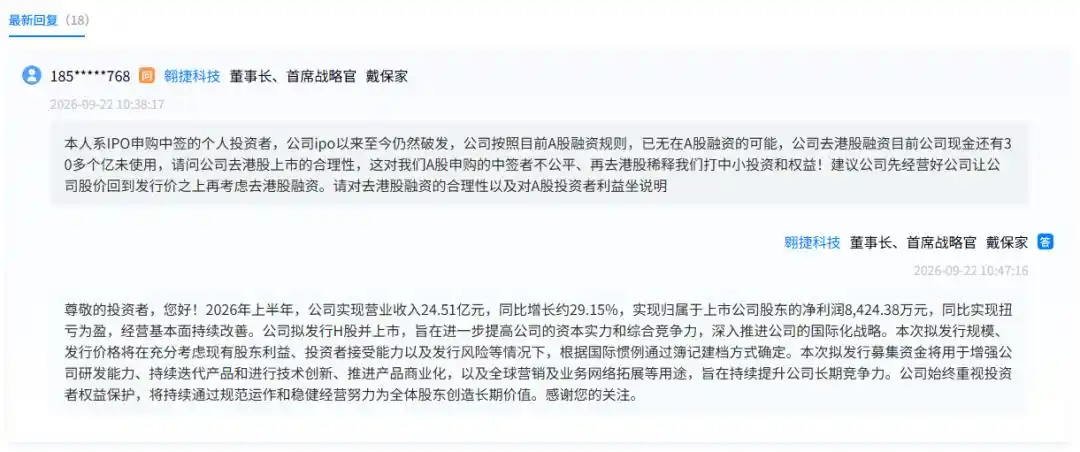
That has led some investors to question why the company is pushing for a Hong Kong IPO while the stock remains below its issue price and while it still has a sizable cash balance. The source article quotes some investors as saying the move was “unfair to investors who won allocations in the A-share subscription.”
Management said the planned issuance size and offering price would be decided through bookbuilding under international practice, while taking into account the interests of existing shareholders, investor acceptance and issuance risk.
The next test is whether scale can turn into durable profit
The return to reported profit in the first half of 2026 is a decent sign at the margin. It suggests operations improved somewhat. But it does not answer the bigger question. Recurring profit is still negative, and operating cash flow is still in net outflow.
Over a longer period, the company’s main strengths are still its technology base in cellular baseband chips, its global market share and the growth potential of its custom business as AI-related demand develops.
For ASR, the real issue is not just whether it can raise more money. The tougher test is whether it can turn technology investment and market share into sustainable cash flow and profit.
The source article was republished by MarsBit from the WeChat public account Zidancj Finance and credited to author Ma Qiong.