
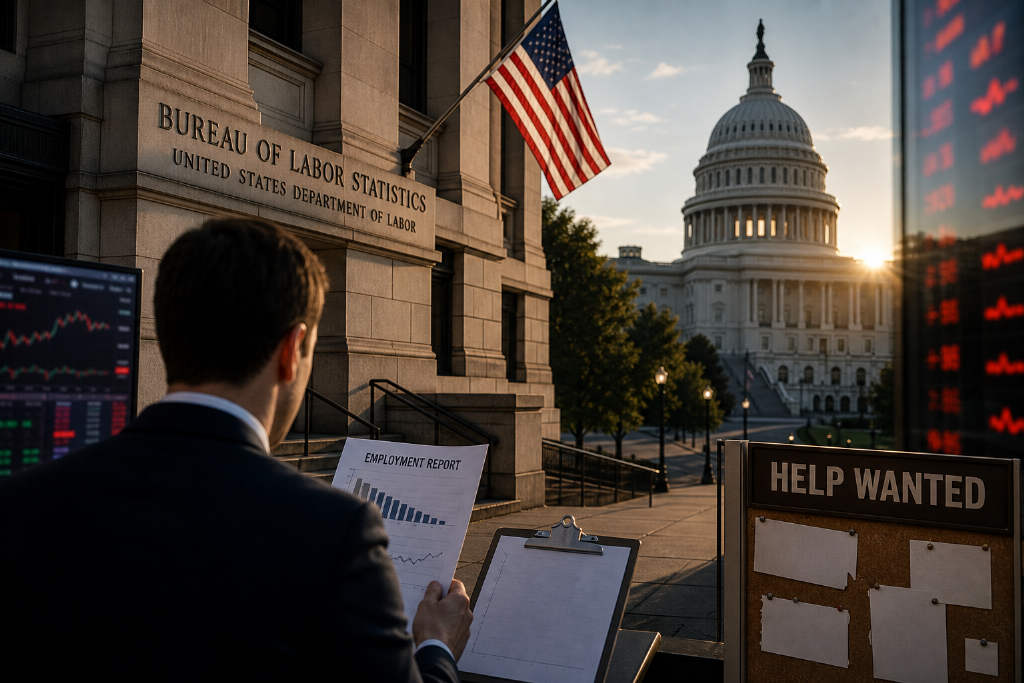
The U.S. Bureau of Labor Statistics will release the August employment report on Sept. 4. It is the last monthly nonfarm payrolls report before the Federal Reserve’s Sept. 15-16 policy meeting, and markets are treating it as a key test of whether the U.S. labor market is still cooling.
July nonfarm payrolls unexpectedly fell by 23,000. May and June were later revised down by a combined 103,000, a sign that underlying hiring momentum was weaker than previously estimated. Inflation, meanwhile, remains well above the Fed’s 2% target. After Chair Warsh spoke at Jackson Hole, markets raised pricing for a September rate increase.
Capital Street FX said the market’s main question this week has shifted from whether the Fed will stay hawkish to whether slower job growth can offset inflation pressure. JOLTS openings, ADP employment, and the price and employment components of the ISM surveys may offer early signals ahead of Friday’s payrolls release. Still, the variables that may move policy expectations are not limited to headline job creation. Labor-force participation, wage growth, and revisions to prior data may carry equal weight.
Even so, payrolls alone will not provide a final answer for September. The U.S. will publish August PPI and CPI before the Fed meeting. A more precise way to frame Friday’s report is this: it will show whether the labor-side evidence is strong enough to prevent another hike, while inflation data still retains the last part of the pricing power.
A heavy week of data points to one question
In the first week of September, U.S. markets will face a dense run of economic releases. JOLTS job openings and the ISM manufacturing index are due Tuesday. ADP private employment and the Federal Reserve’s Beige Book follow on Wednesday. The ISM services index is due Thursday. Friday brings the August nonfarm payrolls report.
All of them feed into the same question: with inflation still elevated, has the U.S. labor market weakened enough for the Fed to stay on hold?
There is still a clear split in market views on the Fed’s September path. In his Jackson Hole remarks, Warsh said the Fed may still need to take further action if inflation does not return clearly and quickly to 2%. Market pricing cited by Capital Street FX showed that the probability of a 25-basis-point hike in September rose from about 35% to 57% after the speech.
Rates and asset prices adjusted at the same time. The 2-year U.S. Treasury yield rose 6.6 basis points to 4.29%. The U.S. dollar index gained 0.55%. Gold and Bitcoin fell about 3.2% and 3.4%, respectively. Those moves suggest markets have begun to price higher short-term rates back into the dollar, precious metals, and crypto assets.
Whether that hawkish repricing can hold now depends on this week’s labor data.
July payroll weakness looked larger after revisions
U.S. nonfarm payrolls fell by 23,000 in July, far below expectations for an increase of about 83,000. Government employment dropped by 53,000, while private payrolls rose by 30,000. The stronger signal came from revisions: payroll gains for May and June were marked down by a combined 103,000, leaving the average increase over the past three months at about 20,000.
The Bureau of Labor Statistics has confirmed that the August employment report will be released at 8:30 a.m. Eastern Time on Sept. 4.
The unemployment rate, on the surface, looked firm. It fell to 4.1%, a 13-month low. But part of that improvement reflected a decline in the labor-force participation rate to 61.4%. In other words, the lower jobless rate did not fully reflect stronger labor demand. Some of it came from more people leaving the labor force.
Average hourly earnings growth also slowed to 3.2% year over year. If wage growth keeps easing, payroll growth stays weak, and prior months are revised down again, markets may cut back expectations for a September hike.
That is why Capital Street FX argued that Friday’s headline payroll number may not be the most important part of the release. Participation, wage growth, and revisions to historical data may offer a better read on the labor market’s underlying shift.
There is still a reason for caution. Monthly payroll data can be volatile, and a single negative reading may reflect swings in government hiring, industry composition, or seasonal adjustments. A fuller case for a sustained cooling in labor conditions would require all three: weak hiring, slower wages, and downward revisions.
JOLTS, ADP and ISM reports may set the tone before Friday
Before payrolls arrive, markets will get three related sets of indicators.
First is July JOLTS job openings on Tuesday. Openings show unmet labor demand from employers. If the number keeps falling, that usually points to less labor-market tightness. But JOLTS is a lagging indicator, and a drop in openings does not automatically mean companies have started broad layoffs.
Wednesday’s ADP employment report will offer a read on private-sector hiring. ADP and official payrolls differ in survey coverage and methodology, so short-term moves between the two can diverge sharply. For that reason, ADP should not be treated as a direct forecast for nonfarm payrolls. Even so, a print well above or below expectations could still move market positioning ahead of Friday.
The ISM manufacturing and services indexes, due Tuesday and Thursday, add another layer by combining growth, employment, and inflation clues. The July ISM manufacturing index stood at 55.6, the highest level since May 2022. Its employment component rose to 52.8, moving back into expansion territory. The ISM services index came in at 54.1, but its employment component was only 47.4, showing continued expansion in activity alongside softer hiring demand.
Capital Street FX said it is paying closer attention to the prices-paid components than to the headline indexes. In July, the ISM services prices-paid index reached 70.3, a sign that cost pressure remained firm. If this week’s price components stay high, the Fed may find it difficult to look past inflation risk even if hiring slows.
That leaves several combinations that may matter more than the payroll figure alone:
- Falling employment and easing price pressure would strengthen the case to pause.
- Resilient hiring and elevated price components could reinforce expectations for a hike.
- If both employment and prices weaken, U.S. Treasury yields and the dollar could face a more visible pullback.
The market is trading the Fed’s reaction function
The reaction function, in market terms, is the framework investors use to judge how the central bank is likely to respond to changes in growth, employment, and inflation.
Warsh’s Jackson Hole speech altered the market’s short-term reading of that framework. He said the 2% inflation target would not change and argued that current financial conditions should not yet be seen as clearly restrictive. That pushed investors to reassess whether the Fed might still tighten again as long as the labor market does not deteriorate quickly.
At its July meeting, the Fed voted 9-3 to keep the federal funds target range unchanged at 3.50% to 3.75%, with three dissenters favoring a 25-basis-point increase. The minutes also showed that policymakers saw economic activity continuing to expand steadily, while inflation remained above the 2% goal.
Against that backdrop, the importance of August payrolls is not that it can decide the September outcome on its own. Its role is to change the evidence threshold required for another hike.
If the labor data comes in clearly weak, the Fed will face a more visible two-sided constraint. Another hike could speed up labor-market cooling, while leaving rates unchanged could allow inflation to stay above target. If hiring keeps expanding and wage growth remains firm instead, policymakers would have more room to keep inflation control as the first priority.
Payrolls may move hike odds, but CPI still comes last
The original text described this week’s employment report as the “final verdict” before the September meeting. That wording needs to be softened.
On the official schedule, the Fed meets on Sept. 15-16. August PPI and CPI are due on Sept. 10 and 11. That means payrolls is the last full monthly employment report before the meeting, but not the last important batch of economic data.
Three follow-up signals stand out:
- Whether payroll growth stays close to zero or turns negative, and whether prior readings face another meaningful downward revision.
- Whether labor-force participation and wage growth weaken at the same time. If a lower unemployment rate still mainly reflects lower participation, the labor market may be less stable than it appears.
- Whether the CPI release confirms easing price pressure. Even if payrolls are weak, markets may still preserve some pricing for a hike if core inflation surprises to the upside again.
For asset markets, weaker employment data could push down short-dated Treasury yields and the dollar, while giving some relief to gold, Bitcoin, and other assets that are sensitive to real rates. Strong employment combined with high inflation could keep short-end rates moving higher. Those outcomes, however, remain market inferences based on current pricing. The actual reaction will still depend on the gap between the data and expectations, as well as existing investor positioning.
So the real question Friday is not whether the Fed will definitely hike in September. It is whether the labor market has weakened enough to limit the Fed’s room to do so. The final answer still awaits next week’s inflation data.