
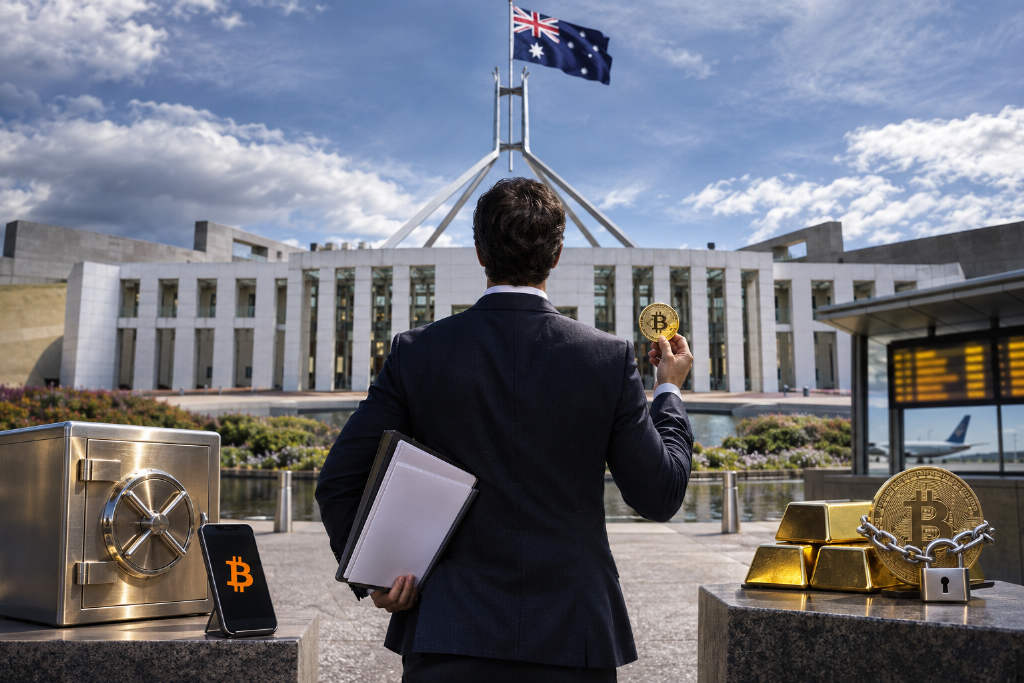
Australia’s decision to remove the 50% capital gains tax discount on investments from July 1, 2027 has jolted local crypto holders, with Bitcoin investors now looking at a much larger taxable share of future gains.

Cointelegraph reported that the new framework will leave investors with only a small inflation-linked adjustment, while several legal options remain available for those who start planning early.
Some Australians are already considering major moves. Finder founder Fred Schebesta is relocating to Singapore, which has a 0% capital gains tax rate, and described the tax changes as a 「killer blow」. Less extreme options mentioned in the report include using a self-managed super fund, trading through a company at the company tax rate, or waiting to see whether a future government reverses the reform.
YahooFinance was cited as a source in the piece.
What changes on July 1, 2027
Since 1999, Australian asset owners have generally paid tax on only half of their capital gain. From July 1, 2027, they will instead pay at their full income tax rate. The report says that means a 30% CGT rate when income and gains are between A$45,000 and A$135,000, 37% on the portion between A$135,000 and A$190,000, and 47% above that. All figures in the story are in Australian dollars.
The article adds that low-income earners who are not on welfare, including students and retirees, will still face a minimum 30% CGT rate regardless of how small the gain is.
The only remaining discount is an inflation adjustment to the cost base. Cointelegraph gave the example of a house bought in 2027 for A$1 million and sold 10 years later for A$1.5 million. With inflation at 3%, about A$344,000 of that gain would be attributed to inflation and would not be taxed.
Andrea Yuen, CEO of Swyftx, said, 「The challenge for cryptocurrency is that the CGT changes, indexation really helps slower growing assets not fast ones.」
The article then applied the same logic to Bitcoin. A purchase at A$10,000 and a sale 10 years later at A$100,000 would receive an inflation discount of only about A$3,439. Under the old system, tax would apply to A$45,000 of gains. Under the new system, tax would apply to A$86,561.
Stockspot analyst Chris Bryki compared 10 asset classes under the proposed rules and wrote in The Australian that 「Crypto sits at the bottom because almost its entire return comes from capital growth.」
Strategy 1: Realize gains before the deadline if markets cooperate
Any gain made before July 1, 2027 would still fall under the current 50% discount regime. On that basis, one possible response is to hope a strong bull market lifts portfolio values before the cutoff date.

The report says holders should keep accurate records of the value of every crypto asset they own on that day, because any gain above that level would be taxed under the higher regime.
Ben Simpson, founder of crypto advisory service Collective Shift, said Bitcoin’s performance since mid-year in a difficult macro environment leaves room for more upside before July.
He also stressed that he is not a financial adviser, adding: 「I probably wouldn’t be betting the farm on the fact that we’re gonna have a huge bull run」.
Yuen took a harder line on that idea. 「A strategy isn’t a strategy if you’re just sort of hoping,」 she said.
Strategy 2: Back parties that say they would reverse the reform
According to the article, both the Coalition and One Nation have promised to reverse the CGT changes. Crypto voters who care strongly about the issue could try to influence the outcome through the ballot box.
That path is far from certain. The ruling Australian Labor Party holds 94 of 150 seats in the House of Representatives, making it difficult to remove from office.
Cointelegraph noted that if government changed and legislation cleared the Senate in time, the reform could technically be reversed before anyone had to file taxes after July 1, 2028.
Still, the report said it is more likely that any change would come later. Adrian Forza, director of Crypto Tax Australia, said that would make capital gains calculations very difficult.
Strategy 3: Move crypto exposure into a self-managed super fund
Australia’s retirement vehicles are known as superannuation funds. Once a person is over 60, investments in that structure can be accessed tax-free, even if they continue to grow.
The problem for crypto investors is that retail super funds do not allow clients to invest in crypto directly. To use this route, investors would need to set up a self-managed super fund, or SMSF. Simpson said about one-third of his high-net-worth clients invest in crypto through SMSFs.
「Buying Bitcoin and accumulating it there is a super solid idea,」 he said, while warning against loading the structure with altcoins. 「You’re risking your retirement, which is an ultra long-term hold, on short-term altcoins.」

The article noted that Australian super fund AMP has invested in Bitcoin, but does not let its clients do the same.
Simpson said the main drawback is time. Younger investors may not be able to access that money for decades.
In practical terms, the strategy appears better suited to wealthier investors over 50 who have a shorter wait ahead of them.
The report also said the government has made SMSFs burdensome to run, with compliance paperwork, audits and unavoidable fees. Annual costs typically range from A$2,000 to A$4,000. Online providers such as Stake can lower annual costs to around A$1,330, but only if the investor buys Bitcoin or Ether ETFs.
There is another hurdle: investors must sell their existing crypto and pay tax on it before buying back exposure through an SMSF. Annual contribution caps also apply. Even so, Forza said that with some creativity, investors should be able to get almost A$400,000 into the structure.
The article said a more detailed report on setting up a crypto SMSF is expected in December.
Strategy 4: Borrow against Bitcoin instead of selling it
Another route discussed in the report is borrowing against Bitcoin so that no sale takes place. The logic is familiar from wealthy investors in traditional markets: servicing a loan can be cheaper than triggering tax through a disposal.
Cointelegraph said Bitcoin holders can now access lenders including BlockEarner, Veild and Swyftx, which allow BTC to be posted as collateral.
「We like to bring that strategy to the masses, not just to billionaires,」 Yuen said.
The risks are substantial. Borrowers face high interest rates, relatively short loan terms that are typically 12 months, and the possibility of losing their Bitcoin if the market moves against them. They also cannot borrow against the full value of the collateral. Swyftx’s loan-to-value ratio is around 40%.
Yuen said, 「If your collateral drops below a certain amount, there will be a margin call. I would say it’s a bet on a price going up. I think you have to have a view that crypto will go up — or at least not go down so that you get margin-called... Otherwise, a crypto-backed loan wouldn’t make sense for you.」

Simpson said he does not recommend the strategy because of the risk, though he acknowledged that it can work in some cases. He gave an example in which borrowing at 10% interest while Bitcoin compounds at 33% a year would leave an investor better off than paying CGT.
He also warned that this is a leveraged bet best suited to sophisticated investors.
The article pointed out that Bitcoin is down 28% over the past year. Anyone who borrowed a year ago could have faced margin calls, possible liquidation and interest costs.
Using Bitcoin-backed loans for a house deposit is becoming more popular, according to the report.
Forza said borrowing can itself become a taxable event in some cases, especially in DeFi. If a user deposits ETH into Aave, it is automatically swapped into WETH, which he said is a taxable event. Withdrawing the ETH later creates another taxable event.
Borrowing from centralized lenders such as BlockEarner or Swyftx remains a gray area, with the Australian Taxation Office yet to clarify whether it counts as a taxable event.
Forza said, 「If you’re talking about [borrowing] ten grand fine. But if you’ve got three to five Bitcoin, I wouldn’t risk it because if it goes against you then you’re going to be paying tax.」
He added, 「Vield is the only one in Australia that’s got a private ruling that says their product is not a taxable event. No one else has got one.」
Swyftx confirmed it does not have a private ruling and said clients should seek tax advice. BlockEarner did not respond to a request for comment.
The article said part two of Cointelegraph’s Australia CGT feature will be published later this week and will cover four more ways to reduce crypto tax bills, including setting up a company or leaving the country entirely.



