
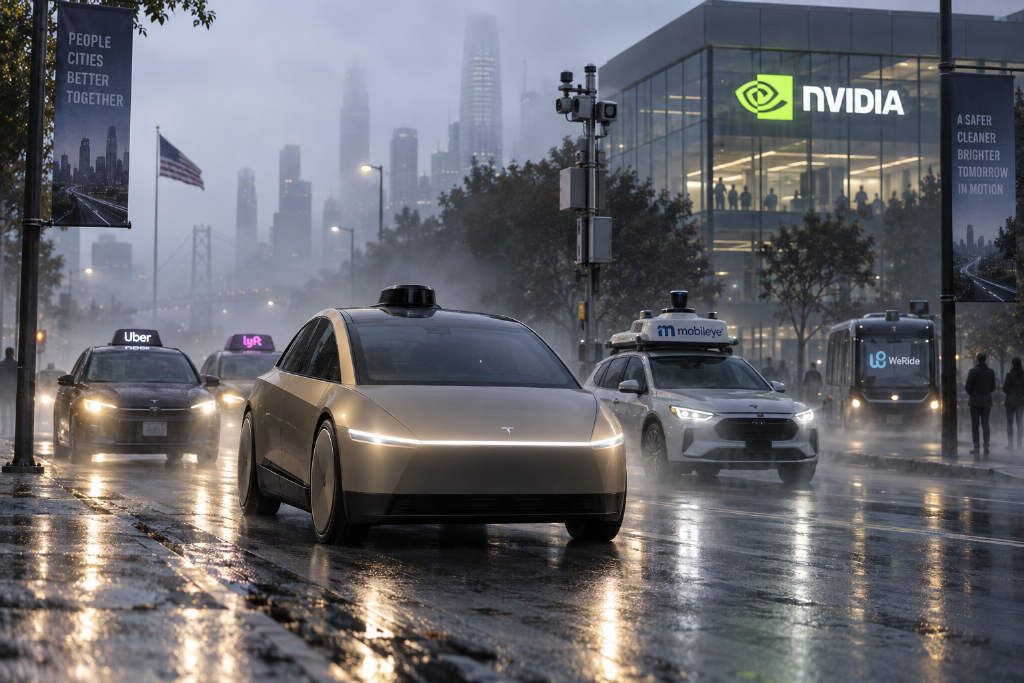
Tesla (NASDAQ: TSLA) recently introduced Cybercab, putting a fresh spotlight on its autonomous vehicle strategy. ABMedia, citing analysis from The Motley Fool, said more than 10 companies around the world have already entered the autonomous vehicle and robotaxi business, and that the opportunity now spans far more than carmakers alone.
According to the report, the autonomous driving ecosystem covers AI chip suppliers, fleet operations and demand-matching platforms. Investors looking for exposure outside Tesla can also watch five U.S. stocks linked to software architecture, automation systems and platform operations.
Mobileye: an upstream supplier with deep automaker ties
Mobileye (NASDAQ: MBLY), an advanced driver-assistance systems provider, generates about $2 billion in annual revenue. Its free cash flow over the past year was $388 million. The company supplies Level 1 and Level 2 chips and software for about 30 million vehicles a year and has built relationships with automakers including Volkswagen.
The report said Mobileye is testing Level 4 autonomous vehicles in Austin, Texas, and in Europe. It is also working with MOIA, a Volkswagen subsidiary, to improve safety through multi-sensor redundancy. For traditional automakers such as Ford or Stellantis that want ready-made technology, Mobileye can offer modular packages. The analysis said the value of a package per vehicle could rise from about $50 to several thousand dollars, and that the company may also take a cut from future robotaxi trips.
Nvidia: a central supplier across the ecosystem
Nvidia (NASDAQ: NVDA) was described as a key player in autonomous driving. The company provides chips and AI training tools that help automakers and developers process data from cameras, LiDAR and radar.
Its NVIDIA Drive platform offers software development kits and models. Partners mentioned in the report include Mercedes-Benz, Toyota and Jaguar, as well as operating platforms such as Zoox, Uber, Lyft and Grab.
WeRide (NASDAQ: WRD), which uses Nvidia chips, has expanded into the Middle East, Europe and Southeast Asia. The report said the company’s latest quarterly revenue rose nearly 100% to $34.1 million.
Uber: demand aggregation and fleet matching
The report said robotaxis need more than vehicle technology to become commercially viable. Operators also need riders and dispatch systems. While companies such as Waymo and Tesla have their own app capabilities, many autonomous driving developers prefer to focus on vehicle manufacturing and technical research, leaving fleet operations and trip dispatch to outside platforms.
In that setup, Uber (NYSE: UBER) acts as a demand aggregator. By combining ride-hailing, food delivery and retail delivery demand, it gives autonomous driving suppliers a route to market. According to the report, Uber has already partnered with about 12 autonomous driving companies and helps them turn technology into revenue.
Lyft: an existing dispatch network with takeover appeal
Compared with Uber, Lyft (NASDAQ: LYFT) is smaller, with a market value of about $6 billion. Still, the analysis said its operating network has strategic value. For autonomous driving companies such as Waymo, Zoox or Baidu that need dispatch infrastructure, Lyft could be an attractive acquisition target because a buyer would gain an established customer base and dispatch system.
Five names, different parts of the same trade
The analysis breaks the investment case for autonomous driving into several segments: ADAS supply, AI chips and training platforms, robotaxi operations, order matching and platform networks. The five U.S.-listed names highlighted alongside Tesla were Mobileye, Nvidia, Uber, Lyft and WeRide.