
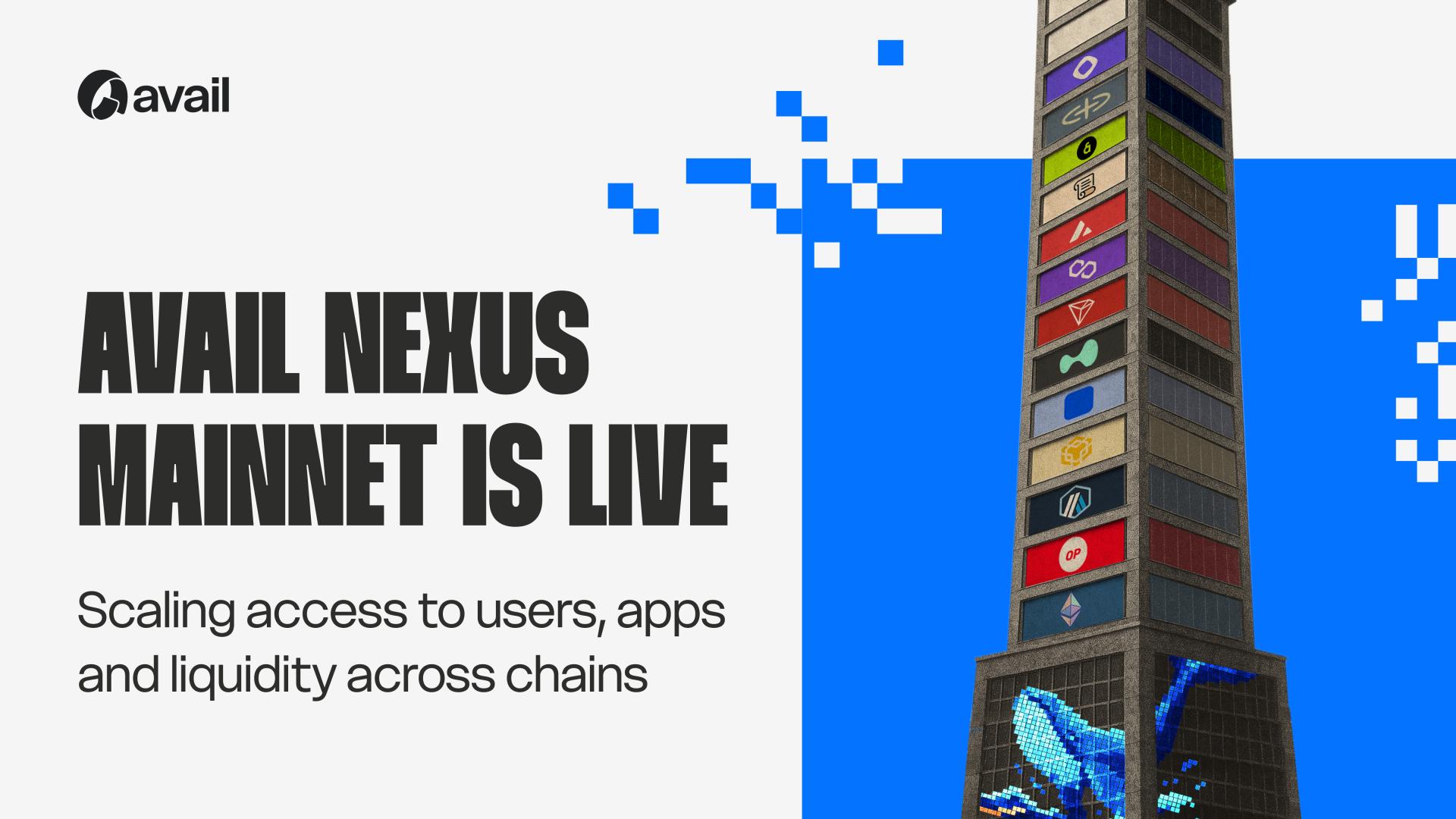
Avail has launched Nexus Mainnet, introducing a crosschain network built to connect rollups, appchains, and dApps in a single coordinated environment. The company said the network brings together liquidity, assets, and user flows across major ecosystems including Ethereum, TRON, Polygon, Base, Arbitrum, Optimism, HyperEVM, BNB, Scroll, Monad, and Kaia, while Solana support is listed as coming soon.
A shift away from bridge-based crosschain design
Avail describes Nexus as a liquidity-aware crosschain system rather than a conventional bridge layer. Its model uses an intent-solver architecture: users specify the result they want, and the network determines the route, liquidity source, and execution path. According to the announcement, Nexus can pull funds from multiple chains within a single transaction and uses Exact-Out execution to make outcomes more predictable no matter where liquidity sits.
Co-founder Anurag Arjun said blockchain fragmentation and siloed interactions have constrained both builders and users. In his view, chains should not operate as isolated networks merely passing messages, but as parts of a unified and verifiable system where assets, users, and intended actions can move freely.
What users are meant to gain from Nexus
Avail says the user experience is meant to change in several ways. The company points to a single experience across ecosystems, without bridge-heavy workflows or gas token friction. It also claims deeper liquidity and better pricing through crosschain aggregation, with execution coordinated across chains and access to apps regardless of where those apps are deployed.
The announcement frames this as a move from simple message passing to shared execution and shared liquidity. Arjun added that the product is aimed at supporting the type of Web3 experience needed for the next generation of consumer applications.
SDKs and APIs target multichain app builders
For developers, Nexus is available through SDKs, APIs, and lightweight Elements. Avail says this allows one-time integration for access to a multichain user base, unified collateral pools that update in real time across chains, intent-based trading and strategy execution, and crosschain actions without having to manage bridges, routers, or complex infrastructure directly.
Co-founder Prabal Banerjee said crosschain execution at scale has long been a major problem for builders. Nexus is intended to abstract routing, verification, and execution so teams can focus on application logic instead of maintaining the infrastructure underneath.
Avail DA and AVAIL token sit at the base layer
Avail also said unified verification is planned for a later stage and will be powered by Avail DA. The company referenced its Infinity Blocks roadmap, which targets 10 GB block capacity. That roadmap is presented as a way for builders to launch independent appchains with high throughput and finality while staying connected to the wider ecosystem through verifiable crosschain data. The $AVAIL token is described as the coordination asset and economic backbone of this model.
Initial ecosystem integrations span DeFi, AI, and SocialFi
At launch, Avail said integrations are live or in progress across DeFi, infrastructure, SocialFi, AI, and crosschain tooling. Named ecosystem participants include Lens Protocol, Sophon, TRON, Space & Time, Lumia, Validium Network, Vanna Finance, Mace, Clober, Station X, Nexus AI, Bitte.ai, Neova, Gummee, and Symbiotic.
With mainnet now live, developers can start integrating through the Nexus SDK. Avail also said users will soon be able to try the first wave of Liquid Apps, applications built to show how unified liquidity can work across chains. More chain integrations and ecosystem expansion are scheduled to roll out over time.