

Avalanche’s real-world asset sector is expanding even as AVAX remains under pressure. According to data cited from RWA.xyz, the value of tokenized assets on Avalanche has reached $2.1 billion, up more than 60% month over month, pushing the network into the top five public blockchains by RWA scale.
The report, written by Jae for PANews and published by MarsBit, describes a market split that has become hard to ignore: Avalanche is gaining ground in tokenized finance while its native token has not followed the same path. Recent growth on the chain has been driven by BlackRock’s BUIDL fund, Securitize’s tokenization efforts, and a series of enterprise and payment deployments in Japan and South Korea.
BUIDL has become the main engine of Avalanche’s RWA growth
The article argues that capital efficiency, composability and regulatory depth remain the key battlegrounds in RWA. On that front, Avalanche has benefited from the rapid expansion of BlackRock’s tokenized Treasury fund BUIDL and Securitize’s work in compliant on-chain issuance.
BlackRock and Securitize launched BUIDL in March 2024. The tokenized money market fund invests mainly in U.S. Treasuries, cash and repurchase agreements, and was designed to offer qualified investors an on-chain yield-bearing dollar product.
What was initially viewed as a symbolic trial has since grown into a major source of on-chain assets. Based on the latest RWA.xyz figures cited in the piece, BUIDL’s assets on Avalanche rose 105% in a single week, climbing from $464 million to more than $900 million. Weekly net inflows reached $436 million. That surge helped lift Avalanche’s tokenized RWA total value locked to $2.1 billion, a 60% increase from the same point a month earlier.
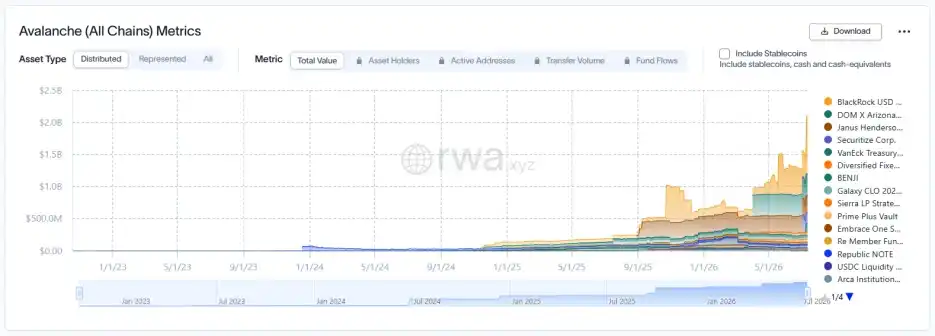
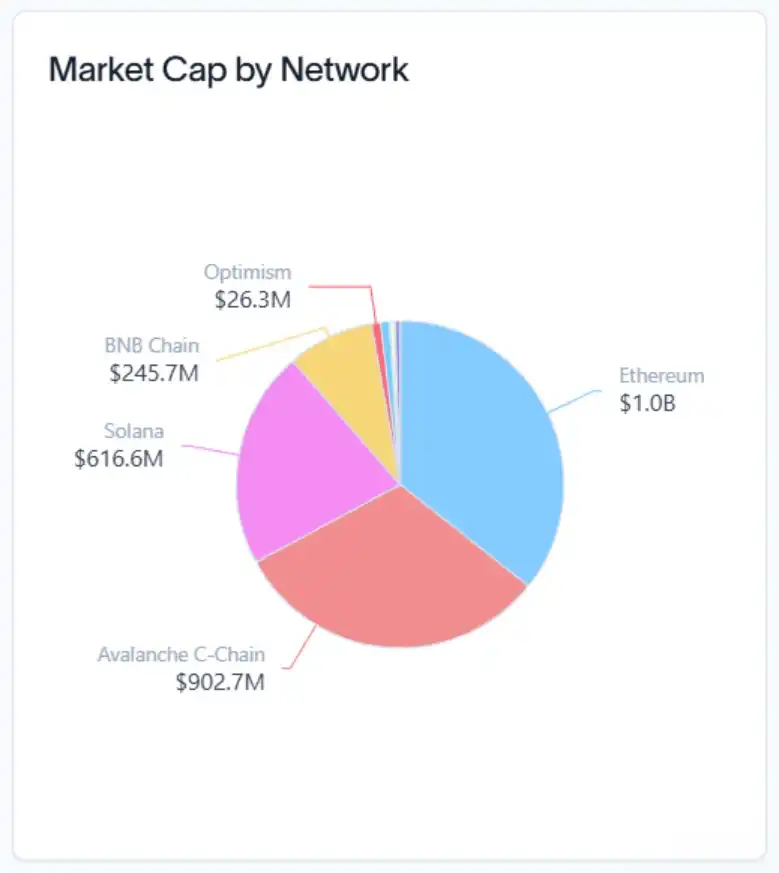
BUIDL’s total assets under management across all networks now stand at nearly $2.87 billion, according to the article. Avalanche accounts for more than one-third of that total, making it the fund’s second-largest distribution network after Ethereum. Within Avalanche’s own RWA ecosystem, BUIDL alone represents 43% of the total.
The report also highlights a second layer of utility around the fund. sBUIDL, a derivative asset pegged 1:1 to BUIDL fund shares, has been accepted as eligible collateral on the non-custodial lending protocol Euler. Compliant users can post sBUIDL and borrow on-chain liquidity such as USDC or AUSD. In the article’s framing, that marks a point where a traditional asset-management product starts to plug directly into DeFi composability while preserving Treasury-based yield.
Securitize has also completed an issuer-sponsored tokenized offering of its NYSE-listed common stock, SECZ, on Avalanche and Solana. The article contrasts that with offshore-wrapped synthetic products, arguing that native on-chain issuance of the same stock provides a clearer example of how tokenized equities can operate under the current securities-law framework. In that reading, Avalanche is no longer just a crypto chain for digital assets. It is being used in structures closer to regulated securities settlement.
Japan is moving tokenized assets and payment rails onto Avalanche
The article says Asia’s tokenization push is taking shape in more operational settings than in Europe or the United States. Instead of focusing only on top-level regulatory architecture for securities and asset management, projects in the region are showing up in retail payments, enterprise settlement and cross-border treasury flows.
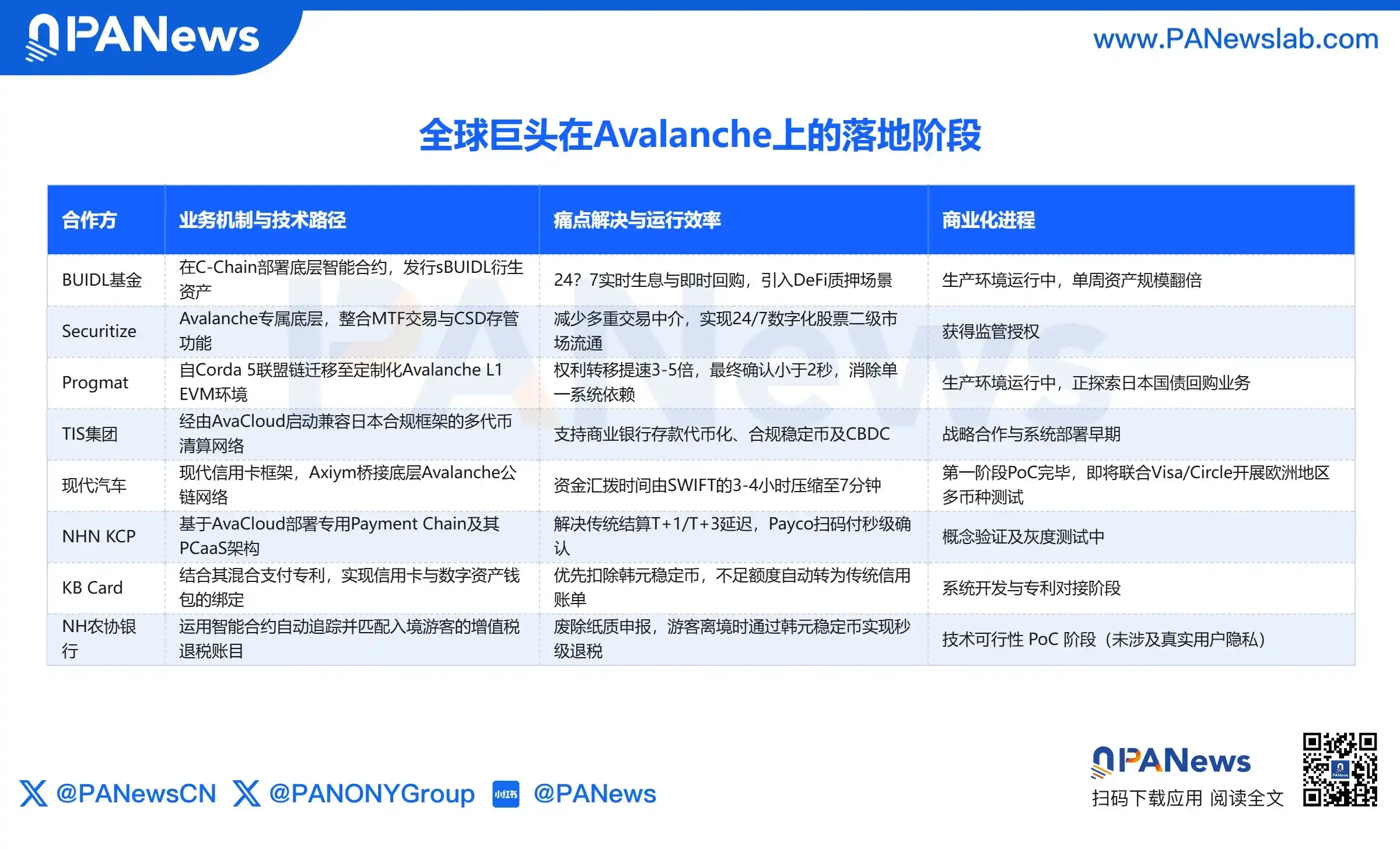
On July 13, Progmat, backed by Mitsubishi UFJ Trust, Mizuho, the Tokyo Stock Exchange, SBI and other major institutions, completed a major infrastructure upgrade by migrating more than JPY 452 billion, about $2.7 billion, in tokenized assets from a Corda 5 permissioned chain to Avalanche.
Progmat holds a 53% share of Japan’s security-token market, the report says, and the tokenized assets it has issued account for 64.6% of the country’s total issuance. Those assets span categories including real estate and corporate bonds.
The rationale for the migration was straightforward in the article’s telling. Consortium chains are closed liquidity islands, limiting asset circulation and cutting projects off from wider DeFi markets. By moving to Avalanche, asset-right transfers can become three to five times faster, while final transaction confirmation can be reduced to less than two seconds. The report adds that the shift could support future 24/7 real-time settlement for products such as Japanese government bonds and on-chain repo agreements.
Japan’s push is not limited to capital markets. TIS, a major Japanese payments company that processes $2 trillion in annual credit-card and payment transactions, has launched a multi-token payments and settlement platform through AvaCloud. The platform supports stablecoins and tokenized deposits issued by banks and enterprises, and it is expected to support instant settlement for central bank digital currencies, or CBDCs, in the future.
South Korea’s use cases span treasury transfers, payment infrastructure and consumer spending
In South Korea, the examples cited in the report are tied more directly to daily spending and business operations, with activity spread across cross-border treasury movement, merchant payments and card-based retail systems.
- Cross-border treasury transfers: On July 10, Hyundai Motor and its group-affiliated credit card unit launched an internal cross-border remittance system on Avalanche. The report describes Hyundai as the first large South Korean company to publicly adopt stablecoins for cross-border treasury settlement. In the first-stage pilot, a $20,000 test transfer between Hyundai Motor subsidiaries in the United States and Mexico took an average of seven minutes, compared with three to four hours through SWIFT, cutting time costs by 97%.
- Payment infrastructure: In mid-April, NHN KCP, described as South Korea’s largest e-commerce payment company, used AvaCloud to build the country’s first payment-dedicated mainnet. That reduced conventional T+1 to T+3 settlement delays to sub-second speed. In a pilot with the mobile payment app Payco, the time from QR scan to payment confirmation was two seconds.
- Retail spending: At the end of March this year, KB Kookmin Card and Avalanche developed a hybrid stablecoin credit-card payment system. Purchases first draw down KRW stablecoin balances, with any shortfall routed automatically through a traditional credit line. The article says that setup improves the user experience for stablecoin payments. In November last year, NongHyup Bank worked with Mastercard and other institutions on a stablecoin-based tourist tax refund pilot on Avalanche, replacing paper-based review with smart contracts and sending refunds instantly in KRW stablecoins.
Avalanche’s dedicated L1 model helps enterprises, but weakens direct value capture for AVAX
The article links this institutional shift to Avalanche’s custom L1, or Subnet, architecture. For enterprises, the tension is familiar: they want the security, efficiency and immutability of distributed ledgers, but they also need data control, access restrictions and compliance boundaries. Avalanche’s model is presented as a way to combine those requirements.
Using low-code tools such as AvaCloud, enterprises can build dedicated L1 environments tailored to their own needs. The article lists three examples. Validators can be restricted to specific jurisdictions to meet data-sovereignty and outbound-regulatory rules. KYC and AML requirements can be embedded at the protocol layer to block interaction from wallets that have not passed identity checks. Dedicated L1s can also run with isolated compute resources and separate gas-pricing mechanisms, avoiding the congestion and fee swings that affect public shared networks.
That gives enterprises a chain they can control while still keeping interoperability with a broader public blockchain ecosystem. In the report’s view, this blend of sovereign isolation and shared security is a strong fit for large institutions.
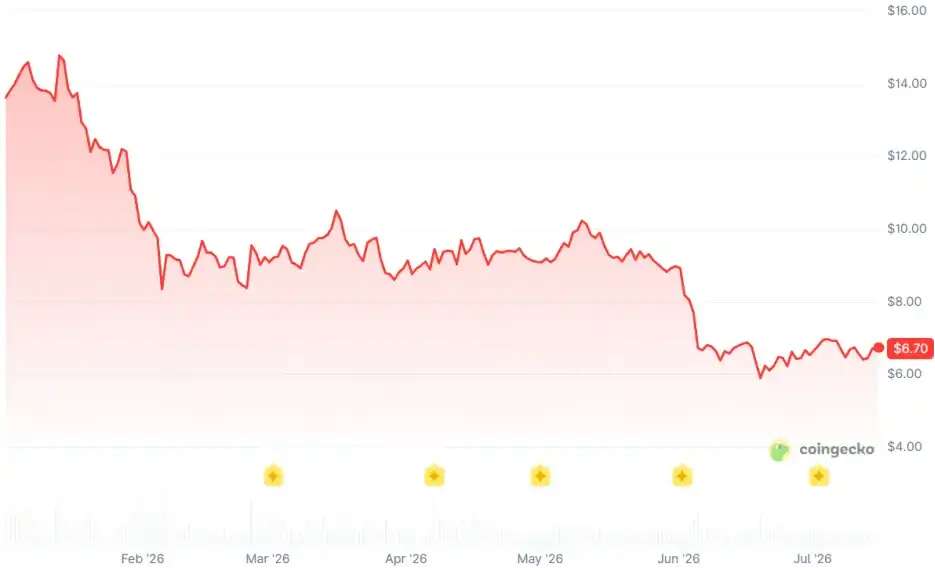
Yet the same structure creates a problem for AVAX. The report says Avalanche’s RWA footprint has expanded to more than $2.1 billion, and major enterprises are entering the ecosystem, but AVAX is still down more than 50% this year. The disconnect comes from how those enterprise deployments are actually used.
To avoid balance-sheet risk tied to token volatility, enterprises generally do not use AVAX as the medium for transaction fees on dedicated L1s. Instead, they prefer stablecoins or tokenized deposits as gas assets. In practice, that leaves the Avalanche main network acting more as a low-cost final-settlement ledger and security layer. The value generated by heavy enterprise transaction volume is not easily passed through to AVAX holders through mechanisms such as gas burn.
The article frames this as a structural challenge: token holders absorb price volatility and staking risk, but do not necessarily receive the economic upside from growth in the tokenized-asset ecosystem. Avalanche has gained traction in RWA, but whether that traction can be turned into stronger native-token value capture remains an open question.