

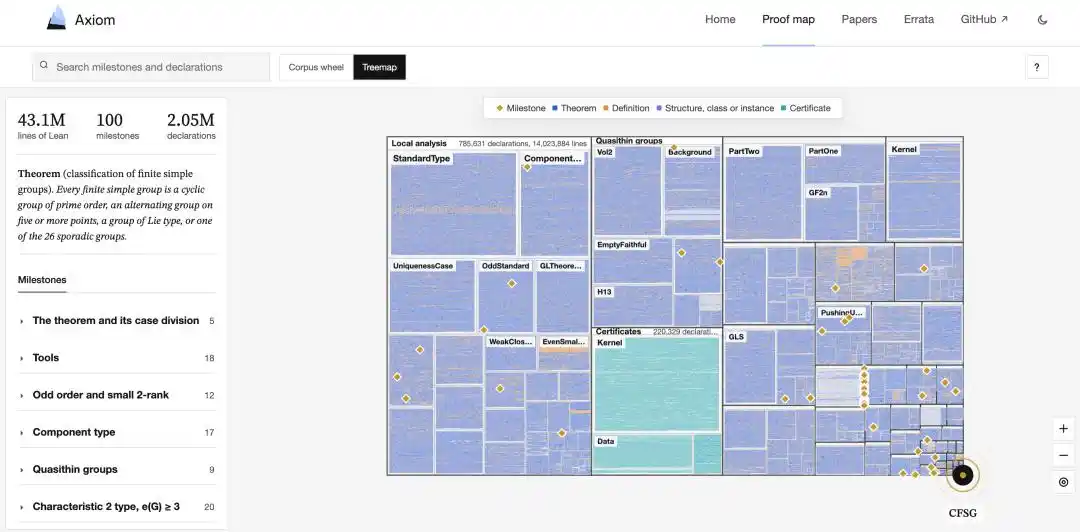
Axiom Math said on Oct. 26 that dozens of AI agents, coordinated by human mathematicians and engineers, completed a Lean formalization of the classification of finite simple groups in 24 days. The company said the project generated about 43.1 million lines of Lean code and 2.05 million formal statements, producing the first computer-checked proof that covers the full classification theorem.

The theorem, sometimes described here as the "Enormous Theorem," is one of the biggest undertakings in the history of mathematics. More than 100 leading mathematicians spent decades writing roughly 15,000 pages of proofs. Axiom said reasoning that had been scattered across more than 500 papers has now been organized into a formal system that can be checked step by step by a computer. During that process, the agents also found errors in historical papers and helped construct a new result in group theory.
What the classification theorem is trying to prove
The classification of finite simple groups is built around the idea of symmetry. A square, for example, matches itself after rotations of 90, 180 and 270 degrees. Mathematicians package those operations and their compositions into a structure called a group. Group theory became a general language for studying symmetry, with applications ranging from geometry to particle physics.
Complicated finite groups can, in a certain sense, be broken into more basic pieces, much as integers can be factored into primes. The pieces that cannot be decomposed further are called finite simple groups. The classification theorem asks a basic question with a very long answer: which such basic objects exist?
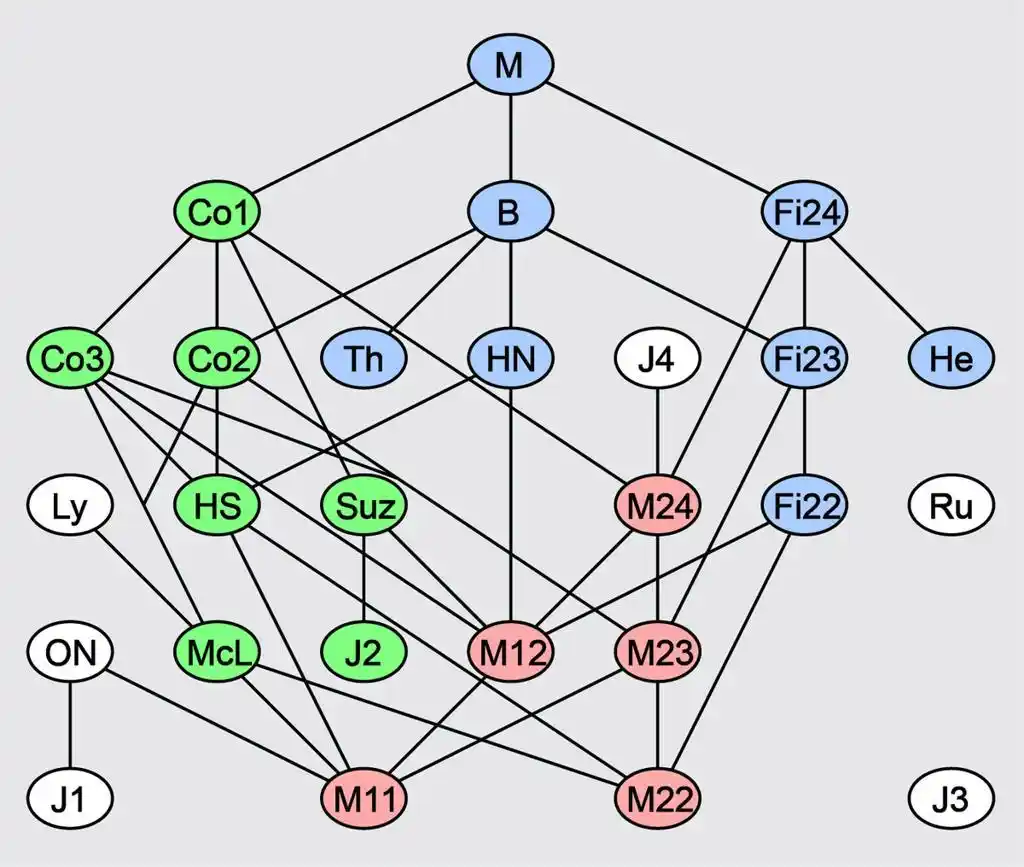
The final list contains cyclic groups of prime order, alternating groups, 16 infinite families of groups of Lie type, and 26 exceptional sporadic simple groups. The largest of those sporadic groups, the Monster Group, has about 8×10^53 elements. Proving that it exists was itself a major mathematical achievement.
Listing the candidates was only part of the job. The harder part was proving that there is no 27th sporadic simple group and no undiscovered family outside the known list.
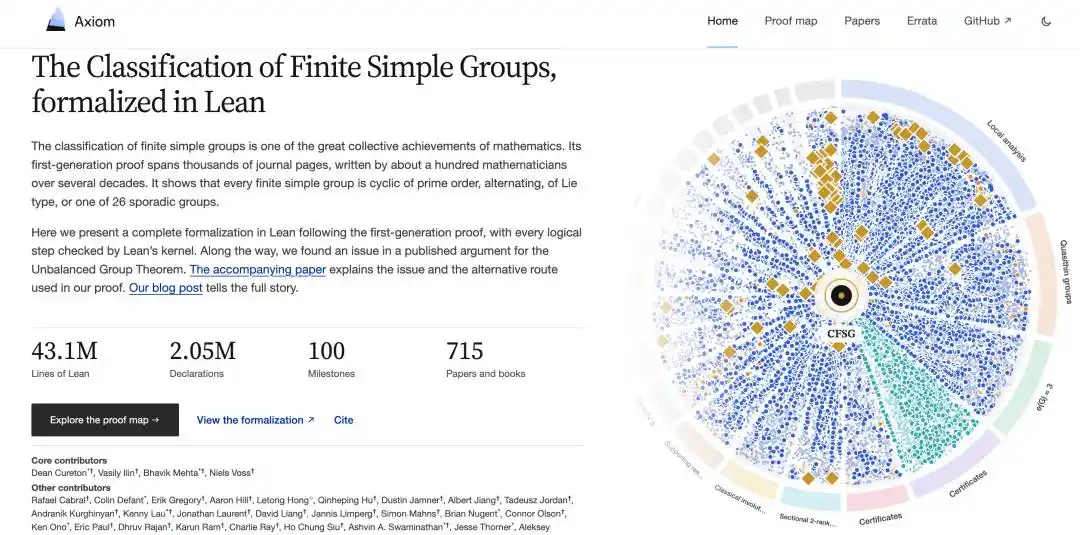
The work stretched across decades. In 1963, Walter Feit and John Thompson proved in a 255-page paper that every non-abelian finite simple group has even order, opening a path for later classification. In 1972, Daniel Gorenstein proposed a 16-step research program. In 1983, he announced that the classification had been completed. Later, mathematicians found that parts were still missing. A key gap in the quasithin case was filled in 2004 by Michael Aschbacher and Stephen Smith with a 1,221-page proof, and further corrections appeared in 2008.
The proof network became so large that no single person could easily verify every connection. One paper cited a theorem in another paper, which depended on earlier lemmas, and many steps omitted assumptions the authors considered obvious. Axiom's project was aimed at turning all of those links into proofs a computer could check.
How the 24-day agent workflow was organized
This was not a case of one model reading 15,000 pages and then dumping tens of millions of lines of code in one pass. Axiom used a multi-agent workflow.
On Oct. 1, the company opened a dedicated Slack channel and used existing Lean libraries and mathematical literature to build a proof roadmap with 108 milestones and about 380 concrete tasks. On Oct. 2, the first agents began claiming work through GitHub Issues.
Some agents broke theorems into smaller parts. Some searched for existing results. Others generated Lean proofs, reviewed propositions or integrated code. When a prerequisite theorem had not yet been completed, an agent could hand off that task to other agents. Human mathematicians handled the hardest obstacles, while engineers coordinated the system as it kept running.
Axiom said the agents were coordinated by its in-house mathematical proving system, AxiomProver. The project used an evolving mix of models, though the company did not disclose the underlying model list. The emphasis was not on a single model doing all the reasoning. It was on task decomposition, proof generation and collaborative verification across agents.
Early progress was slowed by proofs of the wrong statement
A difficult issue appeared soon after work began. An agent could prove a mathematical statement and still miss the statement the project actually needed.
The article compares it to proving that a bridge can safely carry a heavy truck, but only after adding a new assumption that the bridge piers are strong enough. Under that extra assumption, the proof goes through and Lean accepts the derivation. The trouble is that the strength of the piers was never proved.
Axiom said versions of that problem kept showing up early in the project. Some tasks looked finished but had quietly introduced unproved premises. The team had to delete tens of thousands of lines of code built on those assumptions and reorganize the work.
As the codebase grew, Lean's checking speed also became a bottleneck. Changing one foundational theorem could force all dependent code to be checked again. Engineers responded by adding shared build caches and parallel verification so that different agents could reuse results that had already been confirmed.
On Oct. 10, the Slack channel carried a short message: "WE PROVED MONSTER IS SIMPLE." Axiom said the agents had formalized the simplicity of the Monster Group and also formalized its existence through the Griess algebra.
Three days later, progress slowed sharply. On Oct. 13, even though dozens of agents were still generating code, the team completed only one milestone proof that day. The problem was task decomposition. The remaining mathematical obstacles were too complex, and each large problem hid many unresolved smaller ones. The agents could keep writing proofs, but they had trouble measuring how many critical steps had actually been settled and how far the project still was from the finish line.
Axiom then changed course, splitting difficult proofs into smaller and more explicit tasks and requiring agents to explain how those smaller proofs combined into the conclusion the project needed.
Thirty-four literature discrepancies had to be handled
As the formalization moved deeper into the historical literature, the team ran into a more serious issue than scheduling: the original papers could also be wrong.
Human mathematicians often omit familiar reasoning. Lean does not allow that. Axiom said the formalization process surfaced 34 notable discrepancies in the literature, including typographical errors, missing assumptions and substantive issues that required fresh derivations.
One example came from Aschbacher and Smith's work on quasithin groups. A lemma in the original text asserted that two quantities were equal. The agents, using the group SL₂(5), found a counterexample: one quantity was 1, while the claimed equality required it to be 2. Replacing the equality with an inequality repaired the lemma, but later arguments had relied on the equality. The team had to broaden the scope of an earlier argument and rework the affected cases.
A 1986 proof route broke, and the project produced a new theorem
A larger obstacle came from John Walter's 1986 work on the Unbalanced Group Theorem, or UGT. UGT is an important tool in the classification of finite simple groups because it lets mathematicians infer what kind of whole group they are dealing with from certain local structures inside it.
According to Axiom, one key step in Walter's argument assumed that after a certain operation on a specified family of groups, the related simple group would still remain inside that same family. The agents found a counterexample. Starting from PSL₂(49) and considering an involution induced by a finite-field automorphism, the simple component of the relevant centralizer can become PSL₂(7). That group does not belong to Walter's restricted family, so the closure claim does not hold.

This did not overturn the conclusion of UGT, but it did mean that one step in the inherited proof route needed a different justification. Axiom said it consulted group theorists Richard Lyons and Ronald Solomon. A key idea for the replacement route came from Solomon's theory of maximal 2-components, introduced in 1976.
The agents then constructed and formalized a new group-theoretic result called "Preservation of simple tops." It proves that, under the required conditions, comparing certain subgroups preserves the relevant simple-group structure. The result was written into a 35-page paper titled The Unbalanced Group Theorem as Theorem 2.3, and combined with other existing results to complete the UGT proof needed for the classification.
Axiom later said that after the formalization was finished, its mathematicians found a shorter route in the first-generation proof strategy that reached the target conclusion without calling the new theorem. Even so, the theorem and its full proof were kept as an additional mathematical output of the project.
The final repository and what comes next
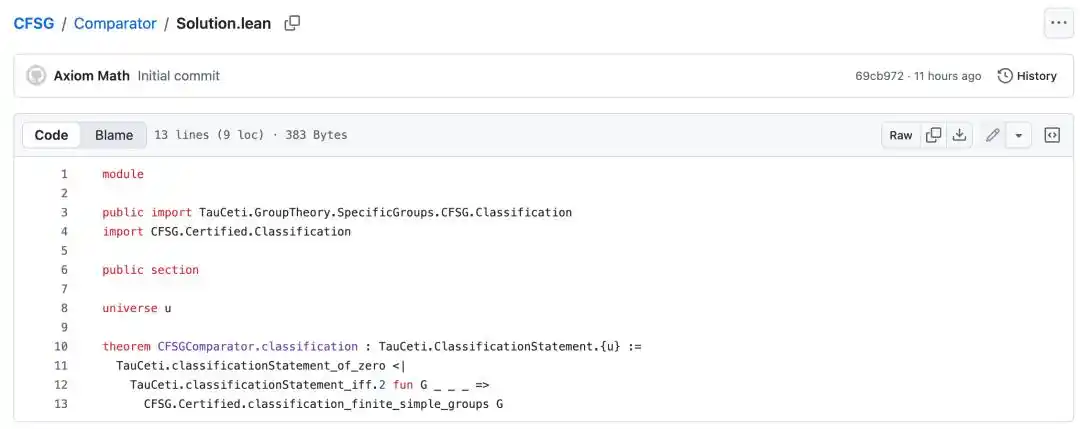
Axiom uploaded the full project to GitHub and released about 43.1 million lines of Lean code. In the repository, the final classification statement says that every finite simple group is isomorphic to one of the groups already constructed on the known list.
The company said the final proof contains no sorry, Lean's placeholder for an unfinished proof. It also said the result depends only on standard axioms and can be checked step by step by the Lean kernel. Axiom published an interactive dependency graph so researchers can trace which prior theorems support a given conclusion.
The project also rests on earlier formalization efforts, including Mathlib, TauCeti and Qiuzhen-CFSG. About 1.2 million lines came from Qiuzhen-CFSG, according to the article. Human mathematical work accumulated over decades, earlier formal infrastructure and AI agents that can work in parallel were brought into the same engineering pipeline.
For later mathematical research, one practical change is that proofs can now be maintained in a more continuous way. In the past, citing the classification of finite simple groups could implicitly pull in hundreds of papers. Now a researcher can follow a formal dependency chain and inspect the exact definitions, assumptions and derivations being used.
Axiom marked the review status of the public repository as team self-assessed. External mathematicians can still examine whether the formal definitions match the original statements and review the mathematical choices made across the project. What Lean adds is a kind of unified mechanical checking that was previously hard to obtain for a proof corpus of this size.
From solving isolated problems to building theory
Looking back at the 24-day run, the most striking point is not simply how much code the AI system wrote. It is that the system began handling a type of large-scale research work that had long depended on human specialists: breaking down tasks, tracking proof dependencies, finding errors in old literature and helping build a new proof route when an old one failed.
Knowledge accumulated over decades is being moved from arguments scattered across papers into structures that software can check, reuse and extend. Axiom's project is a concrete example of AI moving from solving individual math problems toward participating in the construction of an entire mathematical theory.
This article was sourced from the WeChat public account "机器之心" (ID: almosthuman2014), with the author credited as "关注AI的," according to the original report.



