



Babylon Labs has submitted an Aave Request for Comment, or ARFC, asking Aave V4 to support native Bitcoin held in the owner’s own output as collateral. Under the design described in the proposal, borrowers would be able to pledge BTC without giving up their private keys or transferring control of the asset to a custodian, a multisig federation, or a wrapped-Bitcoin issuer.
The proposal was filed on Oct. 14. Aave’s temperature check has already passed with 299,743 AAVE voting in favor and 0 against, and the process now moves to the Snapshot stage.
Why Bitcoin lending in DeFi has depended on custodians
The article says Bitcoin remains the largest pool of idle collateral in crypto, yet using BTC in DeFi lending has usually required holders to surrender control. Of the 20.10 million BTC mined so far, only 1.7% exists as tokenized assets on other blockchains, and nearly every one of those tokens is backed by Bitcoin held by a custodian or a signer group.
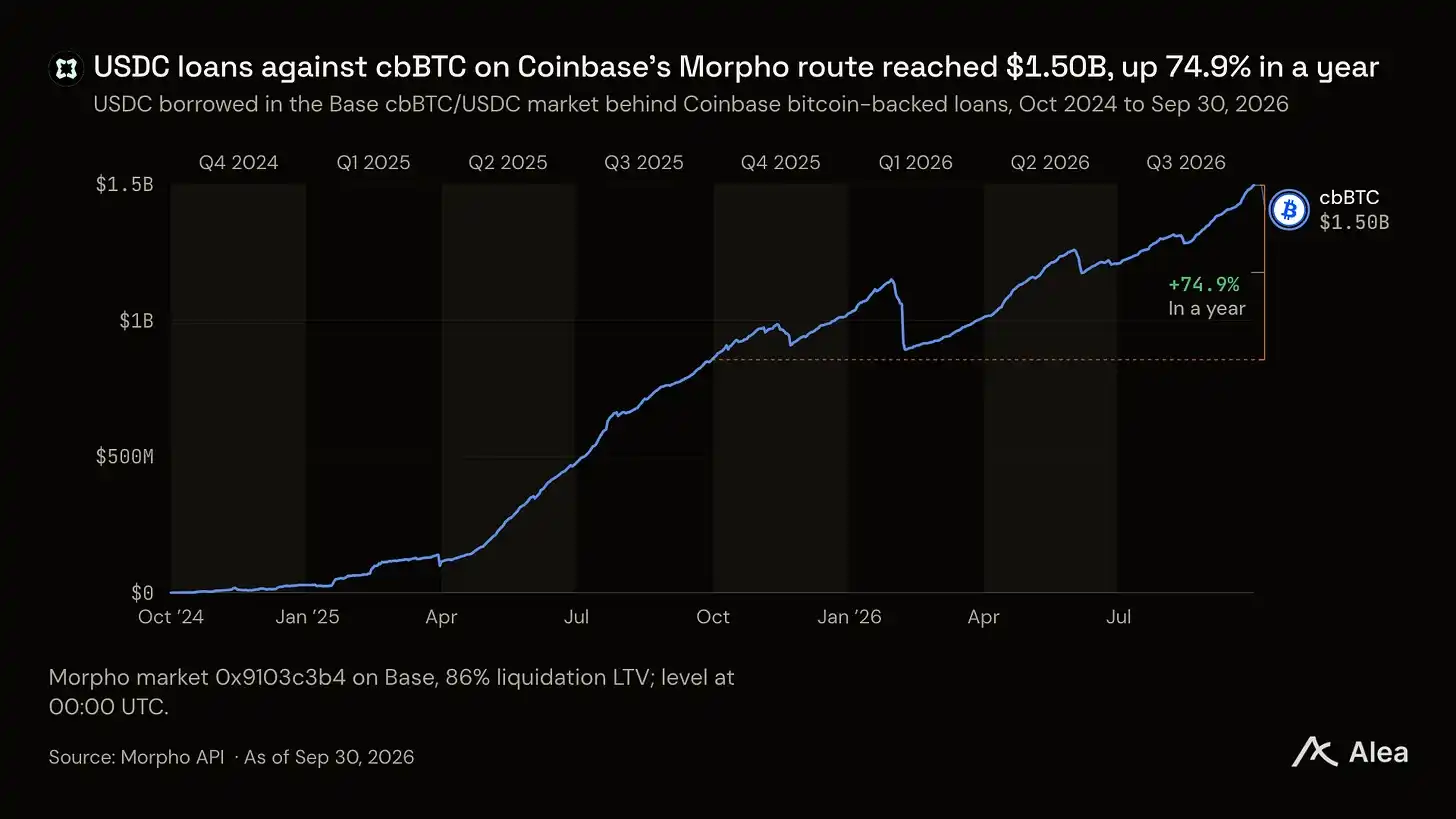
Demand for Bitcoin-backed borrowing is still strong. Coinbase connected its Bitcoin-backed lending business to a market on Morpho, and over the year through Sept. 30, USDC borrowing volume in that market rose 74.9% to $1.5 billion.
Babylon’s proposal is built around a different trust model. It says a malicious withdrawal can be stopped as long as there is one honest challenger, and that challenger can be the Bitcoin holder.
Trust assumptions reduced to a single honest party
The proposal compares Babylon’s vault model with several existing Bitcoin-linked assets. WBTC reserves are managed by a 2-of-3 multisig custodian structure. tBTC requires 51 of 100 signing seats to move tokens. LBTC depends on 10 of 14 consortium members. Babylon’s vault is presented as reducing the trust threshold to a single honest party.
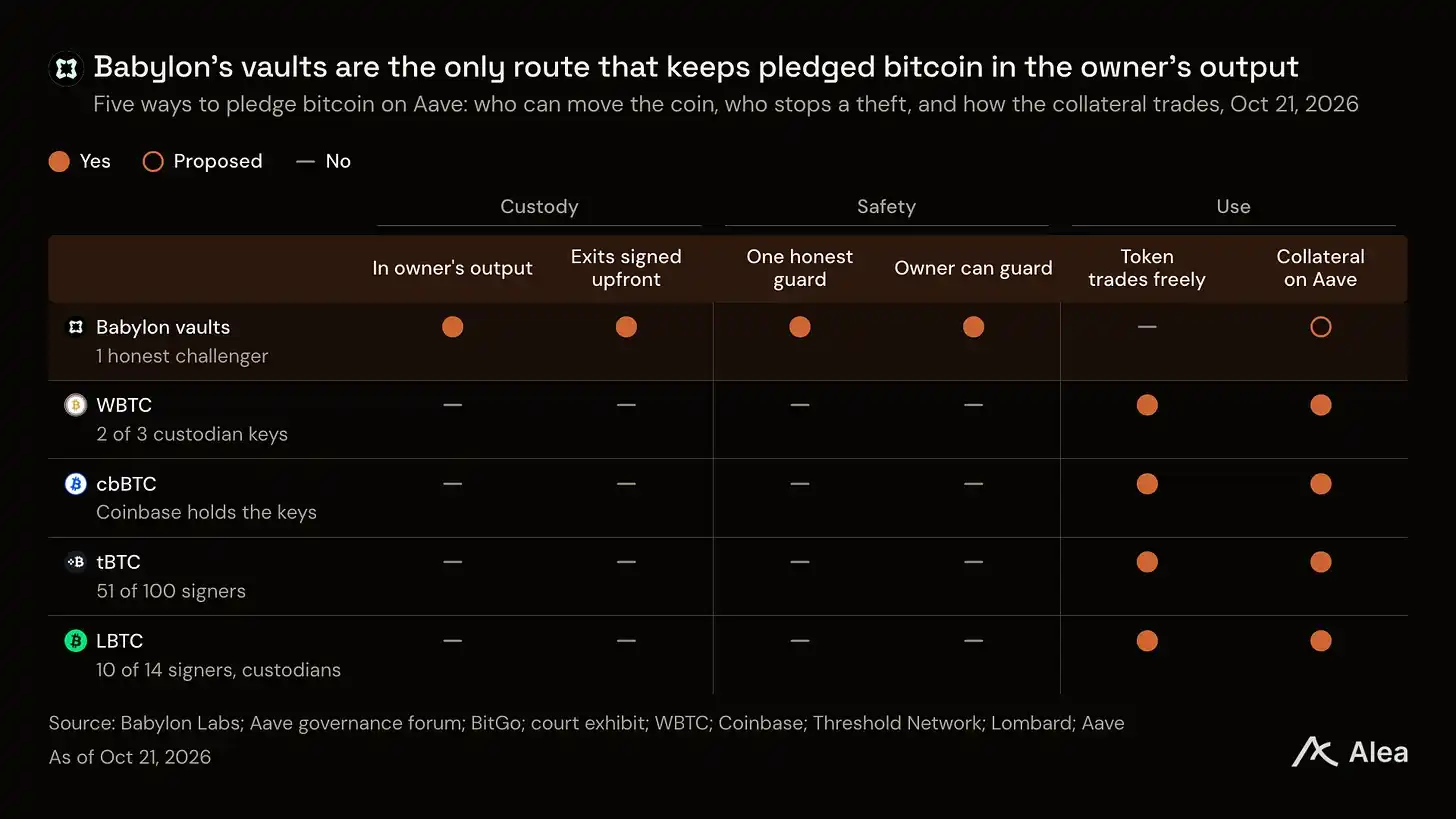
In practice, that means the borrower no longer has to rely on a custodian or a signer federation, only on the existence of one honest challenger. The proposal says the holder can fill that role directly.
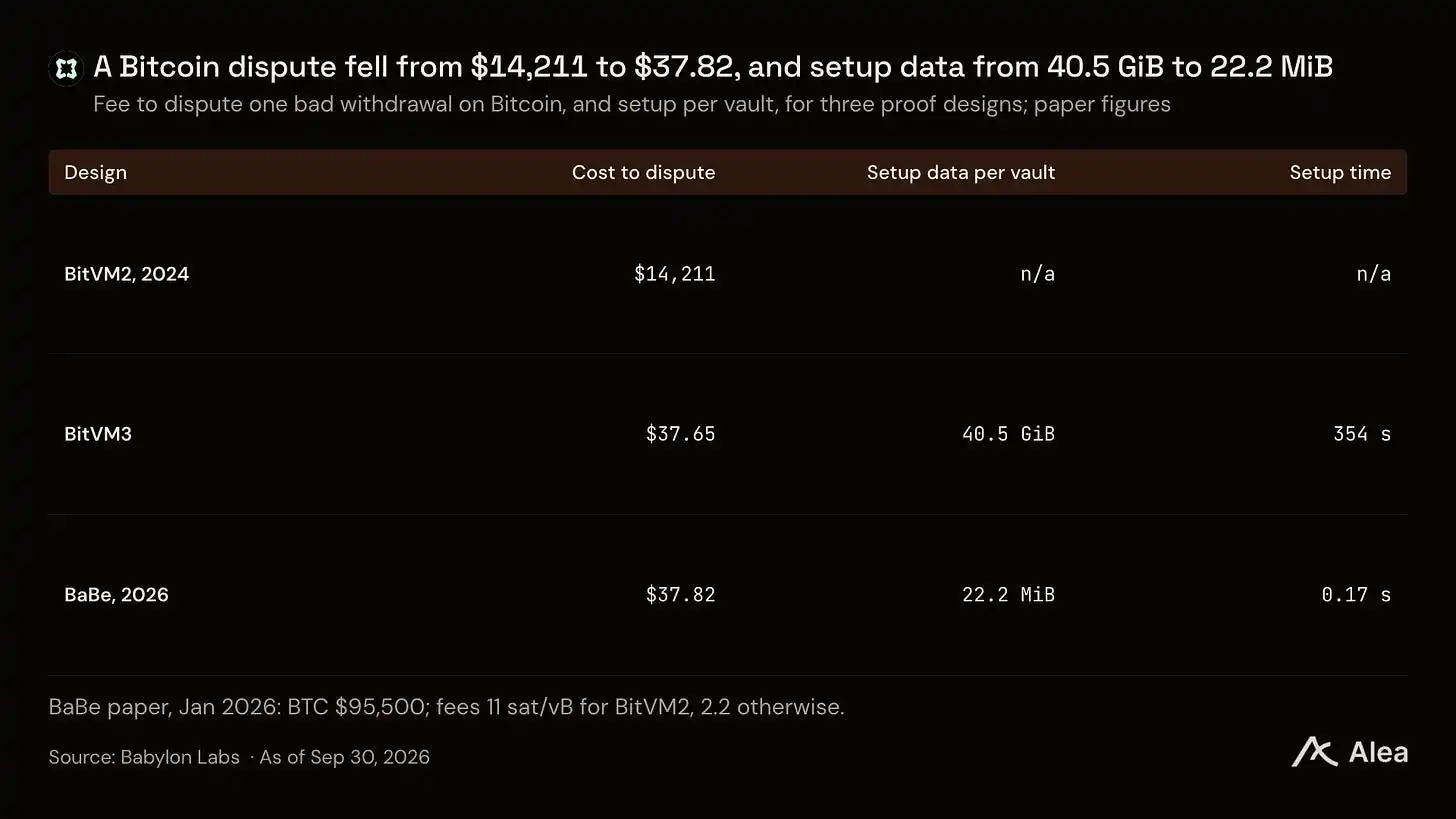
How BaBe lowers dispute costs from $14,211 to $37.82
Bitcoin script can verify signatures, hashes, and timelocks, but it cannot directly verify zero-knowledge proofs or read the state of another blockchain. The article says that writing a proof verifier directly into Bitcoin script would consume about 900 MB of block space per proof, equal to the capacity of 225 full blocks. That limitation is one reason Bitcoin in DeFi has long needed some outside entity to hold it.
BitVM, introduced in October 2023, moved verification offchain so that a claim is accepted by default unless someone proves it false. BitVM2, released in August 2024, reduced bridge trust assumptions to a single honest party, but a single dispute still cost $14,211 in fees and depended on non-standard transactions that most Bitcoin nodes would not relay.
BitVM3 used garbled circuits to cut dispute costs to $37.65, though each vault still needed 40.5 GiB of setup data. BaBe, developed by researchers from Babylon Labs, the University of California, Berkeley, and Stanford University using witness encryption, keeps dispute costs at roughly $38 while shrinking that setup requirement from 40.5 GiB to 22.2 MiB, a 1,868-fold reduction. The article gives the more precise figure for the Babylon system as $37.82, versus $14,211 for BitVM2.
It also says the proof system is scheduled to be presented at ACM CCS 2026.
How the vault works on Bitcoin
The Babylon vault is built around a single owner’s coins. Before the Bitcoin is locked, all parties pre-sign every possible path the BTC could take, including refund, withdrawal, liquidation claim, and challenge. After that, the Bitcoin network will only accept those pre-signed paths.
Any claim on the BTC must include a valid proof and then pass through a challenge window lasting several days. During that period, the vault provider, application keepers, general challengers, or the Bitcoin holder can step in to block a malicious claim.
One of the article’s figures notes that the Babylon committee can pause the vault contract on Ethereum, but cannot move the Bitcoin itself.
How the design would work on Aave V4
Since Aave V4 went live on Ethereum on March 30, the protocol has split lending into liquidity-holding Hubs and borrower-specific Spokes with their own rules. This ARFC adds two new Spokes.
The Babylon Spoke, written by Aave Labs, is a derivative of the standard Aave Spoke and would accept native Bitcoin as its only collateral. Aave has already launched an LBTC Spoke, and Babylon’s proposal would become the first Spoke for unwrapped native BTC. Stani Kulechov described this kind of dedicated Bitcoin hub as 「exactly the use case V4 architecture was built for」.
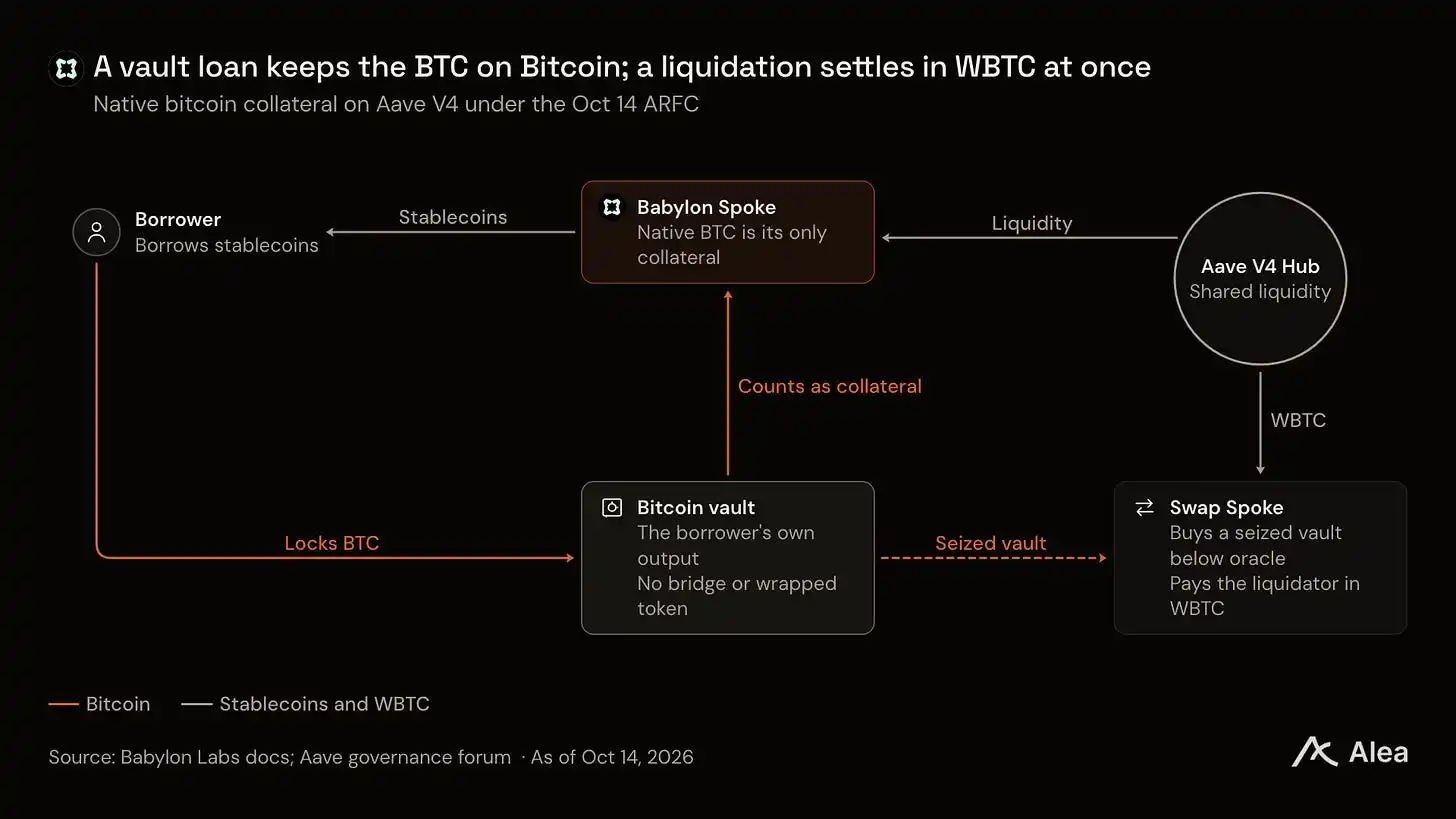
The flow starts with the asset owner locking BTC into a Taproot output on Bitcoin. An adapter on Ethereum then records that position as an adminless, non-transferable, non-tradable, and non-upgradeable receipt token. The owner can then borrow stablecoins from the Hub and pay Aave’s base rate plus a Babylon interest fee, though the ARFC does not set that Babylon fee yet.
Liquidation creates a second stream of interest-related revenue for Aave. If a position’s health factor falls below 1, a liquidator repays the debt and seizes the entire vault. The Swap Spoke buys the vault at a discount to the oracle price and uses WBTC borrowed from the Hub to pay the liquidator. Authorized arbitrageurs later repay the WBTC and redeem the Bitcoin from the Bitcoin network over the following days.
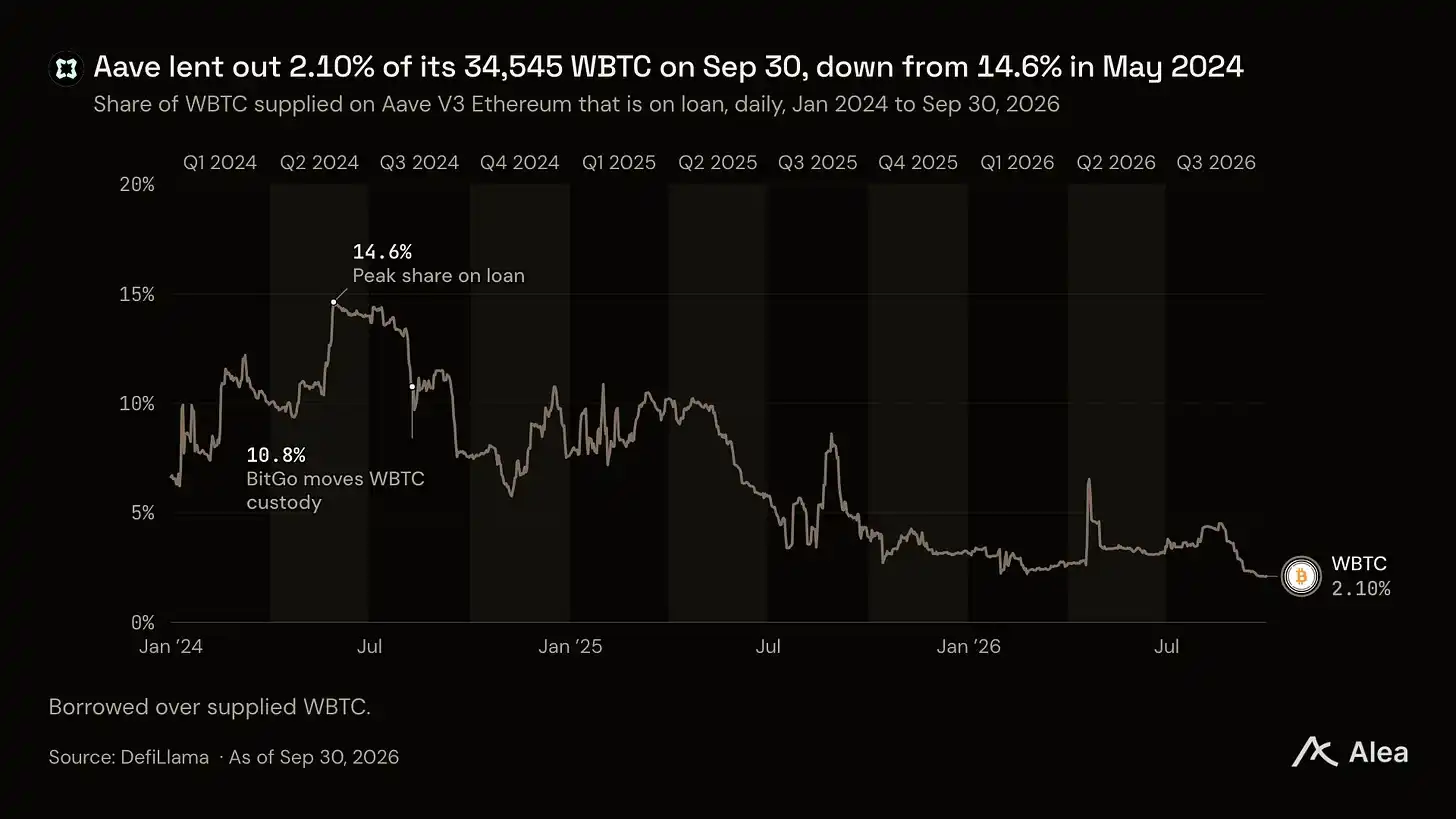
The proposal ties that mechanism to Aave’s existing WBTC reserves. As of Sept. 30, borrowers had drawn only 2.10% of the 34,545 WBTC supplied on Aave, down from 14.6% in May 2024. The article says that leaves enough idle liquidity for the Swap Spoke to fund instant liquidation payouts.
What institutions are being offered
The article compares the structure to tri-party repo transactions. In that market, collateral stays with a trusted custodian while the lender holds an enforceable claim. Babylon’s vault keeps a similar arrangement, but the custody agent is replaced by Bitcoin script and the asset remains under the owner’s control.
Fisher Yu described it as Bitcoin that does not leave the owner’s possession, balance sheet, or national borders. HashKey Cloud plans to let institutional clients in Asia borrow against native BTC through these vaults and deploy the borrowed stablecoins into yield strategies.
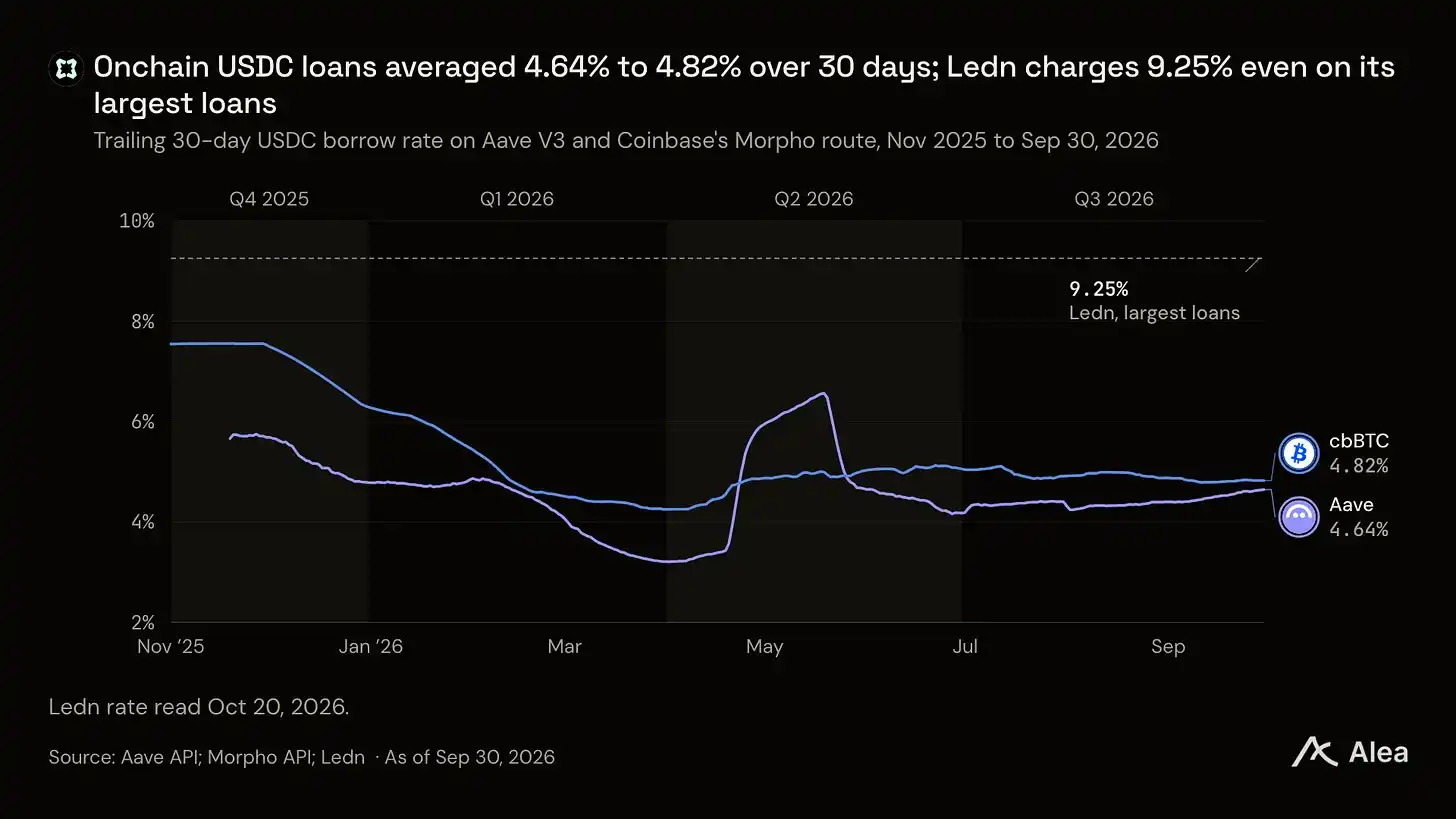
Pricing is another part of the pitch. Ledn lists annual loan rates ranging from 11.49% for loans below $250,000 to 9.25% for loans of $2 million or more. By comparison, the average annualized USDC borrowing rate on Aave V3 over the 30 days through Sept. 30 was 4.64%, with the same rate applied regardless of loan size. Babylon expects vault borrowing costs to land between 3% and 5% annually and plans to charge a 0% vault protocol fee at launch.
The custody-risk backdrop
The article links institutional demand for self-custodied decentralized borrowing to earlier losses in centralized lending. BlockFi lent customer crypto to institutional borrowers, and Genesis lent out crypto from the Gemini Earn program. Both firms had filed for bankruptcy before January 2023.
It also points to changes in WBTC custody. After BitGo moved WBTC custody in August 2024 to a joint venture with BiT Global, stablecoin issuer Sky voted to cut its WBTC lending cap to zero. As of Oct. 20, WBTC reserves held 116,512 BTC, down 25% from 154,707 BTC on the day the custody change was announced.
Under the Babylon vault model, the article says allocators would be focused less on the balance-sheet risk of a custodian and more on a transparent onchain exit path. After the several-day challenge window, the Bitcoin can return through the same route it entered.
The Ethereum-side vault contract can be paused immediately by either of two multisig groups: a 4-of-7 Interim Governance multisig, and a 3-of-5 Emergency Guardian multisig that includes seats for Aave Labs and LlamaRisk. The Emergency Guardian can unpause on its own, while contract upgrades are subject to a five-day timelock. Aave’s risk service providers will set borrowing caps and loan-to-value ratios before the onchain vote.
Revenue split: Aave keeps the first $500,000 and at least 61.5% after that
The ARFC lays out a detailed revenue-sharing structure for qualified revenue. That revenue includes the Hub liquidity fee taken from interest paid by Babylon Spoke borrowers, plus liquidation fees. The rest of the borrower interest goes directly to liquidity providers in the Hub.
Aave keeps the first $500,000 in annual revenue. Above that level, revenue is split by tier. Babylon’s share rises from 18% to 31.5%, while 4% to 7% is used to buy back AAVE and BABY on the open market, with 85% of that buyback allocation going to AAVE. The repurchased tokens are then split evenly between Aave DAO and the Babylon Foundation.
The article gives one example: at $10 million in annual qualified revenue, Aave DAO would retain about $6.92 million, Babylon would receive about $2.52 million, and another $560,000 would go to AAVE and BABY buybacks.
For BABY holders, the article says the vaults create the first direct route from borrower interest to token value capture. At $10 million in annual qualified revenue, the buyback allocation would purchase $84,000 of BABY per year. Babylon also plans to introduce a new design in January to reduce inflation and steer token emissions toward vault usage.
The article includes token performance figures as well. Since Dec. 1, 2025, BABY has fallen 37.1%, compared with declines of 9.2% for BTC and 14.6% for AAVE. It says BABY currently has a circulating market capitalization of about $60.40 million, while 40,843 BTC is staked on the Babylon protocol.
What still has to happen before mainnet
Since the proposal was posted on Oct. 14, Stani Kulechov and other community members have voiced support. The article says Babylon responded within 10 hours to core questions about vault pause authority. It also notes that Aave voters have approved 73 of 74 binary Snapshot proposals this year.
Under Aave’s governance framework, four standard steps remain before a mainnet rollout:
- Risk and technical review: LlamaRisk must publish a risk assessment on the forum, and Aave Labs must publish a technical assessment. Under the framework Aave adopted in August, those are mandatory prerequisites before Snapshot voting on a new asset.
- Snapshot vote: The process includes a one-day delay and a three-day community vote, with a quorum requirement of 320,000 AAVE.
- Onchain AIP: This stage would formally set parameters such as borrowing caps and LTV, followed by a one-day delay, a three-day onchain vote, and a one-day timelock execution period.
- Re-audit and phased launch: Coinspect, Sherlock, Zellic, ABDK, ZK Security, and Runtime Verification have already audited the vault code in multiple rounds. Sherlock reported 8 high-severity and 55 medium-severity issues, all of which were either fully fixed or acknowledged. Coinspect, ABDK, and Zellic will review the final code changes again before mainnet. The rollout would start with conservative initial caps. An earlier December roadmap had targeted April for mainnet launch.
Scenario analysis in the article
The article includes a simple arithmetic model and explicitly says it is not a profit forecast. If vault borrowing reaches the same scale Coinbase had as of Sept. 30, meaning $1.5 billion borrowed at a 4% rate, right in the middle of Babylon’s expected 3% to 5% range, then qualified annual revenue would come to $6 million to $12 million if the liquidity fee is set at 10% to 20%.
Within Aave V4, the Core Hub charges a 10% liquidity fee for USDC, the Plus Hub charges 15%, and the Core Hub charges 20% for USDG. The ARFC leaves the choice of which Hub the Babylon Spoke will connect to for a later AIP.
At $6 million in annual qualified revenue, Aave DAO would retain about $4.5 million per year, Babylon would receive about $1.3 million, and $280,000 would go to AAVE and BABY buybacks. At $12 million, those figures would rise to about $8.2 million, $3.2 million, and $700,000.
Assuming a 50% LTV, a $1.5 billion borrowing book would require about 36,800 BTC in collateral at Oct. 20 prices. The article notes that this is close to Babylon’s current staking total of 40,843 BTC, though staking for yield and vault-backed borrowing are two different uses of the token.
The article’s conclusion is that Babylon has turned a piece of frontier academic research into a credit product that Aave can list directly. Bitcoin stays locked in a script controlled by the owner, the trust assumption is reduced to a single honest party, and Aave gains a way to earn from both borrower interest and idle WBTC reserves. Coinbase had $1.5 billion in loans backed by custodied Bitcoin as of Sept. 30; Babylon’s vault model is presented as offering the same borrowing capacity without relying on a custodian.