
By BlockWeeks
A crypto transfer can settle quickly on-chain. Turning digital assets on an exchange into U.S. dollars and moving that money into a bank account often still takes several business days.
That routine withdrawal flow links two very different financial systems. One runs around the clock in crypto markets. The other is shaped by banking hours, cross-border settlement networks and financial regulation. An exchange may show a user balance on screen, but it does not necessarily control every step once funds leave the platform.
Backpack’s dollar withdrawal flow shows how many parties can sit behind one transfer
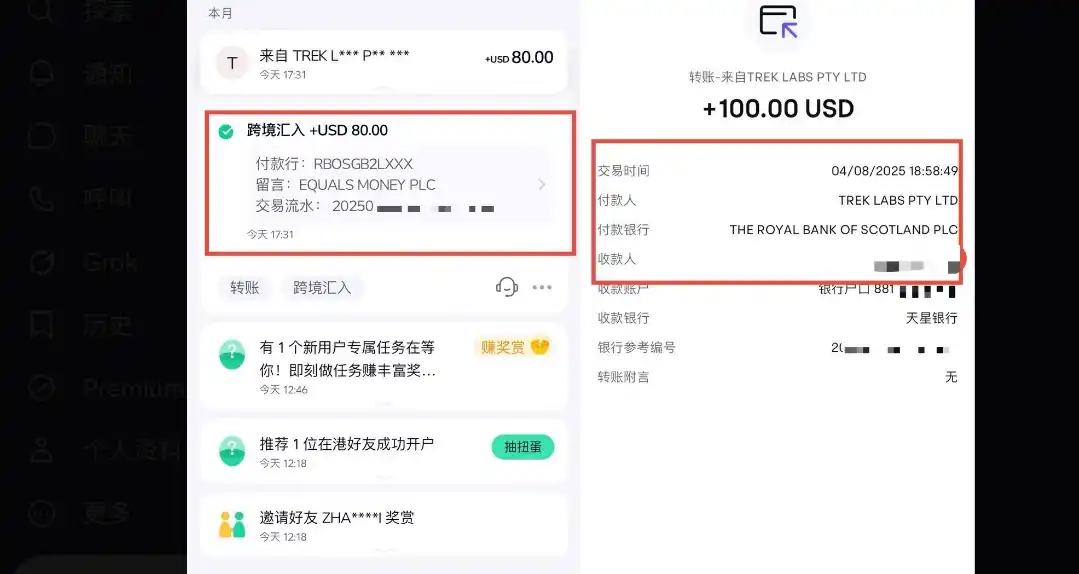
While reviewing Backpack Exchange’s U.S. dollar withdrawal service, BlockWeeks noted one detail: a bank credit record listed Trek Labs Pty Ltd as the payer, while Backpack’s official website named the Royal Bank of Scotland, or RBS, as the clearing bank for U.S. dollar wire transfers.
Australian government corporate registration records show Trek Labs Pty Ltd is an Australian company registered in 2023. Its registered business names include Backpack Exchange and Backpack Wallet. That does not make it a licensed bank, and the payer name alone is not enough to conclude that it directly operated the underlying settlement network.
The two pieces of information are not inconsistent. In cross-border payments, the paying entity, the payment service provider and the institution that ultimately participates in bank settlement can be different companies. Because the full bank remittance message and the relevant contracts are not publicly available, there is no independent confirmation at this stage that RBS took part in that specific transaction, or how responsibilities were divided among the parties.
The point is larger than one withdrawal. It exposes a long-standing commercial reality in crypto that many retail users rarely see: an exchange can control the trading system, the customer relationship and the digital-asset ledger, yet moving actual dollars off-platform usually still depends on banks and other licensed financial institutions.
Those institutions, however, are not necessarily content to remain invisible transfer providers forever.
Banks hold capabilities exchanges cannot easily replicate
RBS has a history of nearly 300 years and now sits within NatWest Group. For a traditional commercial bank of that kind, crypto is only one small segment inside a much broader financial-services business.
According to the 2025 annual report of RBS plc, total income for the year was £2.510 billion. Of that, £2.071 billion came from net interest income, or about 82.5%. In other words, the bank’s revenue base still rests on deposits, lending and related banking activity, not on fees paid by crypto firms.
That does not mean digital-asset clients lack value.
An exchange serving users across multiple countries typically needs stable bank accounts, cross-border payment capabilities, cash management, foreign-exchange services and compliant arrangements for safeguarding funds. For banks, the commercial value in serving these clients may come from long-term account relationships and a bundle of financial services, not just a single wire fee.
There is also a harder barrier to cross: banks can choose not to onboard certain customers.
Exchanges can spend heavily on matching engines, blockchain wallets and internal ledgers. They cannot obtain a banking license, access to payment systems or a correspondent banking network through software development alone. They still need financial institutions willing to take on the related compliance risk.
The 2023 U.S. banking crisis made that dependence hard to ignore
The U.S. banking turmoil in 2023 made the dependency plain.
Silvergate Bank exited operations that year. Signature Bank was closed by regulators. Silicon Valley Bank also fell into crisis. The fallout did not stop with bank depositors; it hit digital-asset firms that relied on those banks for accounts and settlement services.
Circle, the issuer of USDC, disclosed at the time that about $3.3 billion of USDC reserves were held at Silicon Valley Bank, roughly 8% of total reserves. Uncertainty over whether those funds could be accessed helped trigger a brief depeg for USDC in the secondary market. The Federal Deposit Insurance Corporation, or FDIC, later disclosed that Signature Bank also held sizable deposits from digital-asset industry clients before it was shut down.
The lesson was straightforward. Assets can move on-chain at any hour, but the bank money linked to those assets still carries bank credit risk, liquidity risk and the risk that payment channels can be interrupted.
For exchanges, bank relationships are not just an operating-cost issue. They are part of business continuity. Relying on a single payment channel can affect deposits and withdrawals across the platform if a partner bank changes its risk policy. Adding more banking partners can spread some of that risk, but it also brings more complex account management, treasury operations and compliance work.
That is one reason banks have retained meaningful bargaining power in crypto. Trading volume on exchanges can scale quickly. The number of financial institutions both willing and able to support cross-border flows for digital-asset firms does not expand at the same pace.
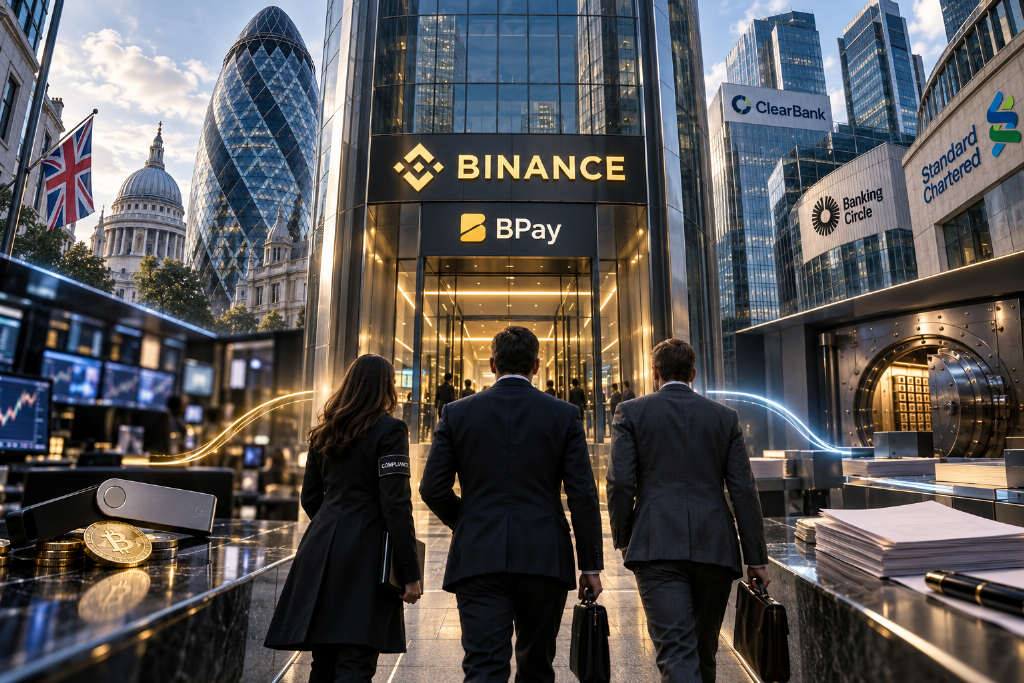
Binance is taking a different route by bringing payments closer to the group
Compared with the model of building payment capabilities through outside providers, Binance is trying to move deeper into the financial-payment layer.
BPay Global B.S.C. (c) is a Binance group affiliate headquartered in Bahrain. It holds a payment service provider license issued by the Central Bank of Bahrain. Under BPay’s terms of service, effective January 2026, it can offer eligible individual and corporate clients payment accounts, money transfers and foreign-exchange services.
From the user side, those services can still appear inside familiar Binance product interfaces. From the corporate side, payment accounts and fund transfers no longer depend entirely on an external payment company with no group affiliation to the exchange.
There are several clear commercial reasons for that structure.
One is lower dependence on outside providers. Payment institutions control more than transfer rails. They also handle customer review, payment workflows, transaction monitoring and fund records. If all of that sits with a third party, an exchange’s product changes can be constrained by the partner’s systems, pricing and risk policies.
Another is tighter coordination between payments and trading. When a user converts digital assets on an exchange and then withdraws to a bank account, the process often runs across multiple accounts and systems. If the group itself can perform part of the payment function, it may be able to coordinate customer identity data, internal ledgers and payment instructions more directly, reducing duplicate development work and cross-institution communication costs.
A third factor is pricing. In January 2026, Binance said it would cut the fee for SWIFT U.S. dollar withdrawals from $60 per transaction to $25. Backpack’s current help-center page, by comparison, shows a $50 fee per U.S. dollar withdrawal for standard-tier users after free quotas are used.
Those prices do not reveal the underlying bank cost by themselves. A withdrawal fee paid by the user may cover bank settlement, payment operations, compliance management and the exchange’s own product pricing. A lower fee can also reflect a decision to attract more inflows, lift trading activity or reduce customer churn.
More important, BPay does not free Binance from banks altogether.
BPay’s formal terms state that client money must be segregated from company funds and held in eligible bank client-money accounts. Funds from different customers may be pooled rather than placed in separate bank deposit accounts for each user. The terms also say BPay does not directly bear the insolvency risk of third-party partner banks.
So Binance may control more of the user-facing payment service, but it still needs banks for safeguarding funds and carrying out related settlement.
What BPay shows is not an exchange preparing to replace traditional banks. It shows an exchange trying to keep more payment functions and customer relationships inside its own group structure without becoming a bank.
Over time, that model could reduce the influence of independent payment providers over customer relationships and pricing. The underlying banks, though, still keep an important role. The open question is how much of the business value they can retain.
ClearBank and Banking Circle want to make traditional banks less of a one-stop gatekeeper
If Binance represents exchanges expanding into payments, ClearBank and Banking Circle represent another force: financial institutions making digital-asset firms a core client segment.
ClearBank in the U.K. is not centered on retail lending. Its focus is bank accounts, payment clearing and embedded banking services for financial institutions and platform businesses.
Its relationship with Coinbase dates back to 2019, and it later provided local U.K. payment and clearing capabilities for digital-asset platforms including Kraken. In November 2025, ClearBank said it would go further by using its embedded banking services to support Coinbase in offering savings accounts to eligible U.K. users.
That development matters beyond crypto deposits and withdrawals.
Under the older model, users held digital assets on an exchange and only touched the banking system when they needed to move money in or out. Once an exchange can integrate regulated banking products such as savings accounts directly, the relationship between the user and the bank can continue through the exchange platform rather than appearing only at the edge of a transaction.
For ClearBank, exchanges become a channel to acquire and serve financial customers. For Coinbase, banking capability becomes a tool to broaden products and improve retention. The commercial relationship starts to extend beyond payment fees into longer-term account services.
Banking Circle is taking a path more centered on cross-border, multi-currency payments and stablecoin settlement.
In April 2026, Banking Circle said it had obtained a crypto-asset service provider, or CASP, license from Luxembourg regulator CSSF and launched stablecoin conversion and settlement services. It later announced partnerships with FalconX, Bridge, which is owned by Stripe, and OSL.
Its partnership with OSL, announced in September 2026, covers six currencies: the Australian dollar, euro, pound sterling, Hong Kong dollar, Singapore dollar and U.S. dollar. The scope includes fund settlement, digital-asset conversion and liquidity management. Through its BC-Now payment network, the two companies said they plan to improve the efficiency of moving institutional funds across markets.
Unlike traditional banks that expand through existing branch networks and corporate account relationships, Banking Circle is trying to let fintech firms access multi-currency fund services through a unified technical connection.
That is attractive for crypto platforms.
An exchange serving users globally may otherwise need separate banking partners for dollars, euros, pounds and other currencies. That means dealing with account opening, contracts, interfaces, reconciliation and treasury management across multiple jurisdictions.
If one provider can bundle payment and settlement capabilities across several currencies, it has a chance to reduce system-integration work and operating complexity for the exchange. Even if different banks and payment networks still sit underneath, the exchange does not need to manage every relationship directly.
From a competitive perspective, that creates a new infrastructure layer between traditional banks and exchanges.
In the past, banks sold accounts and payment capabilities directly to corporate clients. Now some banks and fintech firms are packaging those services as API products, which exchanges and payment platforms can then deliver to end users.
Banks are not being pushed out. But their influence over the end customer, and the way they exercise pricing power, may change. When clients rely more heavily on aggregators’ systems, the bank actually holding the funds may no longer control the interface, the customer relationship or the service price.
Large banks are redrawing their own boundaries too
Still, it would be too simple to frame this as new payment banks replacing large traditional banks.
Standard Chartered’s work with OKX points to a more targeted strategy.
In April 2025, Standard Chartered and OKX launched an off-exchange collateral custody arrangement for institutional clients. Eligible institutions could use crypto assets and tokenized money market funds as trading collateral, while the assets themselves were held by an independent regulated bank custodian. In April 2026, the two companies, together with BlackRock, added BlackRock’s tokenized U.S. Treasury fund BUIDL to that collateral framework.
This is a different business from retail bank withdrawals. The core value is not payment speed. It is asset safety and capital efficiency.
Institutional traders may want to execute large trades on an exchange without placing all collateral directly under the exchange’s control. If a bank can hold those assets independently and connect with the exchange’s systems, it can help reduce counterparty risk to the exchange while supporting more flexible use of assets.
That means Standard Chartered is not merely selling a bank-transfer service to an exchange. It is moving into core infrastructure for institutional digital-asset trading.
Different banks are now taking visibly different approaches to crypto.
ClearBank wants to be the account and clearing infrastructure for digital-asset platforms. Banking Circle is focused on multi-currency payments, stablecoin settlement and treasury management. Standard Chartered is extending its institutional finance and custody strengths into digital-asset collateral management.
NatWest Group, which sits behind RBS, is taking a more cautious route.
RBS still restricts some payments from retail customers to crypto exchanges. Yet in a 2026 digital-asset strategy article, NatWest said it was providing core banking services to selected digital-asset brokers and crypto payment service providers while also taking part in research on tokenized deposits and cross-border settlement.
That is not a contradiction. A bank can limit higher-risk consumer activity while offering regulated services to corporate clients that have gone through due diligence. The risk profile, product use and compliance requirements are not the same.
NatWest is also involved in a U.K. tokenized-deposit research project and in Project Agora, led by the Bank for International Settlements. Rather than entering the crypto trading market directly, its public strategy places more emphasis on using blockchain and programmable money inside existing banking businesses.
The split reflects different judgments inside traditional finance. Some institutions see digital assets as a new corporate-client market. Some want to use blockchain to improve payment and settlement efficiency. Others want to extend existing strengths in custody and treasury management into digital-asset financial products.
For large banks with deep balance sheets and long-standing corporate relationships, there may be no need to chase every crypto business line. Choosing segments with controllable risk and clearer profit structures may fit their strategy better than opening every digital-asset service at once.
Money can move on-chain all day. Getting it out of an exchange is still harder.
Shift the focus back to users and the center of the competition becomes the experience of using money.
Digital-asset markets trade around the clock. Stablecoins can move across time zones. Yet users withdrawing to bank accounts still often wait days. That gap can make it look as if traditional networks such as SWIFT have simply fallen behind blockchain technology.
The reality is more complicated.
SWIFT said in 2026 that about 75% of cross-border payments on its network can reach the recipient bank within 10 minutes. Final crediting of funds, however, can still be affected by the receiving institution’s internal processes, local business hours, foreign-exchange controls and compliance checks.
Fast transmission of payment information is one thing. Immediate use of the money by the customer is another.
A U.S. dollar withdrawal from an exchange may pass through several status changes: sale or conversion of digital assets, confirmation in the exchange ledger, handling by a payment provider, initiation of the bank transfer, relay through correspondent banks and final posting by the receiving bank.
A delay at any one of those points can affect when the user actually receives the funds.
For banks and payment providers, technology is not the only constraint. Cross-border payments also require identity checks, sanctions screening, transaction monitoring, currency conversion and final settlement of funds.
That helps explain why stablecoins can improve efficiency in some cross-border use cases without simply replacing all banking services. Money still has to move between different forms of currency and different account structures, and someone has to carry the compliance obligations and the related risk at those conversion points.
In October 2025, the Financial Stability Board, or FSB, said in its progress report on the G20 cross-border payments roadmap that policy and technical work had advanced, but the practical improvement seen by end users in speed, cost and transparency remained limited.
Traditional finance is not standing still either.
In July 2026, SWIFT said its blockchain-based shared ledger had entered an early application stage. Seventeen banks were preparing to join live transaction pilots using tokenized deposits for cross-border payments, with goals that included improving round-the-clock payment capability and the efficiency of fund usage.
That makes the future of cross-border money movement less of a binary choice between bank networks and blockchains.
Banks can use tokenized deposits to improve settlement. Stablecoin firms can expand local-currency payment reach through bank partnerships. Exchanges can connect to more banking networks through payment companies.
Different technologies may end up coexisting rather than one system fully displacing the others.
The real prize is the long-term funding relationship behind the user
Under the traditional exchange model, core revenue usually comes from trading commissions, financing and other platform financial services. Bank deposits and withdrawals look more like a necessary operating cost. As long as users can move money in and out smoothly, an exchange does not necessarily need to run the underlying payment business itself.
That changes when exchanges start extending into savings, payments, institutional finance and other asset-management services.
Whoever controls the user’s payment account may gain access to more of that user’s funding needs. Whoever can offer lower-cost bank connectivity may attract a broader user base. Whoever can connect stablecoins with traditional bank settlement may secure more room in the future cross-border payments market.
Withdrawal fees, then, are not the end point of the competition.
The value tied to bank accounts, treasury needs, foreign-exchange conversion, institutional service and long-term customer relationships may be larger than the value of a single withdrawal. Even so, how much any institution can actually earn still depends on account contracts, fund scale, fee arrangements and regulatory limits. Client balances cannot simply be treated as money a service provider is free to use.
For exchanges, lower-cost withdrawals can make the service more attractive, but overreliance on one bank can create concentration risk. Adding more partners can make the payment network more resilient, while also increasing operating and compliance complexity.
For payment companies, the opportunity lies in combining multiple banks, currencies and payment networks and turning a complicated flow of funds into a standardized service exchanges can use. But once customer relationships and technical interfaces become concentrated in those providers, banks may need to rethink how they preserve bargaining power.
For traditional banks, the most valuable capabilities remain compliant accounts, safeguarding of funds, financial networks and risk management. Yet as payment infrastructure becomes more standardized, holding a banking license alone may not be enough to secure a long-term edge.
This round of competition is no longer just about who processes a SWIFT wire. It is about how customer relationships, operating responsibilities and commercial returns are divided among banks, payment companies and exchanges.
That brings the discussion back to the original Backpack dollar withdrawal.
Trek Labs on the bank record, RBS on the marketing page and the withdrawal service shown by the exchange each point to different roles in the movement of funds. Public information is still not enough to reconstruct the full settlement path of that transfer. It does show at least one thing clearly: when a user clicks withdraw on an exchange, the service is often supported by more than one institution.
Binance is bringing part of the payment stack into its own group through BPay. ClearBank and Banking Circle are trying to turn banking services into infrastructure for digital-asset platforms. Standard Chartered is extending into institutional custody and asset-management links. Large banks such as NatWest are exploring digital-asset finance more cautiously.
The strategies differ, but they point in the same direction. The boundary between crypto and the traditional banking system is being redrawn, and control over the movement of money is becoming part of the competition between exchanges and financial institutions.
For ordinary users, the value of that competition will not be decided by how many banking partners an exchange advertises or by the financial language on a product page. It will be decided by whether money can move in and out reliably, whether the real cost is transparent and whether someone is accountable when problems arise.
Technology can change the speed of moving funds. Trust, risk and responsibility still have to be carried by specific financial institutions. That may be the part of crypto payments that is hardest for technology alone to replace.



