
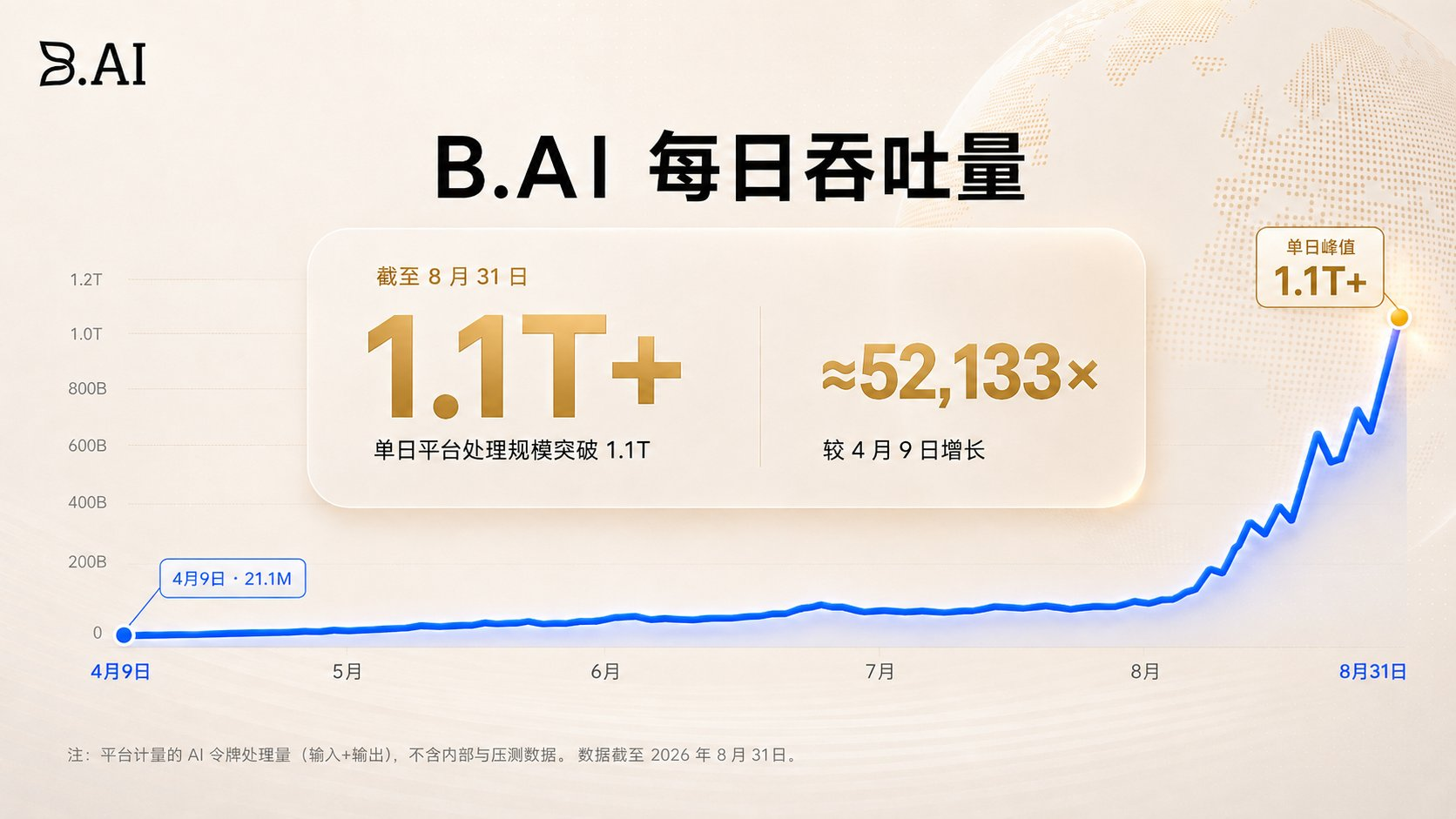
B.AI, an AI infrastructure platform, said its daily token throughput has surpassed 1.1 trillion for the first time, a milestone the company described as arriving less than five months after launch and placing it in the ranks of trillion-scale AI calling infrastructure.
In the article, credited to B.AI and published by Foresight, the company said growing demand from developers worldwide for multi-model access and Agent applications is pushing the platform beyond its original role as a unified model gateway. It said the product is now extending into model routing, usage metering, and payment and settlement, a direction it summarizes as an “intelligent global settlement layer.”
From 21.1 million to more than 1.1 trillion in 145 days
According to the figures provided in the article, B.AI’s user base has exceeded 2.28 million. Since its launch on April 9, the platform’s daily token processing volume has climbed from 21.1 million to more than 1.1 trillion, completing the jump from the tens of millions level to the trillion level in 145 days.
The article compares that timeline with OpenRouter, which it describes as a leading global multi-model service platform. Based on the public timeline cited in the piece, OpenRouter took about 2 years and 9 months from launch to reach 1 trillion daily tokens. Using that reference point, B.AI said it reached the same throughput tier at roughly seven times the speed.
The write-up argues that for model service platforms, token throughput is a better gauge of real usage intensity than registered user counts alone. It points in particular to code generation, long-context text processing and Agent workflows, where a single task may keep calling models, tools and context over a sustained period. On that basis, the ability to handle frequent, high-concurrency requests in a stable way is presented as a core test of whether a platform can move deeper into the infrastructure layer.
Late-August growth accelerated sharply
B.AI said its recent growth has started to show the traits of scale. From Aug. 17 to Aug. 31 alone, the platform’s daily token throughput rose about 242x. Over the same period, cumulative processed volume reached 6.86 trillion tokens, and the platform added more than 196,000 API users.
The article says that in the early stage after launch, traffic was centered on chat use cases and one-off model calls. Now, a larger share is coming from APIs, continuously running developer tasks and Agent workflows, indicating a shift in how the platform is being used.
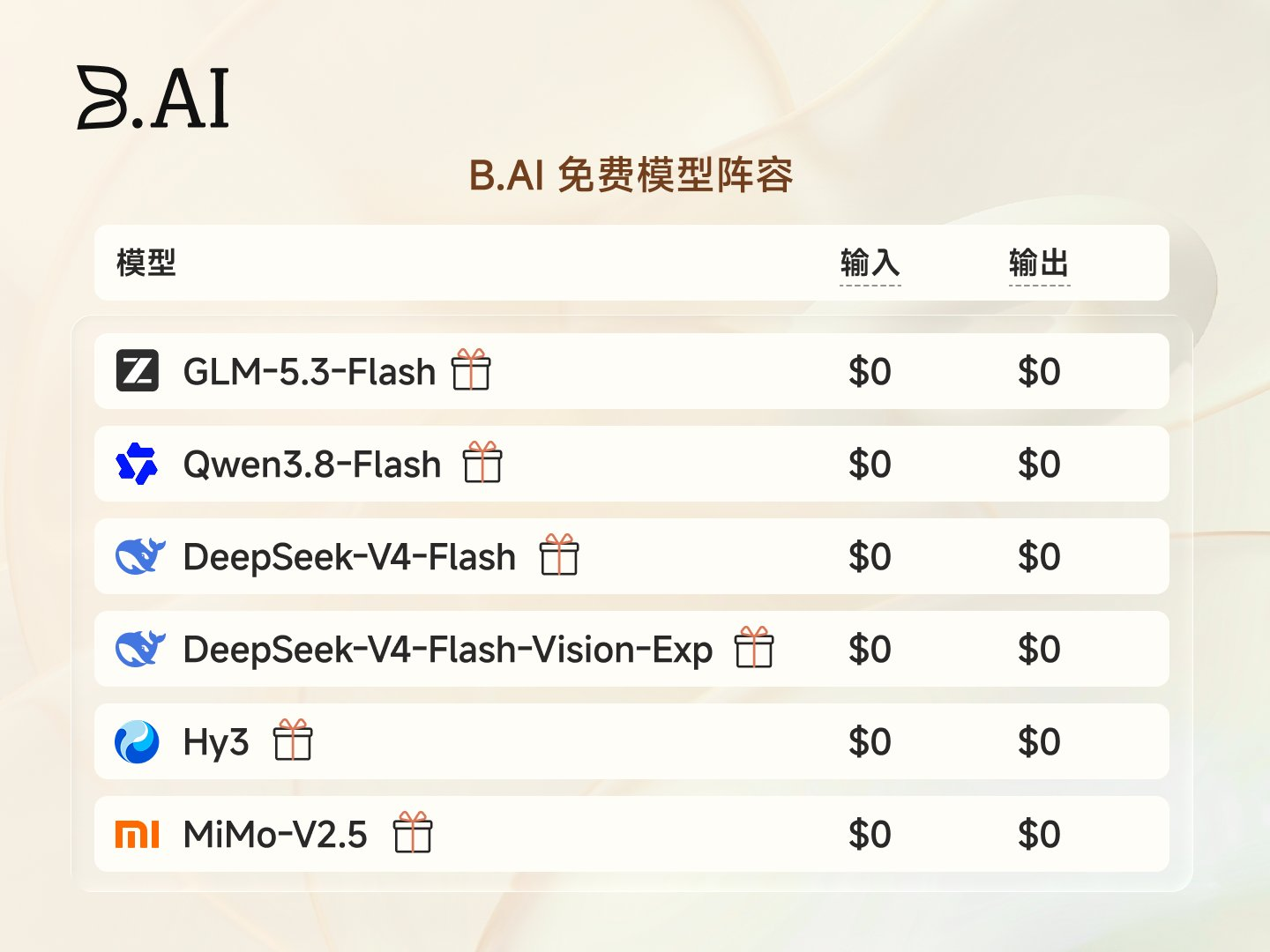
Rapid expansion in model supply was also cited as an important driver. B.AI said it has continued opening access to domestic models including DeepSeek, GLM, Qwen, Kimi, MiniMax, Tencent Hunyuan and Xiaomi MiMo, and has introduced free access for some popular models. Under a unified API system, developers can test different models and switch or combine them based on reasoning ability, context length, response speed and cost, without maintaining separate vendor accounts and keys.
Beyond model access into routing, settlement and Agent infrastructure
The comparison with OpenRouter is used to show where B.AI sees its next step. The article says both platforms treat multi-model access and a unified API as a main entry point, but B.AI is extending its stack into payments, settlement and Agent infrastructure. In that framing, the jump to more than 1 trillion daily tokens first validates model-calling capacity and traffic handling, while also giving the company a larger real-world usage base as it pushes into deeper infrastructure functions.
The article then shifts to the Agent economy. It says that if unified model calling answers the question of which AI to use, large-scale Agent adoption brings a new set of issues: how calls are made, how they are paid for, how settlement is handled, and how identity is established. As usage keeps growing, B.AI said its earlier product buildout around routing, metering, payments, settlement and Agent infrastructure is beginning to show clearer scale effects.

B.AI said it is extending from unified model access into model routing, call metering, and payment and settlement, and is using the phrase “intelligent global settlement layer” to define that product direction. The logic set out in the article is that a future Agent completing a task may need to call different models, data services, on-chain tools and even other Agents in sequence, with each step tied to resource consumption and value exchange.
Traditional payments, multi-chain top-ups and Agent-side capabilities
Around that strategy, B.AI said it has already put in place two layers of capability: a unified API and payment settlement. On one side, developers can use a single account and API to access different models. On the other, the platform supports bank cards, WeChat Pay, Alipay and UnionPay, while also allowing top-ups through multiple blockchain networks and crypto assets, including TRON, BNB Chain and Ethereum. The article says this lets individual developers and teams in different regions complete both model usage and payment on the same platform.
On the Agent side, B.AI said it is continuing work on x402 payments, on-chain identity, Agent Wallet, and MCP and Skills. According to the article, the goal is for Agents to do more than call models and tools in the future: they would also be able to complete payments, settlement and on-chain operations on their own. Rather than acting as a simple model directory, the platform presents this as a foundational service layer built around AI calls.
The article closes by saying that with more than 2.28 million users and daily processing above 1.1 trillion tokens, B.AI has built up a sizable base of real usage. As scale increases, it says the criteria for evaluating such platforms are also changing. Model count and token throughput remain important, but API stability, model scheduling, payment and settlement, and Agent service capabilities are increasingly becoming key measures of infrastructure strength.