
Balancer, once a DeFi protocol with as much as $3 billion in total value locked and known for pioneering multi-asset pools and weighted AMM design, is now heading toward a formal wind-down. Early on Sept. 15, Marcus Hardt, representing the Balancer Treasury Council, submitted a governance proposal calling for the end of all day-to-day operations and R&D, alongside an orderly liquidation process that would run until mid-2028.
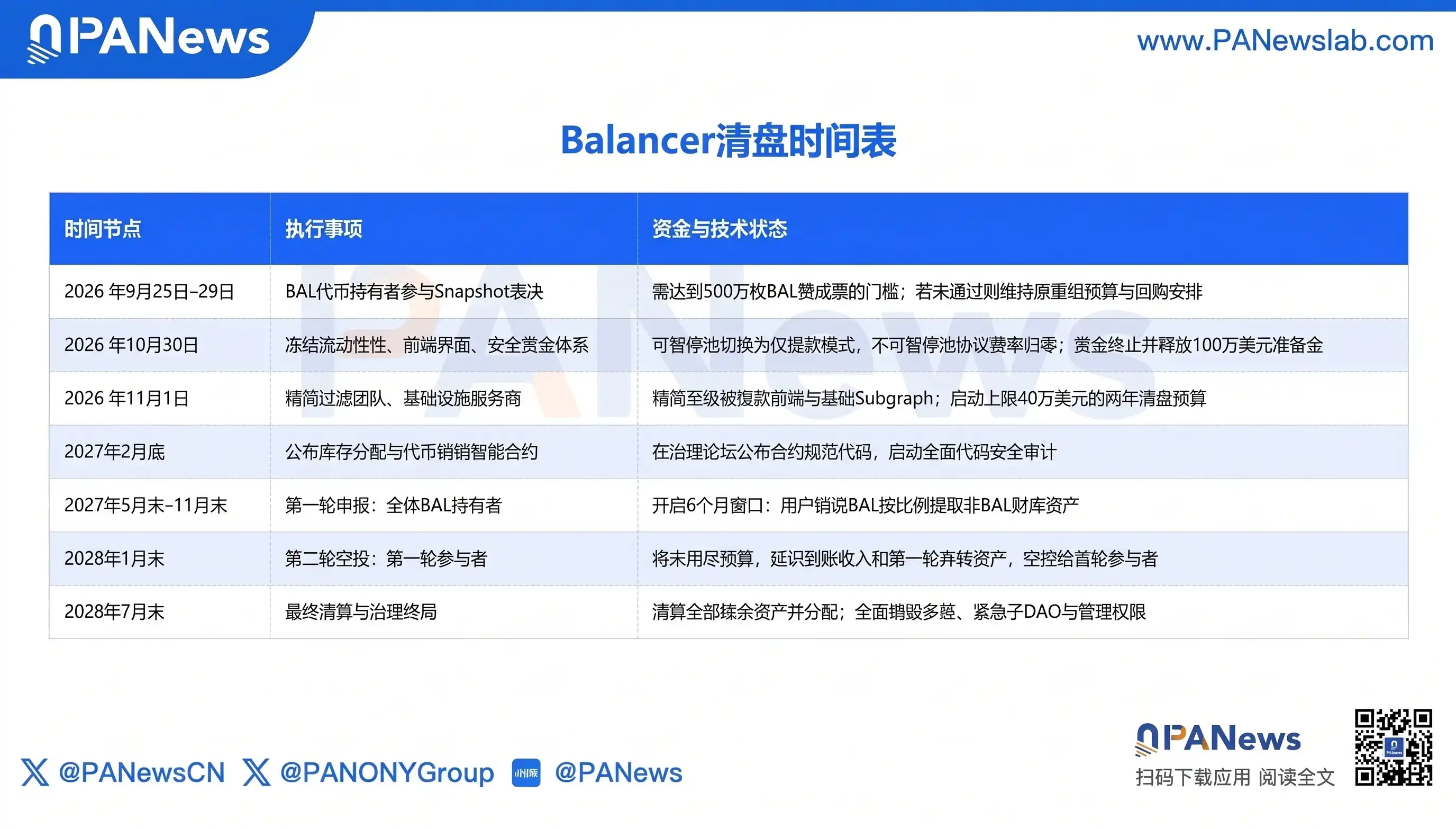
Under the proposal, at least $9 million in non-BAL assets held by the DAO treasury would be distributed pro rata to holders who burn BAL in the first round. The move comes at a time when BAL’s circulating market capitalization is only about $8 million and the treasury’s net asset value remains under pressure. Rather than keep operating, the proposal would return remaining capital.
Only external assets would be distributed
The plan would fully shut down business operations and liquidate assets. The treasury portfolio managed by kpk, the DAO’s treasury asset manager, is currently valued at no less than $9 million and mainly consists of stablecoins, liquid assets, and low-risk yield-bearing positions.
The payout framework is narrow by design. BAL held by the treasury itself would be carved out and excluded from distribution. Only external hard assets would be distributed, and those assets would be delivered in kind on a pro-rata basis to holders who burn BAL.
That structure avoids counting treasury-held native tokens as if they were equivalent to liquid reserves. In Balancer’s case, the proposal uses non-native assets as the basis for liquidation and payout.
Separate exit paths for veBAL, auraBAL, sdBAL, and tetuBAL
The proposal treats derivative and locked positions differently instead of applying a single rule across the board.
- veBAL positions would be forcibly unlocked and split into 80/20 BAL/WETH pool tokens. Holders would need to exit liquidity on their own and convert into BAL to take part in the liquidation.
- auraBAL and sdBAL held through third-party derivative protocols would need to be unlocked before the first distribution window closes, either in the secondary market or through the original protocol. Any position not exited in time would be voided.
- tetuBAL, which is permanently locked because it cannot be upgraded or redeemed, would receive a special exemption. The DAO treasury would compensate those holders with spot BAL based on 50% of the locked balance recorded in a snapshot.
The proposal also isolates risk tied to previously stolen funds. Any future recoveries linked to historical thefts would be kept separate from the treasury and would belong to affected liquidity providers, not BAL holders participating in the distribution.
The wind-down would stretch to mid-2028
The liquidation schedule extends to mid-2028. That timeline is intended to give long-term lockers time to exit while limiting the cost of shutting the protocol down.
It also creates friction. From the proposal’s submission in September this year to the start of the first distribution in May next year, token holders would be waiting eight months. During that period, capital would be tied up and exposed to crypto market volatility. Projects built on Balancer would also need to find replacement liquidity infrastructure on short notice, which adds migration costs across protocols.
A hack exceeding $128 million set the decline in motion
Balancer’s path to this point is tied to a security breach and the chain of problems that followed. On Nov. 3 last year, Balancer’s V2 composable stable pools were exploited, with funds stolen across Ethereum, Arbitrum, Base, Avalanche, and other chains. Losses exceeded $128 million.
White-hat efforts recovered about $28 million in total, but the protocol still suffered an extended outflow of liquidity providers and a sharp hit to brand credibility. The fallout went beyond liquidity. Balancer Labs OÜ, the Estonian entity responsible for core development, also faced legal exposure tied to joint liability risk, putting pressure on the protocol’s operating model.
March reforms cut costs, but revenue kept falling
In March, governance introduced BIP-918 and BIP-919 in what was described as a reset.
- On the operational side, Balancer Labs was dissolved and business functions were moved to Balancer OpCo Limited, a British Virgin Islands entity mandated by the DAO. The full-time team was cut by half, and the annual budget was reduced 34% to $1.9 million.
- On the token side, BAL inflation emissions were stopped, the veBAL dividend mechanism was removed, 100% of protocol fees were directed to the DAO treasury, and a voluntary buyback capped at 35% of treasury NAV was promised after 12 months.
At the time, the target was to reduce the annual deficit from $2.6 million to $700,000, preserve close to nine years of operating runway with existing treasury assets, and wait for growth from a new V3 version.
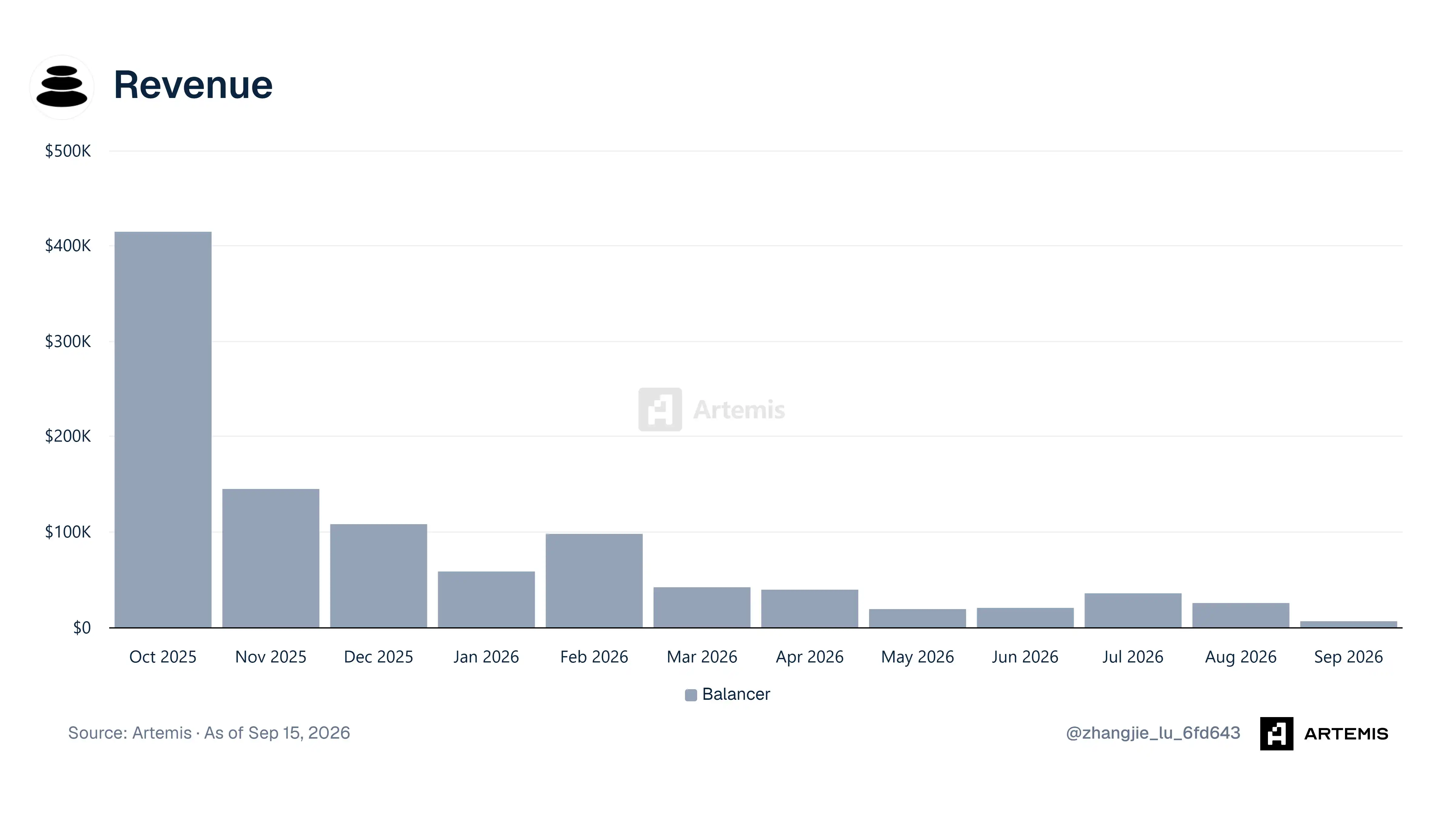
That turnaround never happened. Under the warning threshold set in BIP-918, governance must present a revised plan if monthly protocol revenue stays below $60,000 for three consecutive months. By August, Balancer’s monthly protocol revenue had fallen to about $25,000, while fixed monthly spending remained around $150,000, leaving a monthly loss of more than $120,000.
With the growth thesis no longer working, the liquidation proposal moved to the center of governance.
A structured DAO exit is part of the story
The proposal matters not only because Balancer may close, but because it lays out a controlled exit process. In past crypto shutdowns, many stalled protocols effectively died through unmanaged outcomes such as anonymous team departures, server shutdowns, or abandoned multisig keys.
Balancer’s plan instead includes staffing arrangements, phased infrastructure decommissioning, two rounds of asset redemption, rolling redistribution of unclaimed allocations, and the eventual removal of governance powers. Whatever the final community decision, the document presents a concrete framework for how a DAO can wind down, return capital, and define responsibility at the end of the protocol’s life cycle.